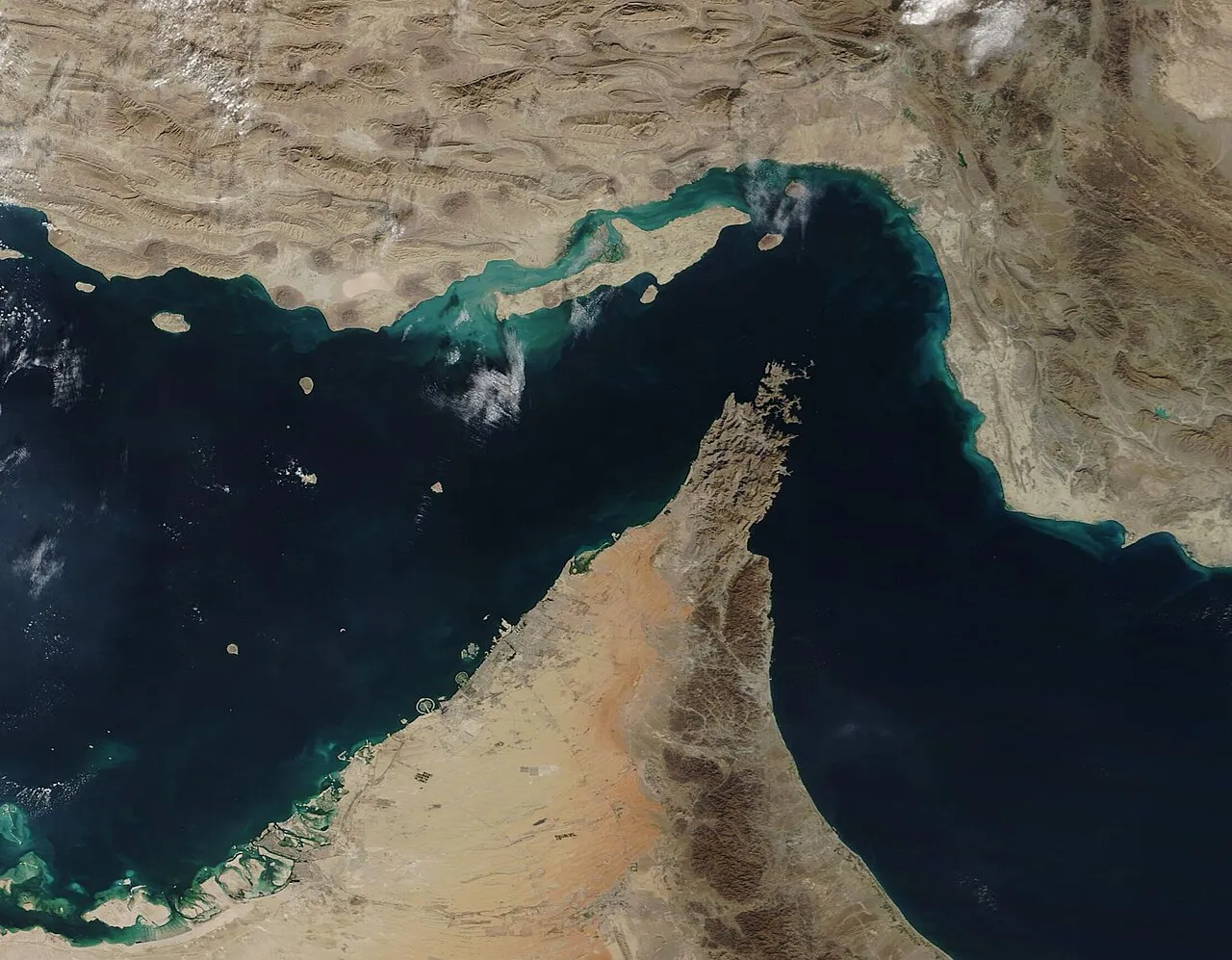
The navy of Iran's Islamic Revolutionary Guard Corps (IRGC) said on Saturday, 17 October, that a supertanker carrying more than 2 million barrels of crude oil exploded and caught fire after striking a naval mine in the Strait of Hormuz. In the same statement, the force declared that "the Strait of Hormuz is closed".
According to the Iranian account, the vessel was attempting to cross the passage by an "unauthorised route" and had switched off its positioning and radar systems to evade detection. The IRGC described the ship as "non-compliant" and said it was acting with the support of what it called the "US smuggling and terrorist army". Iran's Fars news agency published a video it says shows the vessel ablaze.
None of this has been independently confirmed. The statement gives no name, flag, owner or crew for the tanker, and does not make clear where in the strait the incident is supposed to have happened. As of Saturday night there was no report of a rescue operation or of casualties.
Washington says the passage is open
The American version is the opposite. The head of US Central Command (CENTCOM), Admiral Brad Cooper, said on Friday that the strait "remains open for business" and that the passage is controlled by the United States and its regional partners, not by Iran. The command maintains that commercial vessels continue to transit the region despite what it describes as "unwarranted aggression" by the IRGC.
The two claims are not merely rival propaganda: on them rests the risk calculation every shipowner makes each day in deciding whether to send a vessel through the channel. The strait is 34 kilometres wide at its narrowest point and, in normal times, carries around a quarter of all seaborne oil in the world. Iran began blocking the passage in practice after US and Israeli strikes on the country, and the United States imposed a naval blockade on Iranian ports.
This is not the first ship hit in the area. Tasnim, the agency linked to the Revolutionary Guard, had itself reported another tanker on fire in the eastern stretch of the strait a day earlier, and attacks intensified over the ten days before Saturday.
Prices were already climbing
The market moved before Saturday's episode. Brent, the international benchmark, settled on Friday the 16th at $109.86 a barrel, up $3.94 (3.7%) on the day — the highest settlement since 19 May. US WTI closed at $101.41, up 3.5%, its best level since 17 September. Over the week Brent gained 4.9% and WTI 10.4%.
Friday's rise was not about Hormuz alone. Also weighing on prices were the interception, announced by the Saudi-led coalition, of a ballistic missile aimed at Yanbu — the Saudi Red Sea port used precisely to export oil without passing through Hormuz — and the shutdown of a distillation unit at Russia's Ryazan refinery after a drone attack, which again cast doubt on Russian diesel supply.
Governments are already in emergency mode. The International Energy Agency (IEA) agreed to accelerate the release of strategic stocks, and the US Department of Energy opened a call to exchange up to 17 million barrels from the Strategic Petroleum Reserve.
The risk that does not show up in the oil price
One effect of the closure cannot be read off the crude quote. The United Nations (UN) has warned that the lack of an agreement to move fertiliser through the strait could trigger a food crisis: fertiliser shipments out of the Gulf have been largely halted for more than six months. The fertiliser that does not leave the Gulf in October is the harvest that is not planted in the following hemisphere — a delay the energy market prices in days and agriculture prices in seasons.
With information from Euronews, Tasnim, Reuters and RFE/RL.