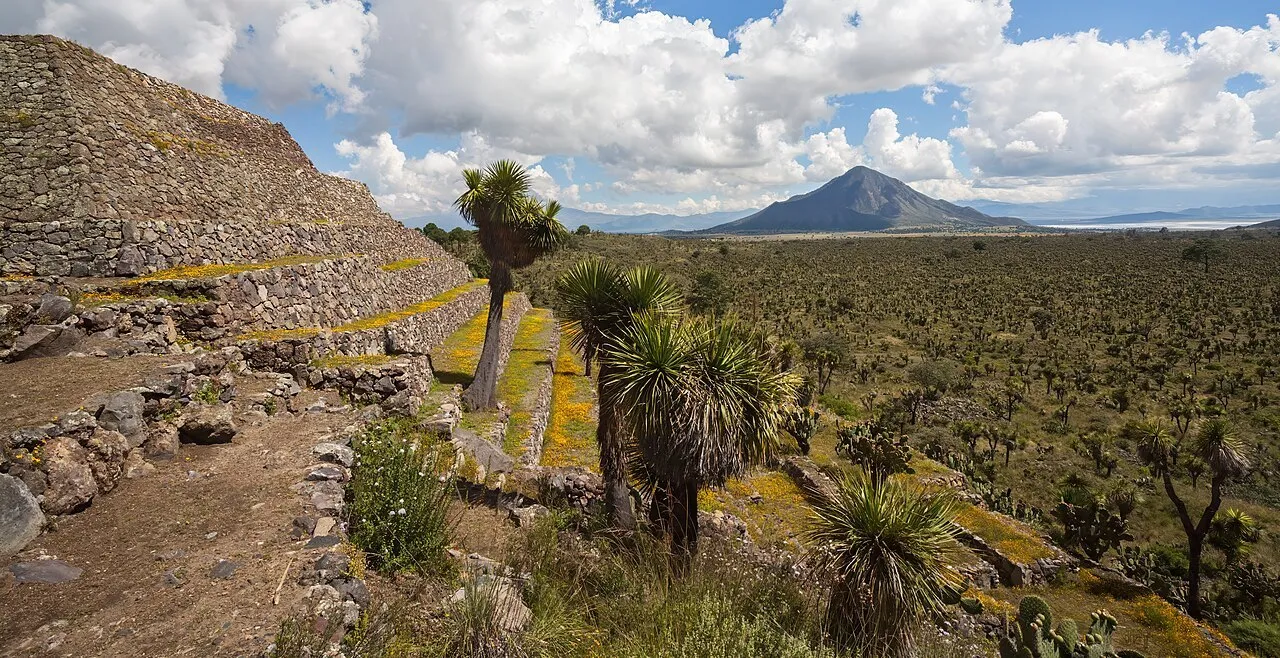
A group of platforms in the Sierra Norte of Puebla, in Mexico, worked as a solar astronomical observatory more than 2,500 years ago. The finding was confirmed by the Instituto Nacional de Antropología e Historia (INAH, Mexico's national institute of anthropology and history) in a statement published on 13 October 2026, with results from the Teteles de Ávila Castillo Archaeological Project.
According to the institute, it is the first observatory of this kind recorded outside the Maya area in Mesoamerica. The complex is known as Group E, or Tetelihtic, and lies east of the Great Plaza of the site's ceremonial precinct, in the municipality of Teteles de Ávila Castillo.
Two platforms and a patio
The complex consists of a quadrangular patio and two platforms:
- the eastern one, elongated, measuring 90 metres south to north by 40 metres east to west;
- the western one, smaller, measuring 46 metres north to south by 27 metres east to west, which served as the observation point.
INAH compares the layout with that of Group E at Uaxactún, in Guatemala's Petén, the reference complex for this kind of astronomical architecture in the Maya world. Both are dated to the Middle Preclassic (1000-600 BCE), but the Puebla complex is roughly twice the size of its Maya counterpart.
February and October, not the equinoxes
The detail the institute stresses is how it worked. Unlike other complexes of the same type, the central section of the elongated platform was not used to mark the equinoxes: it served to identify the start of the prehispanic calendar, in February, and the harvest period, in October.
The eastern platform operated as a solar calendar: from its façade, at dawn, observers could follow the Sun's path on the dates of the equinoxes and solstices. The settlement's original layout and the orientation of its pyramidal structures relate both to the surrounding mountains — the Sierra de Chignautla rises behind the eastern structure — and to the astronomical horizon.
INAH adds that the main structure may be aligned with Canopus, the second-brightest star in the night sky, and that the site may be linked to the Nahua deity Nantehuitz.
Nine centuries of use, and more of worship
Tetelihtic was in use from the Middle Formative, around 900 BCE, until the Protoclassic, around 100 CE. It was partly abandoned as Cantona, Cholula and Teotihuacán emerged — the cities that reorganised the central highlands.
The place did not lose its meaning, however. Offerings found on its periphery, dated between 100 and 600 CE, show that it remained a place of worship after the abandonment. A Totonac offering from between 600 and 900 CE, found on one of the platforms, indicates to the institute that occupation had already ceased by that period.
Two open hypotheses
INAH presents two broader readings as hypotheses, not conclusions. The first: that the findings help clarify the ethnolinguistic ties between Maya groups and the Huastec, with a Maya presence possibly reaching back a millennium before the common era. The second: that the site holds the origins of Totonac culture.
These are weighty claims for Mesoamerican archaeology, and they deserve the caution with which the institute itself frames them. What is established is narrower and still considerable: a complex with a documented astronomical function, contemporary with the earliest Maya observatories, hundreds of kilometres from the area where they were thought to be exclusive.
The project is directed by the archaeologist Alberto Diez Barroso Repizo, a researcher at the Centro INAH Puebla, with support from the Teteles de Ávila Castillo municipal government and the civil association Tzoncoyotl. Mexico's federal culture secretary, Claudia Curiel de Icaza, commented on the results in the statement. On the weekend before the announcement, the site hosted a lecture and a photographic exhibition about the work.
With information from INAH and Tribuna.