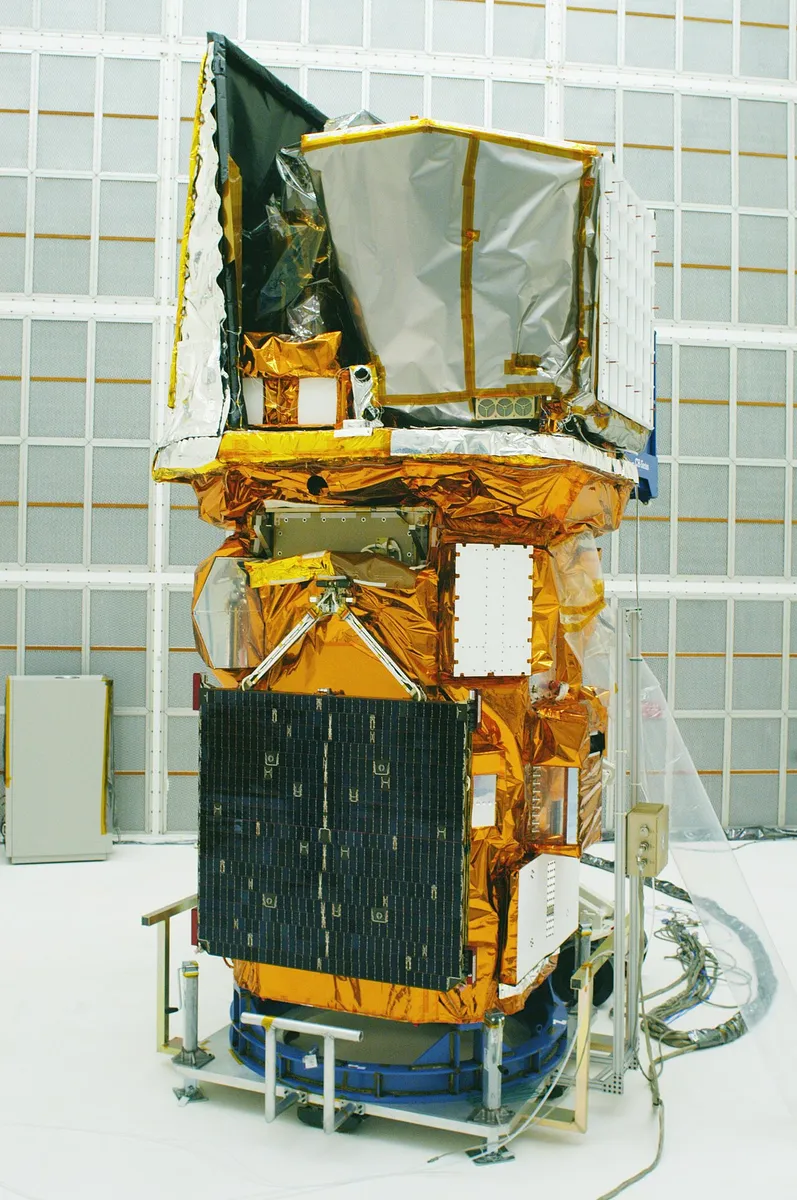
NASA has shut down the science mission of the Neil Gehrels Swift Observatory, the satellite that spent nearly 22 years turning on a dime to catch the briefest and most violent explosions in the universe. Its final observation was made on October 20, 2026, and the agency expects the spacecraft to re-enter the atmosphere and burn up within a few weeks.
Swift was not supposed to last this long. It launched from Cape Canaveral on November 20, 2004, started work the following month, and was built for a two-year primary mission. It ran more than ten times that long.
What it leaves behind
The numbers are the mission's argument. Swift observed more than 2,000 gamma-ray bursts — the flashes released when a massive star collapses or two dense stellar remnants collide — and studied more than 1,400 supernova explosions. Roughly 7,000 scientific papers were built on data it collected.
Its archive holds nearly 22 years of brightness measurements, more than 1.5 million images from its Ultraviolet/Optical Telescope and about 12 terabytes of data, all of it public and all of it still open to researchers.
What made that possible was speed. A gamma-ray burst can be over in a fraction of a second, long before a large ground telescope can be pointed at it. Swift typically needed about a minute to swing its instruments onto a new burst, and it could be scheduled against as many as 75 independent targets in a single day.
"Swift was designed for a two-year primary mission but productive for more than 10 times as long," said Shawn Domagal-Goldman, director of the Astrophysics Division at NASA Headquarters.
S. Bradley Cenko, the mission's principal investigator at NASA's Goddard Space Flight Center, has made the same point about why the satellite had to exist at all: gamma-ray bursts are too brief for big observatories to target directly, so something had to find them and hand over the coordinates.
The half-second that changed a theory
The clearest single result came early. In May 2005, Swift detected the afterglow of GRB 050509B, a burst that lasted just 0.03 seconds. Catching the fading light of a short burst for the first time gave astronomers the evidence they needed for the idea that short gamma-ray bursts are produced when two neutron stars merge — a conclusion that would later connect this field to gravitational-wave astronomy.
Why it is coming down
Swift was placed in an orbit roughly 600 kilometers up. Atmospheric drag pulls on everything in low Earth orbit, and recent solar activity thickened the upper atmosphere enough to make that drag bite harder than planned. The satellite began sinking fast.
Earlier in 2026 the team paused observations to reduce drag and stretch out the spacecraft's remaining time. Science restarted in late August, and Swift went on to observe hundreds more targets — the remnants of stellar explosions, active supermassive black holes in distant galaxies, comets inside our own solar system. Observing meant more drag, and the descent resumed.
On October 20 the observatory reached 171 miles (275 kilometers) — well below the International Space Station, which orbits around 400 kilometers. At that altitude it could no longer hold a steady pointing against the drag, and it dropped into safe mode. The operations team at Penn State, in University Park, then sent the command that formally ended operations and configured the spacecraft for re-entry.
A rescue had been tried and had failed. NASA says a fast-turnaround, high-risk servicing mission meant to boost Swift's orbit ended in August without ever attempting the boost. According to reporting on that effort, the agency had contracted the company Katalyst Space for about $30 million to build a robotic capture vehicle, named LINK, which launched in July; the capture was abandoned on August 19 after reaction-wheel and thruster failures, and LINK itself re-entered the atmosphere in late September.
NASA has not given a date or a location for Swift's re-entry, and cannot: both depend on how active the Sun is in the coming weeks. The spacecraft weighs about 1,450 kilograms and is expected to break up and burn.
A gap at the fast end
John Nousek, the mission's operations director and a professor of astronomy and astrophysics at Penn State, has described Swift's combination of rapid response and tight ground coordination as what put it "at the crossroads of burgeoning areas of research."
That is also the practical problem its end creates. Other observatories see deeper and sharper, but nothing currently in orbit matches Swift's ability to be looking at a brand-new explosion roughly sixty seconds after it was first detected. For now, the fast end of transient astronomy loses its workhorse, and keeps the archive.
Reporting from NASA Science and NASA.