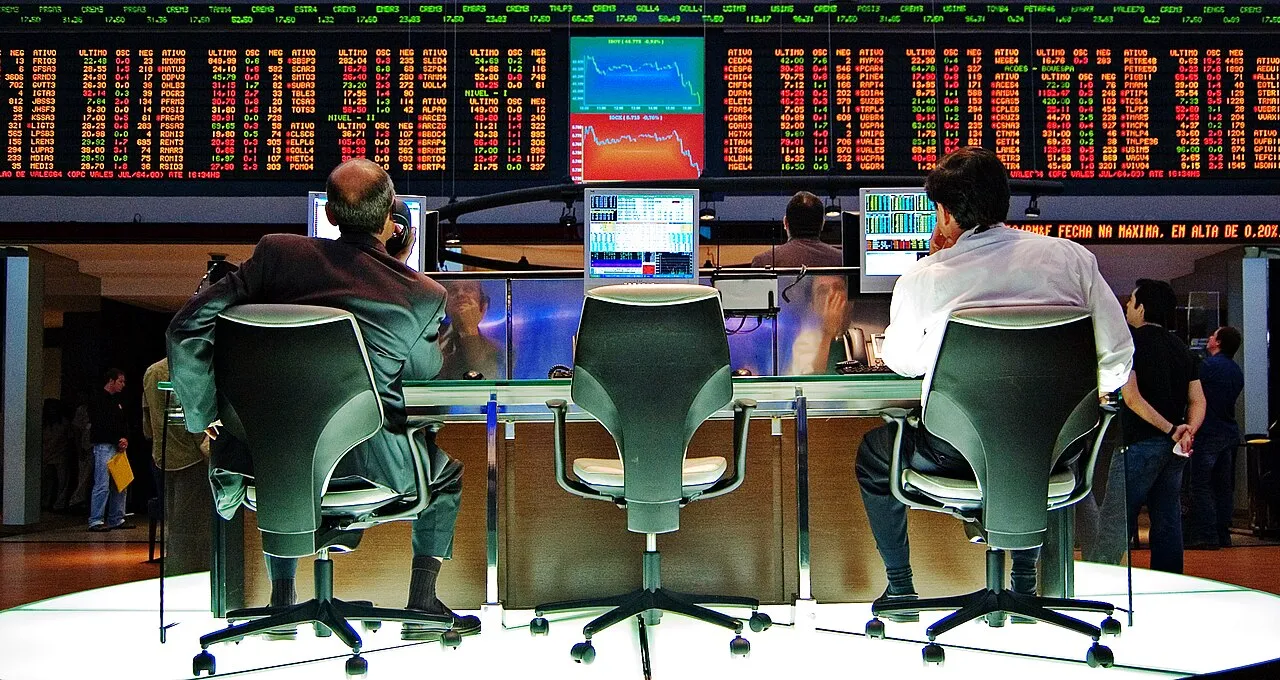
The first session on Brazil's stock exchange after the presidential runoff ended with the Ibovespa's steepest fall since March 2020. The index closed on Monday at 176,608.23 points, down 13.88% from Friday, when it had finished at 205,082.56 points, up 0.47%. It is the lowest level since 31 August.
The slide began before the cash session. Index futures, which trade ahead of the cash market's open, collapsed in the pre-opening auction, and the B3 (the São Paulo exchange) triggered its circuit breaker right at the opening auction, suspending trading for 30 minutes. Trading resumed at 10:40 a.m. local time. It was the first time the mechanism had been used in more than six years — the last had been in March 2020, at the start of the covid-19 pandemic, when the exchange halted six times in a single month.
How the halt works
Under the B3's rules, a 10% fall in the Ibovespa from the previous close triggers a 30-minute suspension, and a second halt, of one hour, follows at 15%. At 20%, the exchange sets the length. On Monday, according to the B3's own explanation to the magazine Exame, the index's theoretical price in the pre-opening auction already pointed to a drop of more than 20%, which is why the first halt was brought forward.
The reopening did not stop the selling. The index reached 169,516.43 points at the day's low, down 17.34%, and spent much of the afternoon between 14% and 15% lower before the close.
Dollar at R$ 5.60 at the high
In the currency market, the spot dollar reached R$ 5.6048 at its high, more than 12% above Friday's close, and ended the day at R$ 5.4029, up 8.2%. On Friday the currency had closed at R$ 4.99, down 0.90%.
On the yield curve, rates on DI interest-rate contracts rose by more than 200 basis points at medium and long maturities. That is a market repricing: it does not change the Selic, Brazil's policy rate, which is set by the Comitê de Política Monetária (Monetary Policy Committee) of the Banco Central (Central Bank), but it signals that a higher risk premium is being demanded to lend to the country over the medium and long term.
What the market says it repriced
Analysts quoted by the financial press tied the sell-off to a reassessment of the fiscal outlook and of economic policy for the new term. Speaking to Money Times, Nomad equity strategist Rebecca Nossig described the session as a "movimento generalizado de liquidação na bolsa" — a generalised sell-off on the exchange — which she attributed to investor caution about economic policy ahead. Rafael Dadoorian, head of the fixed-income desk at Convexa Investimentos, pointed in the same direction, citing the path of public debt.
Part of the market had been positioned for a different result on Sunday: according to Reuters, investors had built positions betting on a win by Flávio Bolsonaro of the Partido Liberal (PL), and the outcome forced those bets to be unwound in a single session. Lula was re-elected with 51.79% of valid votes.
Monday's Focus survey had not yet seen the shock
The Focus report released by the Banco Central that same Monday captured none of this: its projections were collected through Friday, before the vote. In that snapshot, the market's median forecast for 2026 inflation, measured by the IPCA index, had fallen from 5.22% to 5.19%, GDP growth from 1.83% to 1.80%, and the dollar at year-end from R$ 5.13 to R$ 5.05 — roughly 55 centavos below what the currency was worth a few hours later. The Selic projected for the end of 2026 stood at 13.25%.
The market's reading of the new term, then, should only show up in next week's Focus numbers.
With information from Money Times, Metrópoles, Banco Central, B3, Folha de S.Paulo and Reuters.