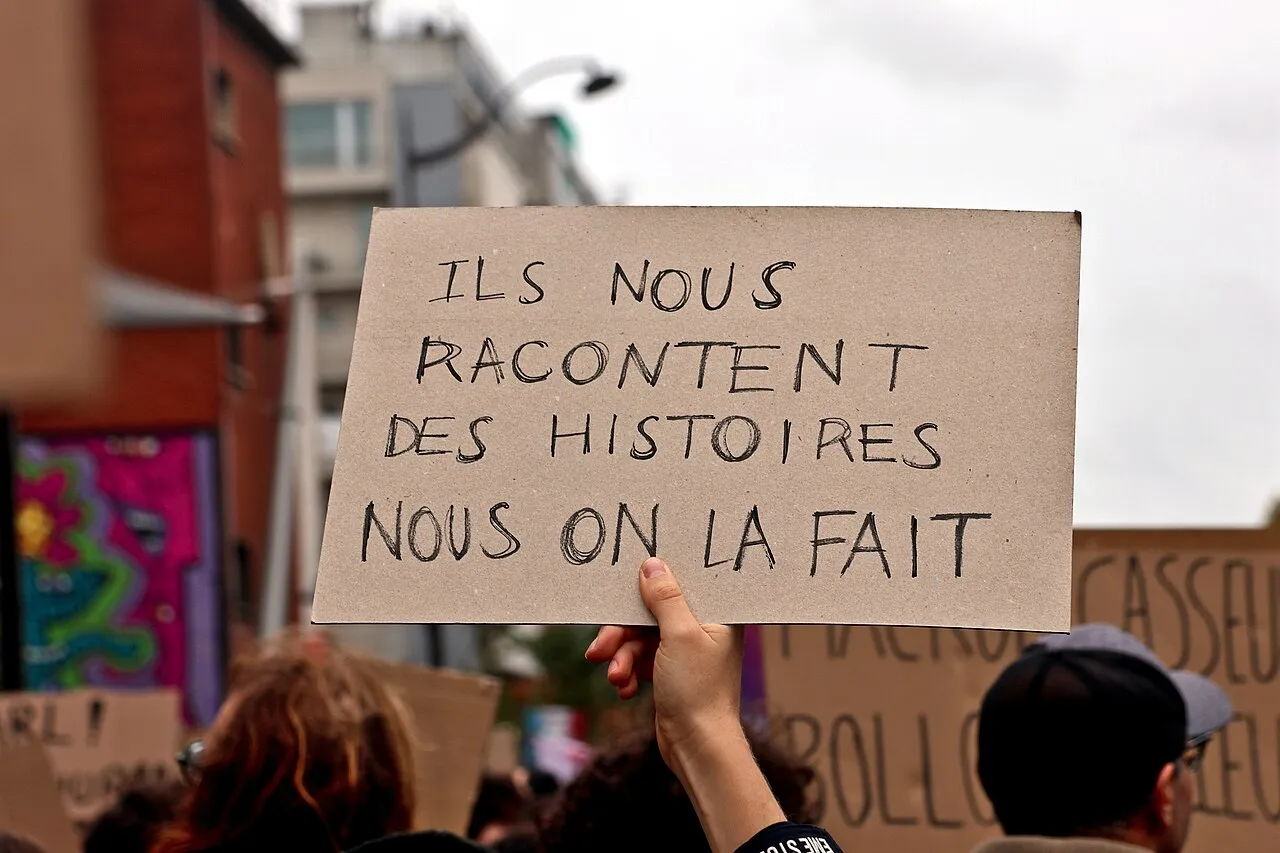
France saw another day of street protests across the country on Saturday, 24 October, with two wildly different headcounts and an evening marked by clashes in at least nine cities. The Interior Ministry put the turnout at about 410,000 people across roughly 298 marches, 110,000 of them in the capital. The CGT (Confédération Générale du Travail, France's main union confederation) counted about 800,000 nationwide and 250,000 in Paris — in both cases close to double the official figure. Neither side offered an explanation for the gap.
Interior Minister Laurent Nuñez said the marches themselves "passed off well" during the day, but that security forces later faced an "extremely elevated level of violence", which he blamed on far-left groups. According to him, "several thousand radical activists" had gathered at the rear of the Paris procession.
Nearly 1,000 arrests, and the count is not closed
Nuñez said late in the day that police had arrested "nearly 1,000" people nationwide and that the number was expected to rise "significantly". The Paris prosecutor's office reported 64 arrests in the capital, six of them minors, with 40 people placed in police custody; police said they had carried out more than 3,000 stop-and-checks in the city. In Nice, 11 people were arrested after clashes between demonstrators and far-right militants.
Up to 70,000 police officers and gendarmes were deployed, along with helicopters, armoured vehicles and water cannon — 20% more than the previous Saturday, according to the ministry. Among the items seized, authorities listed steel balls, lead pellets, fireworks, slingshots, improvised weapons, airsoft gear and a katana.
Two people were seriously injured, according to CBS News: one in Clermont-Ferrand, with no further details released, and a 20-year-old man in Toulouse who reportedly lost fingers.
Paris rerouted, museums closed
The customary route between Place de la Bastille and Place de la Nation was banned, and the Paris march was pushed to the southeastern edge of the city. Police used tear gas and water cannon as the march ended, and authorities put the number of people involved in the clashes in the capital at 500.
The city spent the day under de facto emergency conditions: 24 metro stations were closed at police request, the Louvre and the Musée d'Orsay did not open, the Art Basel Paris fair cancelled its weekend programme, and much of the central retail district boarded up its windows. Nuñez said there had been looting, on a far smaller scale than the week before, when around 3,000 businesses were damaged or looted.
Outside the capital, protests were banned in Montpellier, Rouen and Nice, and in central Lyon, where police fired tear gas to disperse about 150 people. In Marseille, a union march was authorised under strict conditions and drew about 17,000 people by the police count. In Orléans, a march against the congress of the Rassemblement National, the French far-right party, drew 11,000 people according to police and 26,000 according to organisers; at the party's own event, Jordan Bardella was re-elected president with nearly 99% of the vote.
From a school blockade to a political crisis
The movement began in mid-September with secondary-school students blockading their schools over dilapidated buildings, teacher shortages and Parcoursup, the national university admissions system. It has since absorbed cost-of-living and inequality grievances, drawn in unions and former Yellow Vest members, and become a broad protest against Emmanuel Macron's government. On the previous Saturday, 17 October, more than half a million people marched and more than 2,000 ended up in custody.
Macron received student representatives on Friday 23 October, the first such meeting since the mobilisation began, and promised more teaching posts and an overhaul of Parcoursup. The students left saying the meeting had not eased the tension and called for further protests until concrete measures arrive. Another day of action is already set for next Saturday.
The political calendar weighs on the deadlock: Macron cannot run for a third consecutive term and leaves the Élysée in 2027, and polls point to Marine Le Pen as the favourite to succeed him. That vacuum helps explain why a protest born in a school courtyard is still in the streets more than a month later, with no interlocutor able to bring it to an end.
The same day brought clashes in eight Italian cities, with nine arrests and 371 brief detentions — 110 of them minors — as well as unrest in Tirana, Albania, according to CBS News. Italian Prime Minister Giorgia Meloni announced the deployment of 500 additional soldiers to Milan.
With information from Al Jazeera and CBS News.