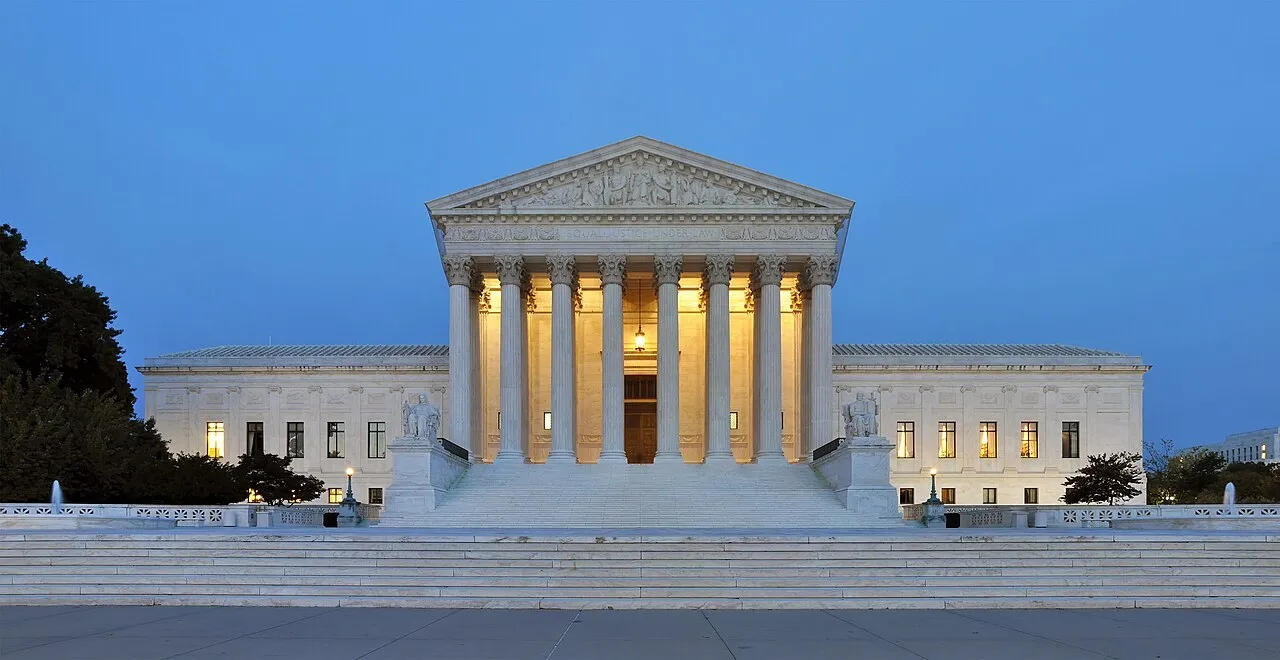
The Supreme Court spent two hours on Wednesday, November 4, on a question that sounds procedural and decides who lives: when a scientific manual changes, does a 24-year-old constitutional rule become new again?
The case is Guerrero v. Johnson, No. 25-1003, argued on appeal from the Fifth Circuit. In 2002, in Atkins v. Virginia, the Court held that executing people with intellectual disabilities violates the Eighth Amendment. Dexter Johnson, on Texas's death row, says he is one of those people — and that he could not have proved it when he first went to federal court.
The numbers at the center of the case
Johnson was convicted in 2007 of a double murder committed in Texas in 2006, among the victims a 23-year-old woman, Maria Aparece. The case before the justices is not about his guilt.
At his trial, a defense expert placed his IQ between 74 and 88 and concluded he was not intellectually disabled under the diagnostic standards then in force, which leaned on a cutoff near 70. The American Psychiatric Association's DSM-5, published in 2013, de-emphasized those cutoffs and accepted that a person scoring above 70 can still be intellectually disabled. Texas adopted the new framework in 2018. In 2019, Johnson scored 70 on an IQ test, and a second expert concluded he met the DSM-5 criteria.
A federal district court found that his Atkins claim had been "previously unavailable," allowed a second habeas petition and stayed his execution. The Fifth Circuit affirmed in July 2025, and the full court declined to rehear the case 9-7, with Judge James Ho dissenting from that denial alongside Judges Edith Jones, Jerry Smith and Kurt Engelhardt. Texas asked the Supreme Court to step in last February, and the justices granted review in June.
New law or new facts
Federal law allows a second habeas petition only in narrow circumstances. Under 28 U.S.C. § 2244(b)(2)(A), a prisoner may file again if the claim rests on a new rule of constitutional law made retroactive by the Supreme Court. A separate provision, § 2244(b)(2)(B), covers new facts — but it also requires the facts to bear on guilt, which an intellectual-disability claim does not.
That is the whole fight. Texas argues Atkins was decided before Johnson's crime and before his first petition, so nothing about the law is new; what changed is the evidence, and Congress deliberately drew a line between the two. Johnson argues a rule is "available" only when it can actually be used, and that the DSM-5 is what made Atkins capable of protecting him.
Texas Solicitor General William R. Peterson argued for the state, with Emily M. Ferguson of the Justice Department's Office of the Solicitor General appearing in support — the Trump administration filed an amicus brief backing Texas, arguing that psychiatric standards cannot convert an old decision into a new rule. Louisiana and 21 other states also sided with Texas, warning of "a recipe for eternal Atkins claims and zero finality." Jeremy Schepers, of Dallas, argued for Johnson, with support from the National Association of Criminal Defense Lawyers, which compared the claim to challenges built on discredited forensic science.
How the argument went
Justices Clarence Thomas and Amy Coney Barrett pressed Schepers on whether Atkins could possibly have been new when Johnson began his appeals in 2007. "We believe that Atkins was new based off of the character of the decision in 2002 and that it remains new now," Schepers answered.
Justice Brett Kavanaugh pushed at the other end of the timeline, asking what happens when the next edition of the manual arrives, and the one after that. Justice Sonia Sotomayor turned the same logic on Texas, asking why a new clinical rating would not be enough to raise a claim that had not previously been available: "I don't see what the difference is." Peterson replied that Johnson could always have claimed intellectual disability, because Atkins predated his conviction, and so does not qualify for a second round.
The Court appeared skeptical of Johnson's position overall, with Kavanaugh and Barrett the most pointed about the risk of reopening sentences each time diagnostic standards move. A decision is expected by the end of the term, in June or July 2027.
One detail worth holding onto: the state's finality argument and Johnson's availability argument can both be true at once. Diagnostic criteria really did change, and reopening cases every time they change really would have no natural stopping point. Whichever way the Court resolves that, it is choosing which of the two costs to absorb.
Reporting from the Supreme Court of the United States, SCOTUSblog, the Denver Gazette and the Fifth Circuit's January 2026 order.