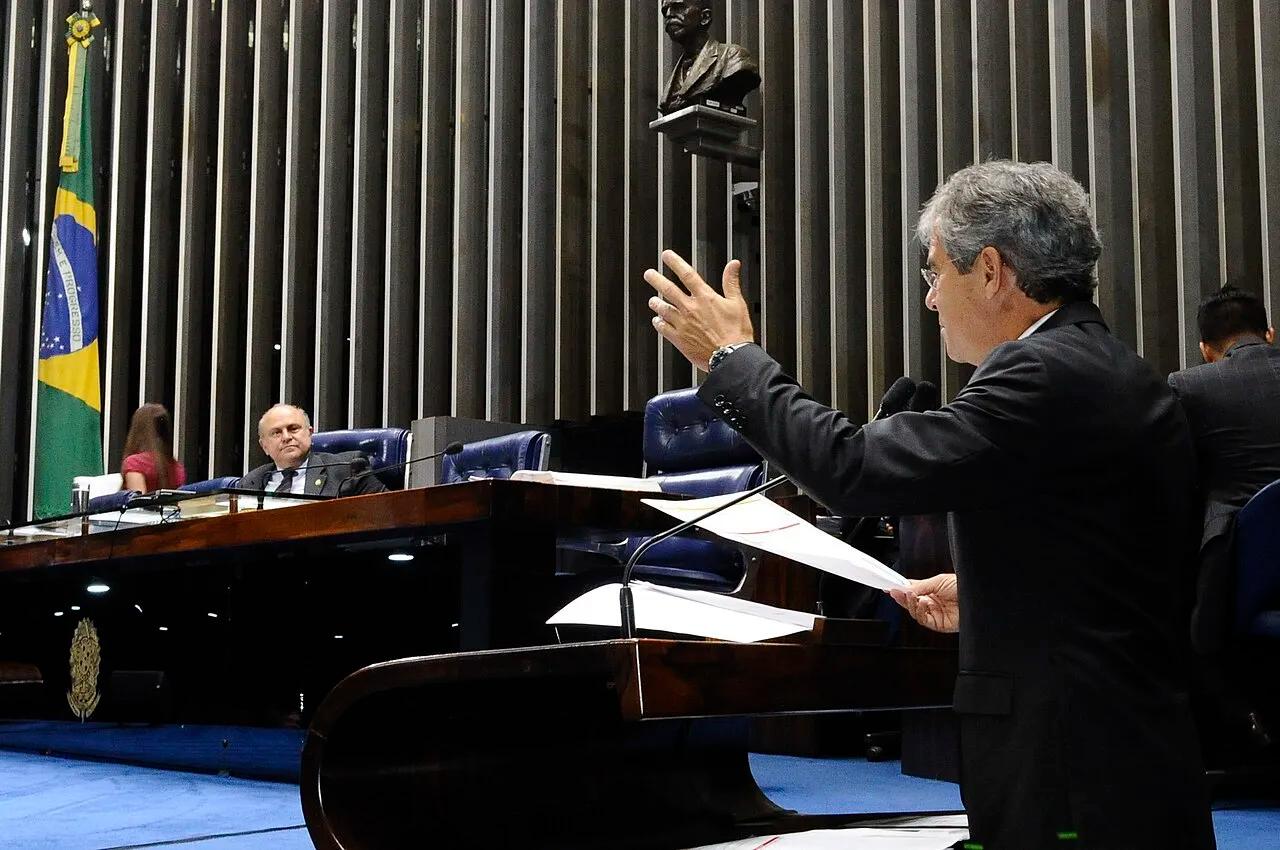
Brazil's Congresso Nacional (National Congress) enacted Constitutional Amendment 141 at a joint session on Friday (16), ending the country's 6x1 shift pattern — six days of work for one day of rest — and cutting the working week from 44 to 40 hours with no reduction in pay. The text began as PEC 221/2019 and cleared the Senate on Wednesday (14) in the two rounds the constitution requires, by 75 votes to 1 each time.
The single vote against came from Senator Hamilton Mourão (Republicanos-RS), a former vice-president of Brazil, according to Agência Brasil. The opposition had tried to keep the proposal off the floor but released its members to vote once the session was called, and most of its senators backed the text. Opposition leaders did not attend the enactment ceremony.
A 14-month transition, in two steps
The amendment does not take effect all at once. The calendar has two steps:
- Within 60 days of publication, every employee gains two paid weekly rest days, and the maximum week falls from 44 to 42 hours;
- Twelve months after that first cut — roughly 14 months after enactment — the ceiling reaches 40 hours a week, again with no pay reduction.
Contract and agreement clauses incompatible with the new rules lose their validity at the end of the 60-day window. Schedules already at 40 hours or less are not cut proportionally.
A simple calculation sizes up the intermediate phase: 42 hours spread across five days works out to 8 hours 24 minutes a day — slightly above the 8-hour daily limit the constitution sets once the transition ends. That gap is what becomes overtime when the adaptation period closes.
What collective bargaining can still do
The amendment leaves room for negotiation. During the transition, a collective agreement or convention may extend the working day to accommodate the 42-hour week, provided the two rest days are preserved. Compensating days off is allowed, averaging two per week across the month and with at least one rest day every seven, Agência Senado reports.
Occupations with special schedules may offset Saturdays or Sundays worked, as long as that average of two paid days off a week holds. On Agência Brasil's reading, the rule allowing compensation within the same calendar month keeps a 6x1-style arrangement possible where a collective agreement provides for it — a point likely to feed the debate over implementing legislation.
University degrees, outsourced staff and small firms
Employees with a university degree earning at least 2.5 times the ceiling of the Regime Geral de Previdência Social (the general social-security system) — currently R$ 21,188.87 — fall outside the rules on working-time limits and time-keeping, provided direct negotiation preserves the weekly rest.
For staff outsourced by the public administration the deadline is longer: 12 months after enactment. Contracts amended after the first 60 days, however, must already follow the new schedule.
The amendment also opens the way for future complementary legislation with transitional measures for individual microentrepreneurs (MEIs), micro-businesses and small companies, conditional on preserving jobs. "After all, strengthening the MEI is strengthening millions of Brazilian families," said the speaker of the lower house, Hugo Motta, at the session.
Health workers' retirement, in the same session
Congress also enacted Constitutional Amendment 140, which began as PEC 14/2021 and creates early retirement for community health workers and endemic-disease control agents, as well as for Indigenous health and sanitation agents. The Senate had approved it in July by 73 votes to 1.
Under the permanent rule, retirement becomes possible at 57 for women and 60 for men, with 25 years of contributions and of actual service in the role. The transition starts at lower ages — 50 for women and 52 for men until 2030 — and rises gradually through 2041. States, municipalities and the Federal District have until the end of 2028 to formalise these workers' employment status.
"The constitution became more citizen-minded"
At the session, Senate and Congress president Davi Alcolumbre said the double enactment "turns two historic struggles into rights" and that it took "a great deal of courage" to take on the issue. President Luiz Inácio Lula da Silva declared that "the constitution became more citizen-minded" and compared the resistance to the proposal with the opposition to Brazil's 13th-month salary in the 1960s: "It did not break companies."
Lula also drew the limits of the change, saying "nobody wants companies to go under, but nobody wants workers to die for lack of rest either".
With information from Agência Senado and Agência Brasil.