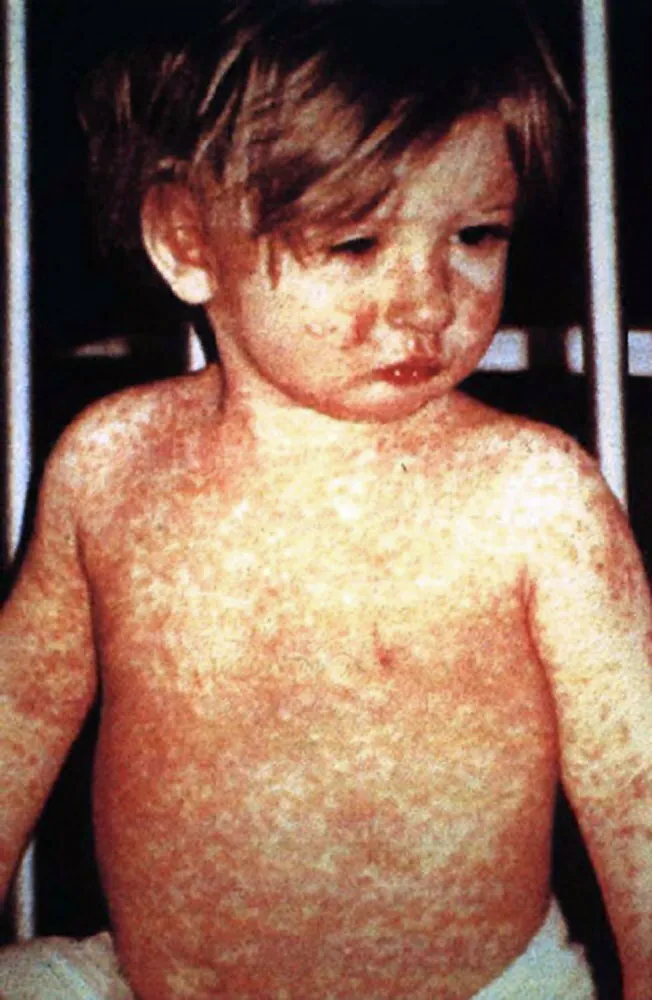
The United States has recorded 4,410 confirmed measles cases in 2026, the Centers for Disease Control and Prevention reported on October 16, with data current through October 15. That is 330 more than the week before, and roughly 93% above the 2,289 cases logged in all of 2025.
Forty-seven jurisdictions, including the District of Columbia, have reported cases. Eighteen of this year's cases were in international visitors.
The shape of the outbreak
The CDC counts 42 new outbreaks in 2026 — a number that did not move in the past week — and attributes 4,228 of the 4,410 cases, or 96%, to those clusters. Measles in the United States is not arriving as scattered imported cases; it is moving through communities where enough people are unvaccinated for a chain of transmission to hold.
Hospitalizations stand at 451, about one in ten cases, up 37 in a week. The rate is highest at the two ends of the age range: 15% of children under 5 and 14% of adults 20 and older have been hospitalized. By share of cases, the 5-to-19 age group accounts for 42%, adults 20 and older for 41% and children under 5 for 17%.
The death toll is where the federal and state ledgers diverge. The CDC's national table lists two deaths and notes the figure is subject to change. Pennsylvania's health department alone has confirmed five measles-associated deaths in its outbreak, with a sixth under investigation — a gap that reflects the lag between a state confirming a death and the CDC's national tally recording it.
Pennsylvania and New York
Pennsylvania has the country's largest outbreak: 1,222 cases across 42 counties as of October 14, including 86 reported since October 9, and 225 hospitalizations. At the state's request, the CDC has sent an Epidemic Intelligence Service investigator. Since the outbreak began in late April, state staff have administered more than 5,900 MMR doses at 202 pop-up clinics.
New York took a different route. Governor Kathy Hochul declared a statewide disaster emergency on October 5, effective through November 4. The order widens the list of health professionals allowed to give vaccines and gives nurses more latitude to order measles testing — an administrative loosening aimed at the bottleneck, not at the virus directly.
The number underneath the number
Measles needs roughly 95% coverage with two doses of the MMR vaccine to stop circulating in a population. Kindergarten coverage in the United States has fallen from 95.2% in the 2019–20 school year to 92.4% in 2025–26. The CDC estimates that the gap leaves about 280,000 kindergarteners unprotected.
Those points are three percentage points apart on paper. In practice they sit on either side of the threshold at which an imported case burns out on its own rather than becoming an outbreak — which is the arithmetic behind a year in which 96% of American measles cases were outbreak-associated.
Reporting from the Centers for Disease Control and Prevention and Al Jazeera.