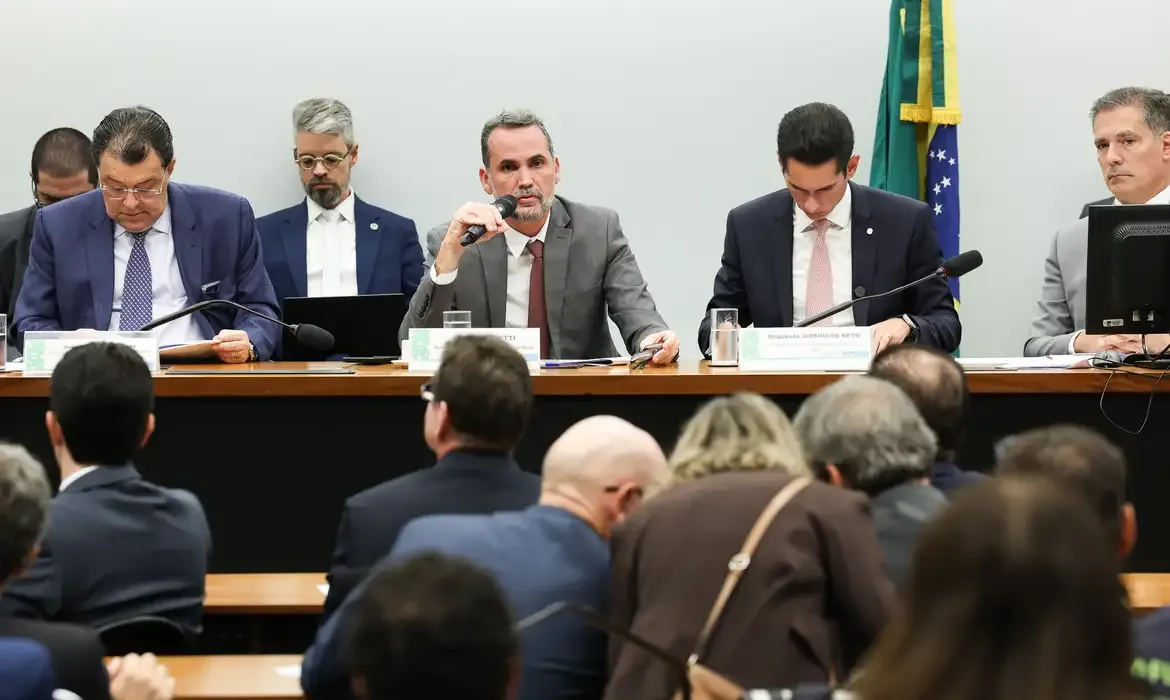
Brazil's federal government has put numbers on the adjustment it intends to make to next year's public accounts. At a hearing of the Comissão Mista de Orçamento (Joint Budget Committee) on Wednesday, Planning and Budget Minister Bruno Moretti detailed a set of measures whose estimated effect is R$ 50 billion to R$ 60 billion in 2027, with a slightly larger impact in later years. Hours later, the government's leader in the Senate, Jaques Wagner (PT-BA), filed the complementary bill (PLP) that brings the package together. Senator Eduardo Braga (MDB-AM), who is also the rapporteur for the 2027 budget, will report on it.
"In essence, the PLP gives us instruments to contain spending," Moretti said, as quoted by the newspaper Correio Braziliense.
A tighter cap than the fiscal framework allows
The core of the text is the spending limit. Brazil's current fiscal framework, the arcabouço fiscal, lets federal spending grow by up to 2.5% above inflation. The bill cuts that real growth to 2% in 2027 whenever projections point to a risk of falling below the lower bound of the fiscal target, and the remaining 0.5 percentage point is frozen.
Two details change how much the rule bites. First, once triggered, the freeze could not be reversed within the same year, even if revenue improved later. Second, the order of magnitude: Agência Brasil, the state news agency, estimates the extra squeeze from replacing 2.5% with 2% at R$ 12.8 billion.
The trigger would also reach tax offsets and mandatory spending that carries no constitutional protection.
Tax breaks, credits and "supersalaries"
The bill raises to 20% the across-the-board cut in tax benefits and incentives granted to sectors of the economy — ten points above the cut already in force. Companies currently exempt would pay 20% of the full rate, and the presumed-profit rate would rise by 20%.
There is also a limit on companies using credits they hold with the Receita Federal (federal tax authority) to pay taxes, a broadening of the mechanisms for blocking spending during budget execution, and a review of so-called supersalaries — pay above the constitutional ceiling — for which Congress would have 120 days from the law's publication to take up.
One further point: up to 40% of the financial surplus held in earmarked funding sources, including public funds, could be used to meet constitutional obligations. Social security, health, education, security and revenue-sharing money is excluded.
Oil revenue out of the health floor
One of the measures with the widest reach is an accounting change. Extraordinary oil and gas revenue would be taken out of the Receita Corrente Líquida (Net Current Revenue) base used to calculate the minimum health spending floor and the Federal District fund. The rule was adopted temporarily in 2026 and applied only when the primary result was negative; the bill extends it until 2030 and applies it to a positive primary result as well.
"We are doing something quite reasonable, which is to take out the extraordinary revenue related to oil," Moretti told the committee.
The text also provides that, if the previous bimonthly report projects a deficit, the government would stop counting revenue from the export tax on crude oil and bituminous minerals. And it opens R$ 10.5 billion of fiscal room in 2026 to pay part of the diesel subsidy, an expense the bill's justification ties to the effects of the war in the Middle East.
The target is 0.5% of GDP
The package serves one goal: a primary surplus of 0.5% of GDP in 2027, equal to R$ 73.2 billion, on a path towards 1.5% of GDP by 2030. The primary result is what is left before interest payments on the debt.
Part of the way is already covered. Keeping two fiscal triggers already approved by Congress should yield, by the ministry's own count, about R$ 9 billion next year. "For next year, these triggers can generate savings of R$ 9 billion," Moretti said.
The minister acknowledged that the size of mandatory spending limits the executive's room for manoeuvre, but argued that part of it guarantees rights — he cited the policy of raising the minimum wage — and said the aim is to balance the books without cutting social programmes or the constitutional minimums for health and education. The review, he said, targets "tax expenditures that do not deliver those results".
What is still missing
Because it is a complementary law, the bill needs approval in both houses of Congress. The government worked to put it on the Senate floor on Wednesday itself, with Braga as rapporteur and negotiations open with party leaders.
Concentrating the report in a single senator — the same one handling the 2027 budget — ties the adjustment to the budget bill he will report on: the PLP is the instrument that makes the budget's headline number achievable. Without it, the 0.5%-of-GDP target depends on spending freezes through the year.
With information from Agência Brasil, Correio Braziliense and Agência Senado.