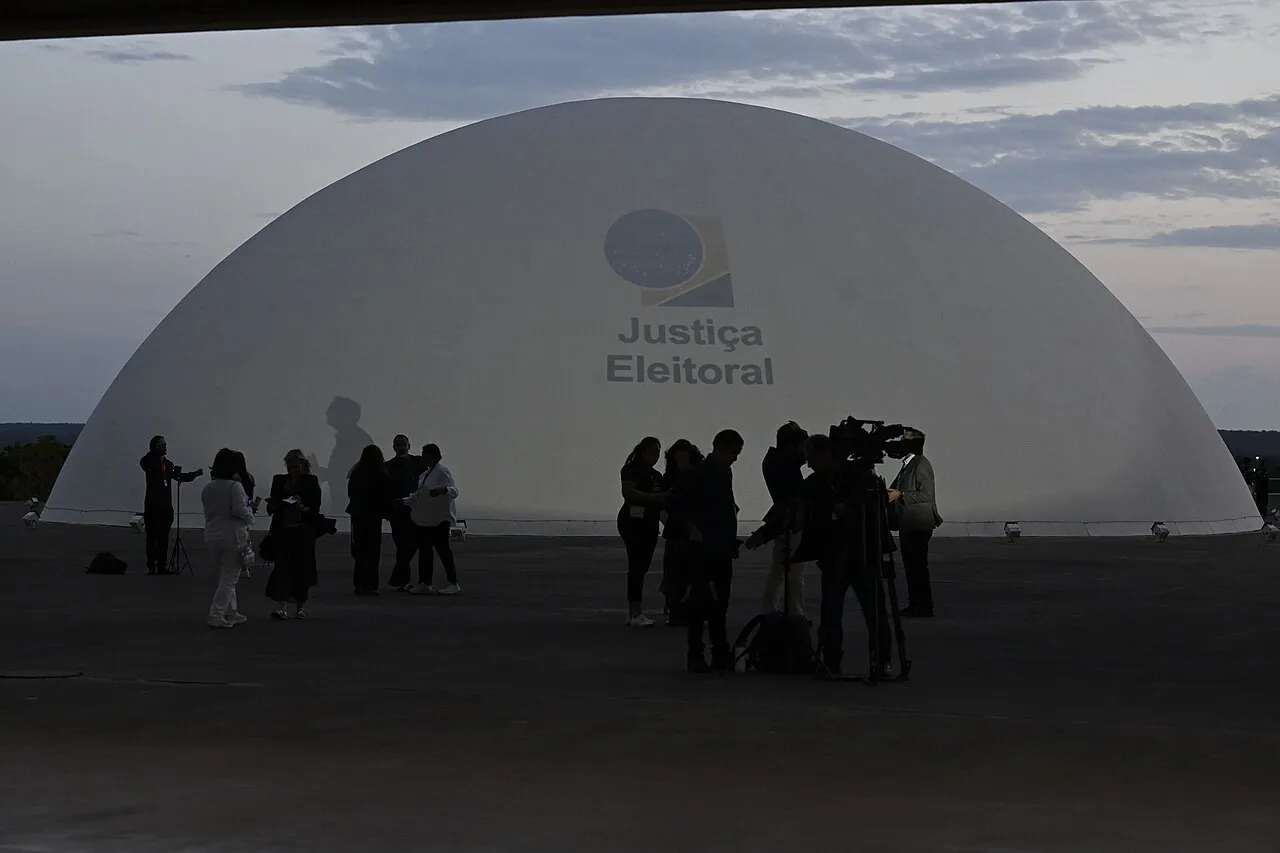
Polling stations across Brazil open at 8 a.m. and close at 5 p.m. Brasília time this Sunday (25) for the runoff of the 2026 elections. Voters decide who takes the presidency from 1 January and, in five states and the Federal District, who runs the local government. The electoral roll is the same as on 4 October: 158,745,502 people.
A 1.87-point gap in the first round
Flávio Bolsonaro (PL) and Luiz Inácio Lula da Silva (PT) reached the runoff because neither won a majority of valid votes three weeks earlier. In the final count released by the Tribunal Superior Eleitoral (TSE, Brazil's superior electoral court), Flávio Bolsonaro took 56,104,503 votes (47.03%) and Lula 53,879,538 (45.16%) — a gap of 2,224,965 votes, or 1.87 percentage points.
The next three candidates together drew 8,729,604 votes, slightly over 7% of the valid total: Augusto Cury (Avante), with 2.89%; Renan Santos (Missão), with 2.24%; and Ronaldo Caiado (PSD), with 2.18%. None of the other eight names on the ballot passed 0.27%.
The heaviest number sits outside the head-to-head. First-round abstention was 21.08% — roughly 33.5 million people who did not show up — and another 5.97 million voters turned up and chose no one: 2,300,798 blank votes (1.84%) and 3,674,249 null votes (2.93%). Added together, abstention, blank and null ballots exceed either candidate's own first-round tally, and that is the pool both campaigns spent the final stretch trying to reach.
Six state contests
Six federal units return to the polls to choose a governor:
- Acre: Mailza Assis (PP) and Alan Rick (Republicanos)
- Amazonas: Omar Aziz (PSD) and Professora Maria do Carmo (PL)
- Federal District: Celina Leão (PP) and Leandro Grass (PT)
- Espírito Santo: Lorenzo Pazolini (Republicanos) and Ricardo Ferraço (MDB)
- Rio Grande do Norte: Allyson (União) and Cadu de Lula (PT)
- Tocantins: Professora Dorinha (União) and Vicentinho Júnior (PSDB)
In Rio de Janeiro, where the governor's race was settled in the first round, the state's nearly 12.9 million voters cast a ballot for president only. The exception is Itaguaí, in the metropolitan area, which is also electing a mayor and deputy mayor.
Photo ID is mandatory
Every voter must present an official photo document — identity card, passport, driving licence or the e-Título app, when it carries a photograph. The requirement applies even to voters identified by fingerprint. The paper voter registration card is not mandatory, though it helps locate the right polling station.
Mobile phones and other electronic devices are banned inside the booth; the electoral authority advises writing the candidates' numbers on a slip of paper. Outside it, individual and silent expression of preference is allowed — a flag, a badge, a sticker — but gatherings with campaign material, loudspeakers, rallies, motorcades, last-minute canvassing at polling stations, leafleting and voter transport organised by candidates, parties or federations are all prohibited.
Anyone who missed 4 October may vote on Sunday, provided their registration is in order: each round is a separate election. Voters away from their registered municipality can file an absence justification through the e-Título app or at a polling station outside that municipality; those who do not do so on the day have 60 days after the round to file without a fine, through the Justifica system or the app.
Security and the count
The TSE has authorised the deployment of some 25,000 Armed Forces personnel across 301 municipalities, at the request of the regional electoral courts, and the Ministério da Justiça e Segurança Pública (Ministry of Justice and Public Security) opened a joint operation on Saturday (24) with the Polícia Federal (Federal Police), the Polícia Rodoviária Federal (Federal Highway Police), the Abin intelligence agency, the Ministry of Defence and state forces, running until the count ends.
Tallying begins after stations close on Brasília time and can be followed on the TSE website and the Resultados app; a separate app, Boletim na Mão, reads the QR code printed on each station's results slip.
With information from the Tribunal Superior Eleitoral, the Tribunal Regional Eleitoral do Rio de Janeiro, Agência Brasil and CartaCapital.