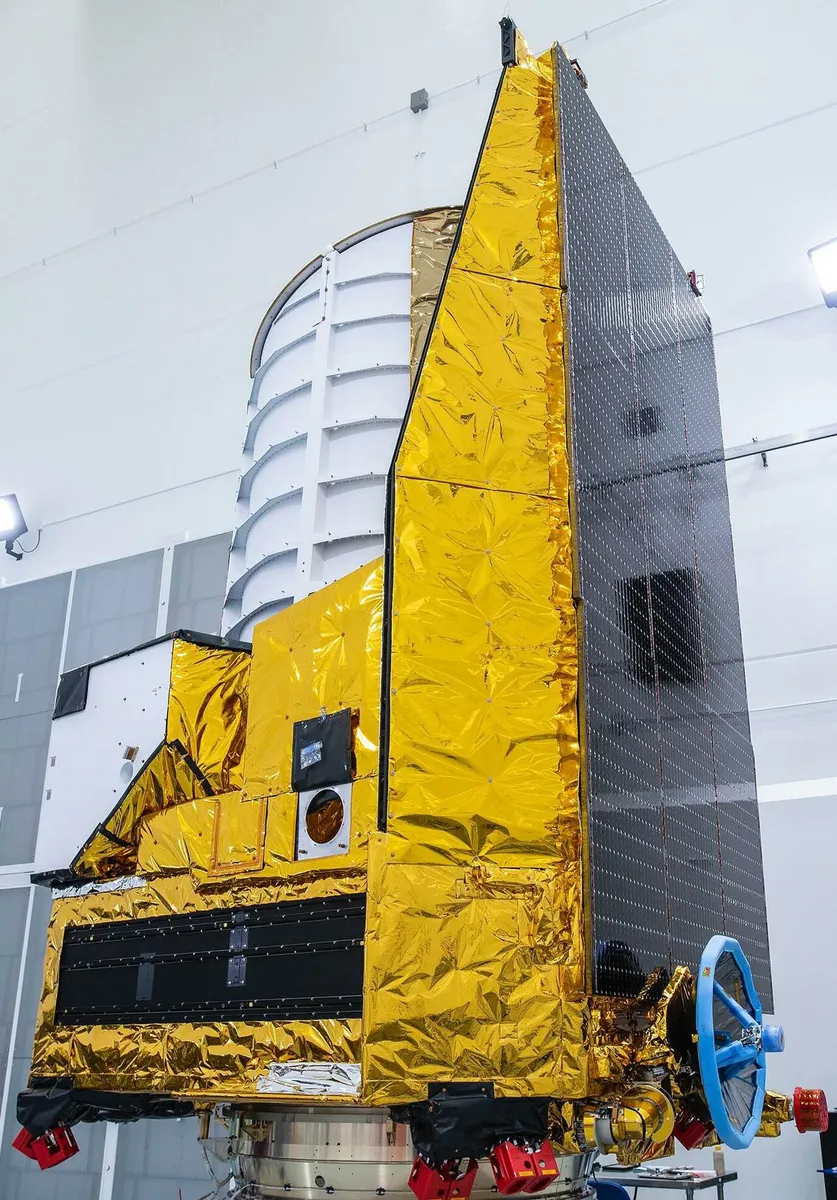
The Euclid space telescope, run by the European Space Agency (ESA), has discovered its first previously unknown comet. Named C/2026 S1 (Euclid), the object was confirmed on 8 October by the Minor Planet Center of the International Astronomical Union (IAU), after follow-up observations by ground-based telescopes. The agency announced the find on 19 October.
At the time of detection the comet was about 1.3 billion kilometres from Earth — roughly the distance from the Sun to a point between the orbits of Jupiter and Saturn. It is a long-period comet: a full trip around the Sun takes thousands of years, and the exact orbit is being refined as more data comes in.
A streak across 16 images
The discovery came out of images captured between 16 and 24 September in Euclid's Deep Field North, a region in the constellation Draco. There were five fields of view, with two to four exposures in each, 16 in total.
The find belongs to Mikko Pöntinen, a PhD student at the University of Helsinki who is part of the Euclid Consortium's Solar System Objects Science Working Group. He ran the images through moving-object detection software he wrote himself.
"I was excited to see my software flag a 'streak' smeared across several images," Pöntinen said in an ESA statement. From that trail he predicted where the object should appear in the other image sets, and found it. The fuzzy cloud around the bright point indicated an active comet shedding dust and gas. Comparison with catalogues of known comets and asteroids turned up no match.
Why Euclid almost never finds comets
Euclid, launched in July 2023, was not built to watch the Solar System. Over six years, the telescope is to observe billions of galaxies out to 10 billion light-years away, in order to build the largest three-dimensional map of the Universe and measure the effect of dark matter and dark energy on cosmic expansion.
To do that, the telescope specifically avoids the plane in which the planets orbit — where there is more dust and therefore more scattered light spoiling the images. It is also where most comets are. This particular comet was only seen because its orbit is steeply inclined to the plane of the planets and it happened to pass through one of the observed fields.
"Very few comets are expected to be discovered by Euclid," said Bruno Altieri, Euclid Archive Scientist and a member of the discovery team. There is also an operational detail: the telescope's observing strategy visits each patch of sky only once, which makes it impossible to return to the object on demand.
According to Altieri, C/2026 S1 is not a suitable target for Comet Interceptor, the ESA probe designed to intercept an as-yet unidentified comet, but the alert served as a test of how the two teams would coordinate a real opportunity. "We are of course happy to have discovered a previously unknown comet," said Valeria Pettorino, Euclid Project Scientist.
The Euclid Consortium brings together more than 2,000 scientists from about 300 institutes. The telescope was built and is operated by ESA, with contributions from NASA.
With information from the European Space Agency and Universe Today.