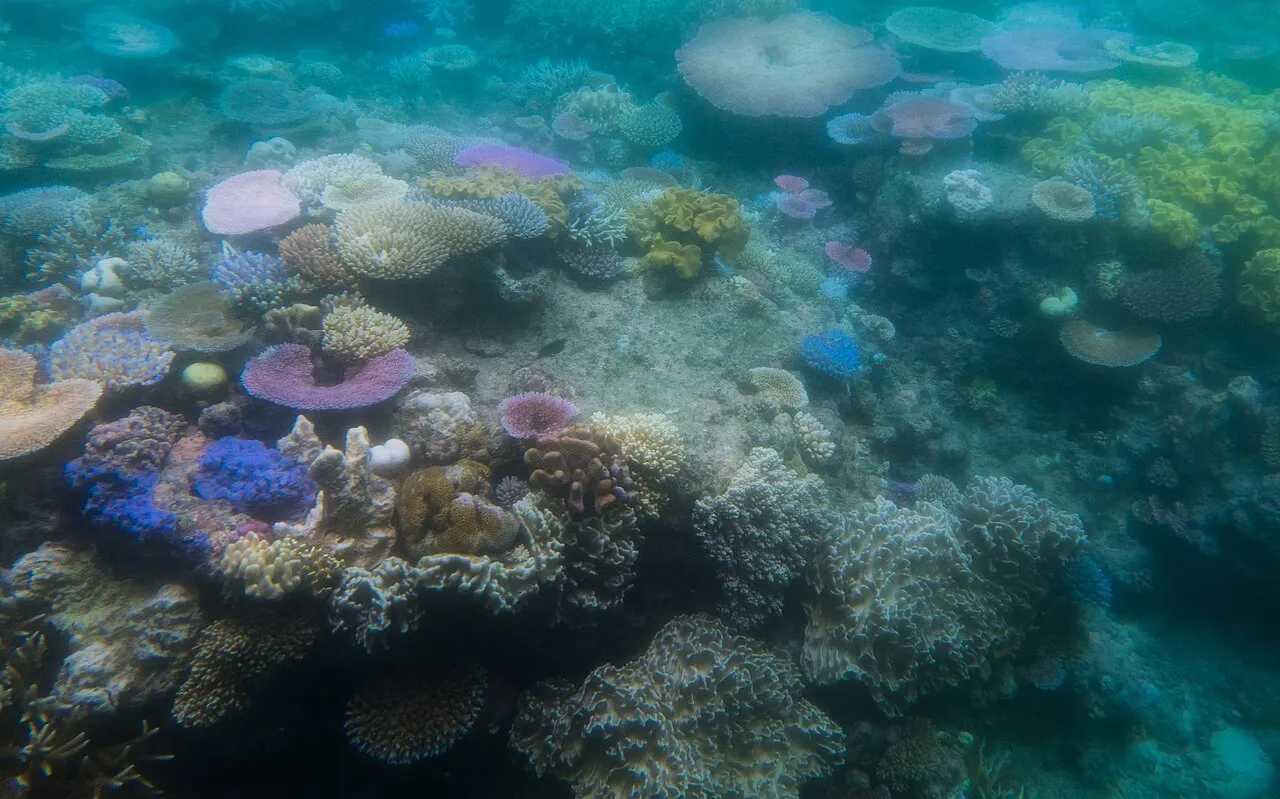
The International Union for Conservation of Nature (IUCN) released on Thursday the first global assessment of warm, shallow-water coral reefs under its Red List of Ecosystems. The result: 96% of the reefs assessed are classified as "critically endangered", the highest category on the scale, and face an extremely high risk of collapse by 2075.
The announcement was made at a news conference at the COP17 biodiversity summit in Yerevan, Armenia, and also from Gland, Switzerland, where the organisation is based.
What was counted
The assessment covered 127 tropical and subtropical ecoregions, together holding 188,362 sq km of reef in more than 80 countries and territories. More than 250 experts took part, coordinated by the IUCN, its Commission on Ecosystem Management, the University of Melbourne and CORDIO East Africa, with the regional nodes of the Global Coral Reef Monitoring Network (GCRMN).
The method combines historical observations, current conditions and projections of ocean warming, drawing on decades of monitoring of coral distribution and degradation and on satellite records of sea-surface temperature. Four of the 127 ecoregions lacked enough data to be classified. One is already listed as "collapsed": the reefs of the western Galápagos Islands, since the 1982-83 El Niño.
The projections are what move the number
The gap between today's picture and the future scenario is the report's most telling figure. Counting only the changes observed over the past 50 years, 24% of the ecoregions would be classified as critically endangered. It is the inclusion of sea-temperature projections that takes the share to 96%.
The IUCN used the IPCC's "middle-of-the-road" scenario, which projects 2.7°C of atmospheric warming by 2100. The UN calculates that the emissions pledges currently on the table put the planet on course for about 2.6°C this century.
The same pattern shows up region by region. In East Asia, 20% of reefs are critically endangered on the basis of observed change alone; once projections are added, all of them are. The northern Red Sea would be rated only "vulnerable" on recent trends, because its corals have unusually strong thermal tolerance.
The largest and most biodiverse systems in the world fall in the most severe category: the Great Barrier Reef in Australia, the Coral Triangle in the western Pacific and Southeast Asia, the Mesoamerican Barrier Reef System and the reefs of the Red Sea.
Heat is the threat, fishing makes it worse
Heat stress driven by climate change is, according to the IUCN, the most consistent threat worldwide: marine heatwaves cause mass bleaching and coral death, with rising frequency.
The second pressure is overexploitation. The depletion of parrotfish and grouper populations — the herbivores and predators that keep algae in check — threatens 63% of reef ecosystems and shows up as a current problem in East Asia, the western Indian Ocean, the Caribbean and Brazil, because it weakens a reef's ability to recover after heat. Coastal development, pollution, overtourism, aquaculture, more frequent storms and outbreaks of crown-of-thorns starfish are also on the list.
Collapse, in the Red List's vocabulary, is not the death of a coral: it is the loss of the features that define the ecosystem. Hard corals all but disappear and algae, rubble and sponges take their place; the food web running from invertebrates and reef fish up to sharks and grouper no longer holds. Reefs shelter about a quarter of all marine species.
"A critical window"
In parallel, the IUCN reassessed 892 reef-building coral species on its Red List of Threatened Species: 44% are threatened with extinction. The two assessments are complementary — one measures the risk of losing species, the other the risk of losing the reef as a functioning ecosystem.
IUCN Director General Grethel Aguilar said it is "not too late" for reefs to recover, but that this depends on decisive action on climate change and ocean warming. For Mishal Gudka, of CORDIO East Africa and scientific lead of the assessment, the future climate threat is "looming and severe", and for exactly that reason there is "a critical window for action" — one in which local authorities have pollution and sustainable fishing to deal with. Emily Nicholson, who leads the Red List of Ecosystems thematic group at the IUCN, added that easing local pressures, expanding marine protected areas and rebuilding fish stocks still change the outcome.
With information from the International Union for Conservation of Nature (IUCN) and AFP.