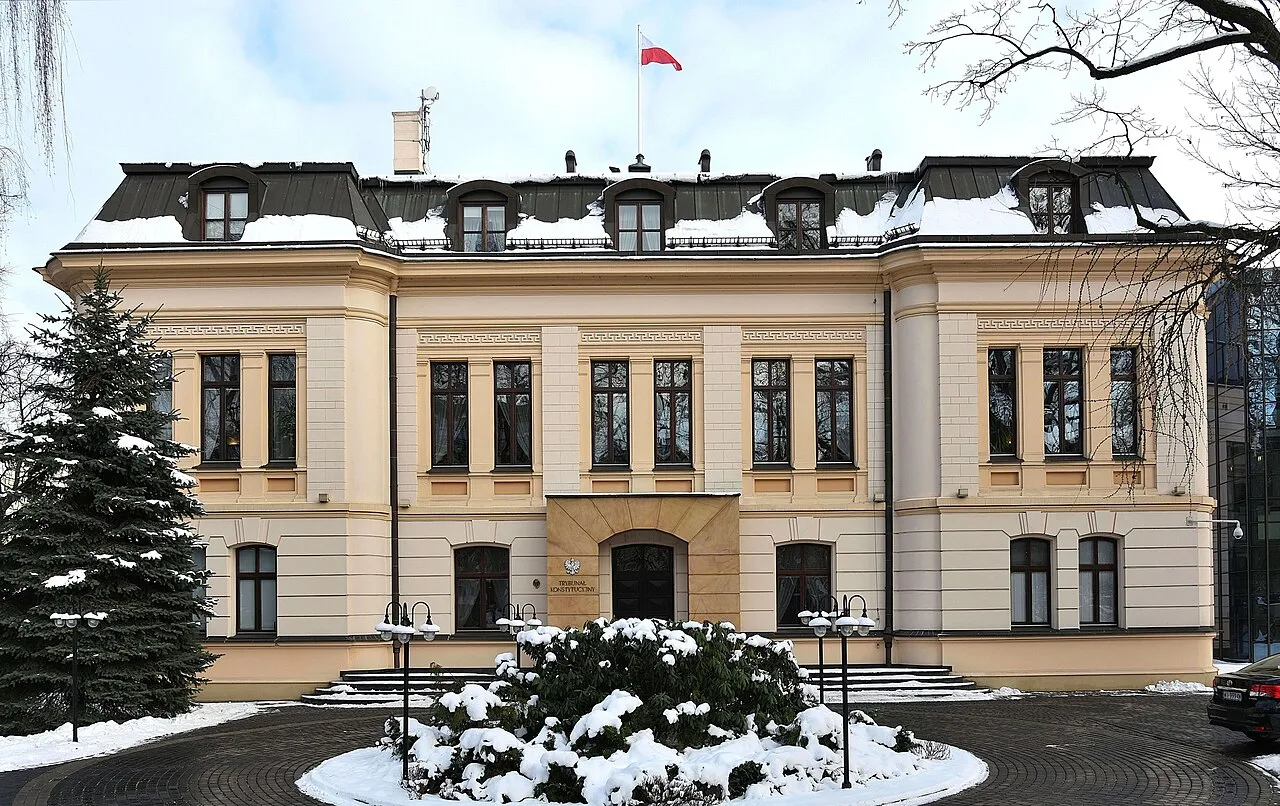
Judge Anna Korwin-Piotrowska signed two orders on Friday suspending for one month the president of Poland's Constitutional Tribunal, Bogdan Święczkowski, and its vice-president, Bartłomiej Sochański. She then began presenting herself as the court's acting president. The Tribunal replied that she is not one of its judges and that the episode amounts to a "coup d'état". Hours later, President Karol Nawrocki ordered his official plane to turn back in the middle of a trip to Senegal.
The crisis is not about a ruling. It is about who controls the court that decides whether Polish laws are constitutional.
The order and the grounds invoked
Korwin-Piotrowska relied on Article 130 of the Law on the Organisation of Common Courts, which allows a judge to be temporarily relieved of duties when their conduct threatens the dignity of the court or the essential interests of the service, and also invoked an "overriding constitutional necessity". In the orders she accuses Święczkowski of blocking the Tribunal's General Assembly, preventing five judges from adjudicating, breaking the rules on assigning cases and sidelining matters of public importance, according to an account by state broadcaster TVP World.
On the same basis, she cited her own seniority on the court to take over the acting presidency.
The court does not recognise the suspension
On its official account on X, the Constitutional Tribunal said its website had been taken over unlawfully, that Święczkowski remains president and Sochański remains vice-president, and that those responsible were carrying out a coup d'état. A court spokesperson said Święczkowski would stay in office "whatever someone might think up" and maintained that the police operation that night had been planned.
Opposition politicians repeated the word "coup" through the evening.
Police and protest in Warsaw
Police were deployed to the Tribunal's grounds in central Warsaw after disturbances outside. According to the force, three people climbed the fence and entered the grounds and were detained, and officers did not enter the court building or act against the Tribunal's own guards. Proceedings against those detained were brought under Article 193 of the Polish Criminal Code, which covers trespass.
Protesters gathered in front of the building, and objects were thrown.
Nawrocki cuts short his trip; Tusk speaks of duty
Nawrocki was on an official flight to Senegal when he ordered the return to Warsaw. "At a moment like this, the President must be in Poland," he said.
Prime Minister Donald Tusk wrote on X that restoring the rule of law is the government's duty and that it is a difficult, sometimes painful process requiring decisive action. He did not comment directly on the suspension.
The background
The standoff has run for months and originates in the judicial overhaul carried out by Law and Justice (PiS), which governed from 2015 to 2023 and was accused by European institutions of packing the courts. Tusk's coalition, in power since late 2023, does not recognise the legitimacy of the Constitutional Tribunal as currently composed and has already ignored its rulings.
According to TVP World, five judges elected by the current parliamentary majority were barred by Święczkowski from hearing cases; Nawrocki, a PiS ally, refused to receive their oaths, which were eventually taken at ceremonies in parliament. Neither the president nor Święczkowski considers those oaths valid.
The dispute carries a price: the European Union had already withheld tens of billions of euros earmarked for Poland over concerns about the politicisation of the judiciary. A constitutional court with two rival leaderships, each claiming to be the legitimate one, is likely to reopen that account just as Warsaw negotiates its next cycle of European funds.
With information from Reuters, TVP World, Meduza and Euronews.