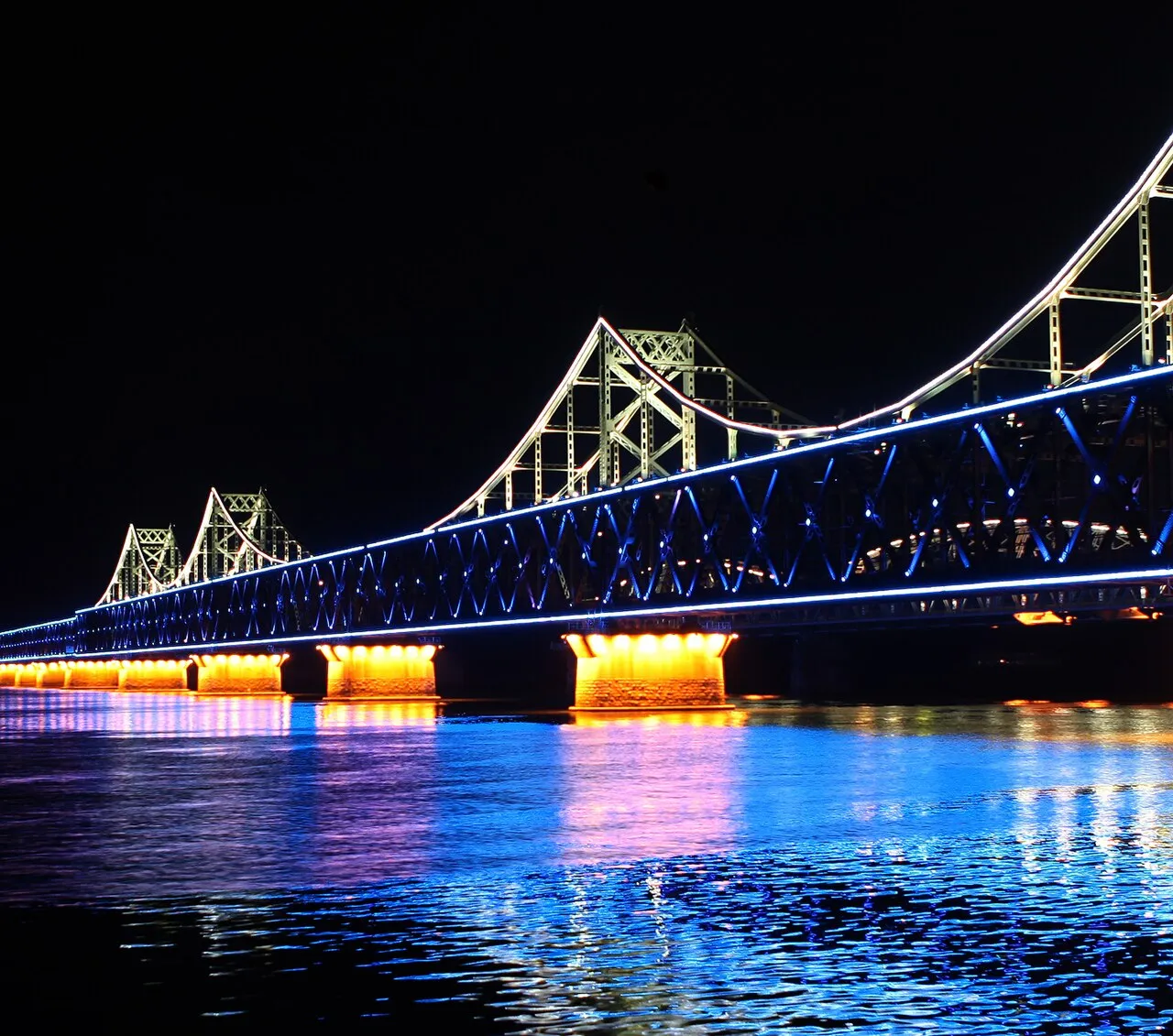
North Korean leader Kim Jong Un walked across the New Yalu River Bridge on Saturday and entered Dandong, in China's Liaoning province. It was his first trip to China in a year, and the crossing he used — linking the Chinese city to Sinuiju, in north-western North Korea — had stood built but closed to traffic for twelve years.
The visit was confirmed by South Korea's Ministry of Unification and by the Chinese state agency Xinhua, and footage from the broadcaster CCTV showed Kim walking along the span towards the North Korean side.
A bridge finished in 2014
Work began in October 2011, was paid for by China and was completed on the Chinese side in 2014. The cable-stayed structure runs about 3 kilometres, at an estimated cost of 2.2 billion yuan, according to the South Korean press. The bridge only opened to traffic on 15 October 2026 — twelve years after it was finished.
The delay was not diplomatic: what was missing on the North Korean side were the connecting roads and the customs and immigration facilities without which the bridge ran out, literally, into an open field. Until now, virtually all overland trade between the two countries passed over the Sino-Korean Friendship Bridge, opened in 1943, with a single rail track, one reversible lane and a 20-tonne limit for trucks.
That is the bottleneck the new crossing removes. For Lu Chao, of the Liaoning Academy of Social Sciences, the project resolves "a major bottleneck in China-North Korea trade logistics" — and China accounts for most of Pyongyang's declared foreign trade.
What Kim did in Dandong
Kim was accompanied by Wang Huning, a member of the Standing Committee of the Chinese Communist Party and the fourth-ranked official in the party, who conveyed greetings from President Xi Jinping. Wang said China was ready to use the bridge's opening to expand personnel exchanges and economic and trade cooperation.
The North Korean leader visited a memorial to the soldiers of the Chinese People's Volunteer Army, who fought alongside Pyongyang in the Korean War (1950–1953), and toured a car factory in the city. He said North Korea would "firmly carry forward the invincible DPRK-China friendship forged at the cost of blood", and that the bridge "would undoubtedly and correctly fulfil its historic mission of linking the two countries".
Two axes at once
The meeting is the latest sign of a rapprochement after years of a border closed by the pandemic. Kim was in Beijing in September 2025, alongside Xi and Russian President Vladimir Putin, for the military parade marking 80 years since the end of the Second World War; Xi made a state visit to North Korea in June 2026. That is two summits in thirteen months.
Analysts read it less straightforwardly than the ceremony suggests. Since 2022, Pyongyang has sent thousands of soldiers and conventional weapons to Russia, and some specialists see in that a new degree of autonomy from Beijing — the bridge being, on that reading, less an act of deference than the opening of a second channel. Christopher Green, of Leiden University, argues the crossing lends Kim's personal backing to bilateral trade.
On the American side of the board, officials in the United States and South Korea are already working on the assumption that there will be no meeting between Donald Trump and Kim this year. Trump is expected at the APEC summit in Shenzhen next month.
With information from ABC News, CBS News, SBS and the Morning Star.