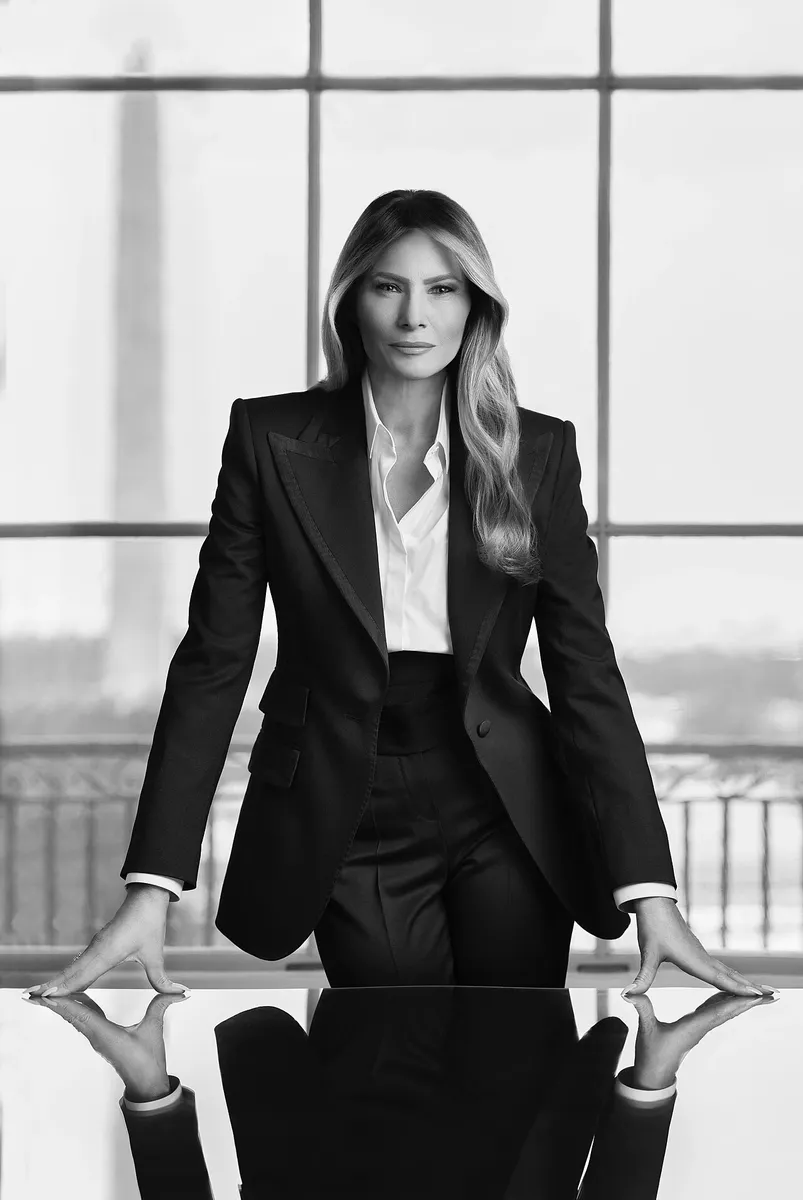
Representatives of Russia and Ukraine stood in the same room of the White House on Thursday, which has not happened often in four and a half years of war. The person who put them there was the first lady.
Melania Trump convened the gathering in the Grand Foyer on November 5 to mark the ceasefire in Oleshky, a Russian-occupied city in Ukraine's Kherson region. Kirill Dmitriev, special envoy of President Vladimir Putin, and Yana Lantratova, Russia's human rights commissioner, attended for Moscow. David Arakhamia, who leads the Servant of the People party in Ukraine's parliament, and Dmytro Lubinets, the parliament's human rights commissioner, attended for Kyiv.
"Together, we can create something more enduring than a temporary ceasefire," she said, urging both delegations to treat the Oleshky truce as a spark in a world of darkness.
She described her own role in unusually concrete terms, saying she acts as an "exclusive intermediary" under written agreements signed by both governments, and that she had been involved in the planning down to reviewing de-mining plans and evacuation routes. She gave the most senior official from each side a letter she had written — one to Putin, one to Volodymyr Zelenskyy. The Ukrainian delegation presented her with the Order of Princess Olga, first class, which Zelenskyy had awarded her earlier in the week.
What the Oleshky truce actually did, and did not do
The numbers are modest and the precedent is not.
The truce held for six days. It allowed aid into Oleshky and the surrounding area and brought out nearly 800 people, from an estimated 2,000 civilians believed to have been left in the city. It was the longest multi-day truce between the two countries since Russia's full-scale invasion began in February 2022, and the first joint relief operation in four years and eight months.
It also expired on Sunday, and neither side extended it. A day later, a Russian bombing of an aid distribution point in Komyshuvakha, in the Zaporizhia region, killed at least 40 people, according to Zelenskyy.
Credit for the truce is not settled either. The White House says the first lady mediated it. Pope Leo XIV also pressed both sides to permit aid deliveries and evacuations during the same period, and accounts of who brokered what differ.
A narrow channel, while the main one stalls
The event is best read against what has not happened. Her husband's administration has spent the better part of two years trying and failing to produce a general ceasefire. Within that stalemate, a six-day local truce for one occupied city, negotiated through the first lady's office and built around humanitarian access rather than territory, is the one channel that has delivered anything at all.
Whether it widens is about to be tested. Russian and Ukrainian negotiators are expected in Abu Dhabi on November 10 and 11 for a new round of US-brokered talks.
The timing carries a domestic edge as well. Thursday's ceremony came two days after midterm elections that handed Democrats control of both chambers of Congress, a result that changes the politics of American aid to Ukraine for the next two years.
Reporting from the White House and Al Jazeera, with additional detail from CTV News.