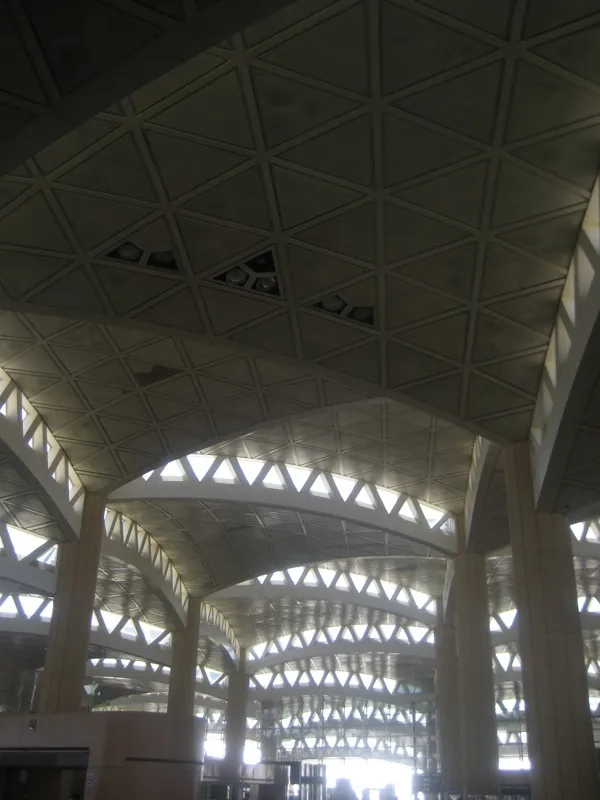
Saudi Arabia's General Authority of Civil Aviation (GACA) said on Monday that King Khalid International Airport in Riyadh remains closed while officials complete the procedures to verify "the safety and operational readiness of the airport's facilities". It gave no date or time for reopening.
This is the third consecutive day of shutdown at the Saudi capital's airport, closed since Saturday's attack — the deadliest in a sequence that, according to a tally by the Turkish agency Anadolu, adds up to ten attacks on five of the country's airports between 5 and 11 October, with at least 20 people killed and hundreds injured. The Houthis, of Yemen, claimed most of them and describe the strikes as retaliation for Saudi bombing of civilian infrastructure in Yemen.
Five attacks on the same airport in six days
King Khalid was struck five times in that window; King Fahd, in Dammam, twice. The airports of Abha, Jazan and Najran were also targeted.
- 6 and 7 October — combined missile and drone attacks hit Riyadh, where a Sudanese national was killed and eight people injured, and Abha, with two women killed (an Algerian and a Moroccan) and 28 injured.
- 8 October — two strikes on King Khalid killed three Saudi citizens, among them a Saudia pilot, and destroyed one of the airline's Airbus A321-200s. The airport returned to normal operations the following day.
- 10 October — a ballistic missile hit the complex housing terminals 3 and 4. GACA recorded 12 dead and 309 injured; an Indian national died on Sunday of his injuries, taking the toll to 13.
- 11 October — a projectile struck Terminal 4 at about 8:30pm local time and set fire to a passenger hall. A Pakistani resident was killed and 11 people injured. The Saudi-led coalition did not immediately attribute that strike.
Almost half the country's flights cancelled
Aviation analytics firm Cirium calculated that 46.4% of all scheduled flights in Saudi Arabia were cancelled as of 4pm on Monday, UAE time. On Sunday, the cancellation rate in Riyadh reached 99.7%.
Flightradar24's figures point the same way: 655 flights cancelled in Riyadh on Sunday (98% of the schedule) and, on Monday morning, 436 in Riyadh (64%), 115 in Jeddah (15%) and 63 in Dammam (27%). Nearly 1,500 flights were cancelled across the country in 48 hours.
Foreign carriers extended their suspensions well beyond the airport's own window — a sign the industry is not banking on an imminent reopening. Etihad cancelled all Abu Dhabi–Riyadh flights through 19 October; Lufthansa Group suspended the route through 16 October; flydubai, through 14 October. Emirates cancelled all six daily Dubai–Riyadh flights on Monday. The US Federal Aviation Administration's safety advisory for Saudi airspace runs until 10 December.
A message to airlines, and effects beyond aviation
The Houthis renewed their warning to international airlines and passengers against using Saudi airports and airspace, which they describe as potential targets for as long as military operations continue.
The fallout has already left the terminal. Riyadh schools moved to online learning. BP pulled out of the capital's energy congress, and other executives in the sector could not get there. Around 500 Bangladeshi passengers were stranded in the city.
In Yemen, the internationally recognised government approved a draft law classifying the Houthis as a "terrorist organisation" and said it had carried out airstrikes on the group's positions in Marib and Taiz provinces.
The escalation also worries because of what sits close to the airports that were hit: oil installations and the shipping lanes of the Bab al-Mandeb strait, where the Houthis seized strategic areas last month. A prolonged closure of the main air hub in the capital of one of the world's largest oil exporters tends to show up less in flight statistics than in energy contracts.
With information from Saudi Arabia's General Authority of Civil Aviation (GACA), Al Jazeera, Anadolu, Gulf Business and The National.