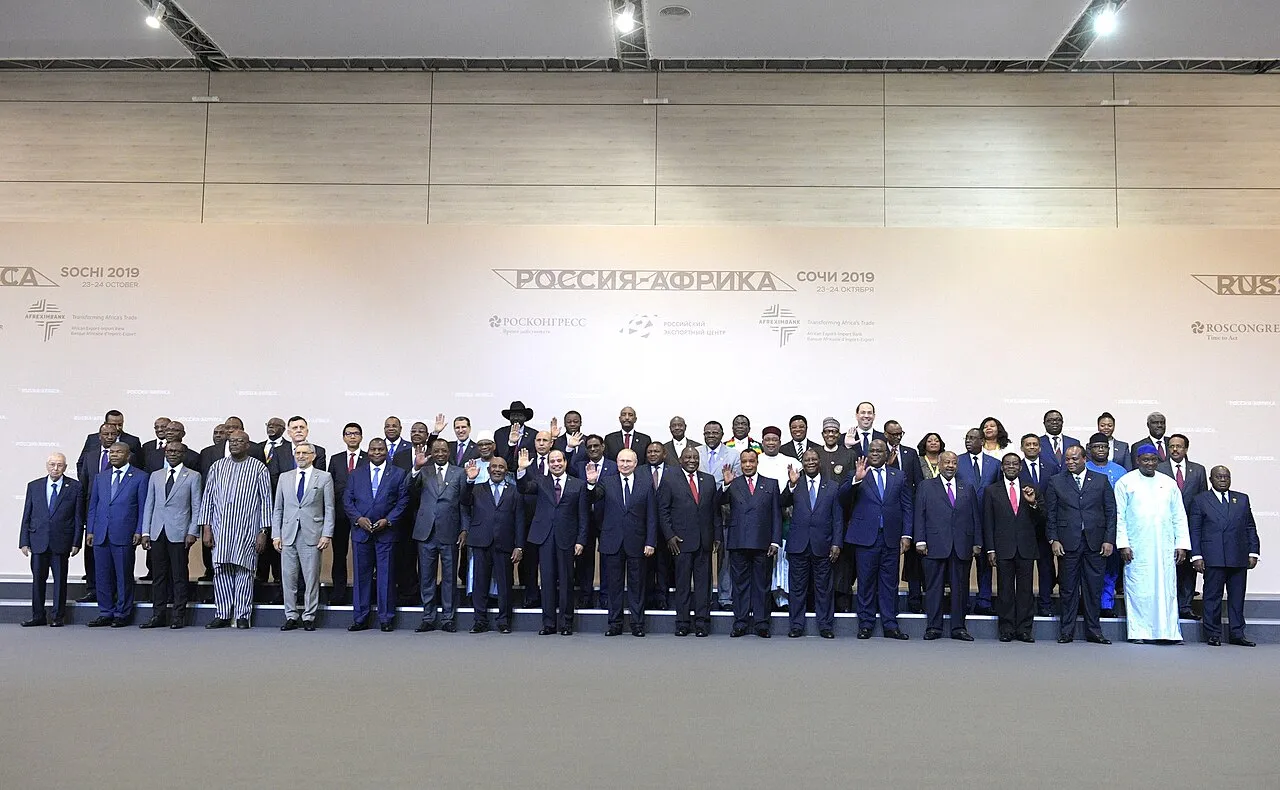
The third Russia-Africa Summit closes on Thursday in Moscow with delegations from 48 of Africa's 54 countries, 22 of them led by a president or head of government. The two-day meeting opened on Wednesday with an Economic and Humanitarian Forum, and participants are expected to adopt a partnership action plan covering 2027 to 2029.
The figure the host kept returning to was a commercial one. Russian President Vladimir Putin said trade between Russia and African countries could "exceed $50 billion in the near future". Last year's volume came in at just over $27 billion, against some $18 billion in 2022 — meaning the announced target requires a jump of roughly 85% from the current level, after a rise of about 50% over three years. Putin set no deadline.
Grain, fertiliser and local processing
The most concrete part of the Russian offer is agricultural. According to Putin, Russia exported 13 million tonnes of agricultural goods to Africa in the first nine months of this year, and more than 40 countries on the continent already receive Russian grain and fertiliser — supply Moscow says it is willing to expand.
The Russian president also said his country is ready to share technology, including digital know-how, and to process African raw materials inside Africa itself, which he argued would create jobs and tax revenue in the countries of origin instead of shipping out unrefined ore. Around 40,000 Africans currently study at Russian universities.
On the political side, Putin called for African countries to carry more weight at the International Monetary Fund (IMF) and the World Bank, and offered to take part in joint transport and agricultural infrastructure projects.
The case against the West
The opening speech was built against what Putin called the "colonial" West, which he accused of trying to exploit the continent's resources and of using debt to hold back African development. He named no countries. Russia's presence, he said, does not involve "predatory neocolonial exploitation" of natural and human resources.
Western governments make the opposite charge: that Russian paramilitary forces prop up military juntas on the continent — Mali is the most frequently cited case — to widen Moscow's influence and push out former colonial powers, France among them. Russia denies it.
Who came, and what the summit is for
Burundi's president, Évariste Ndayishimiye, spoke on behalf of the African Union. Egypt's president, Abdel Fattah al-Sisi, arrived in Moscow on Wednesday and addressed Thursday's plenary session, with a bilateral meeting with Putin on the agenda.
This is the third summit in the format, created in 2019 with a meeting in Sochi and repeated in 2023 in St Petersburg. For Moscow it serves a purpose beyond trade: showing that the country still holds wide-ranging talks outside the West, almost five years after the start of the war in Ukraine and the sanctions that followed.
With information from Reuters, CNBC Africa, SABC/Channel Africa and Daily News Egypt.