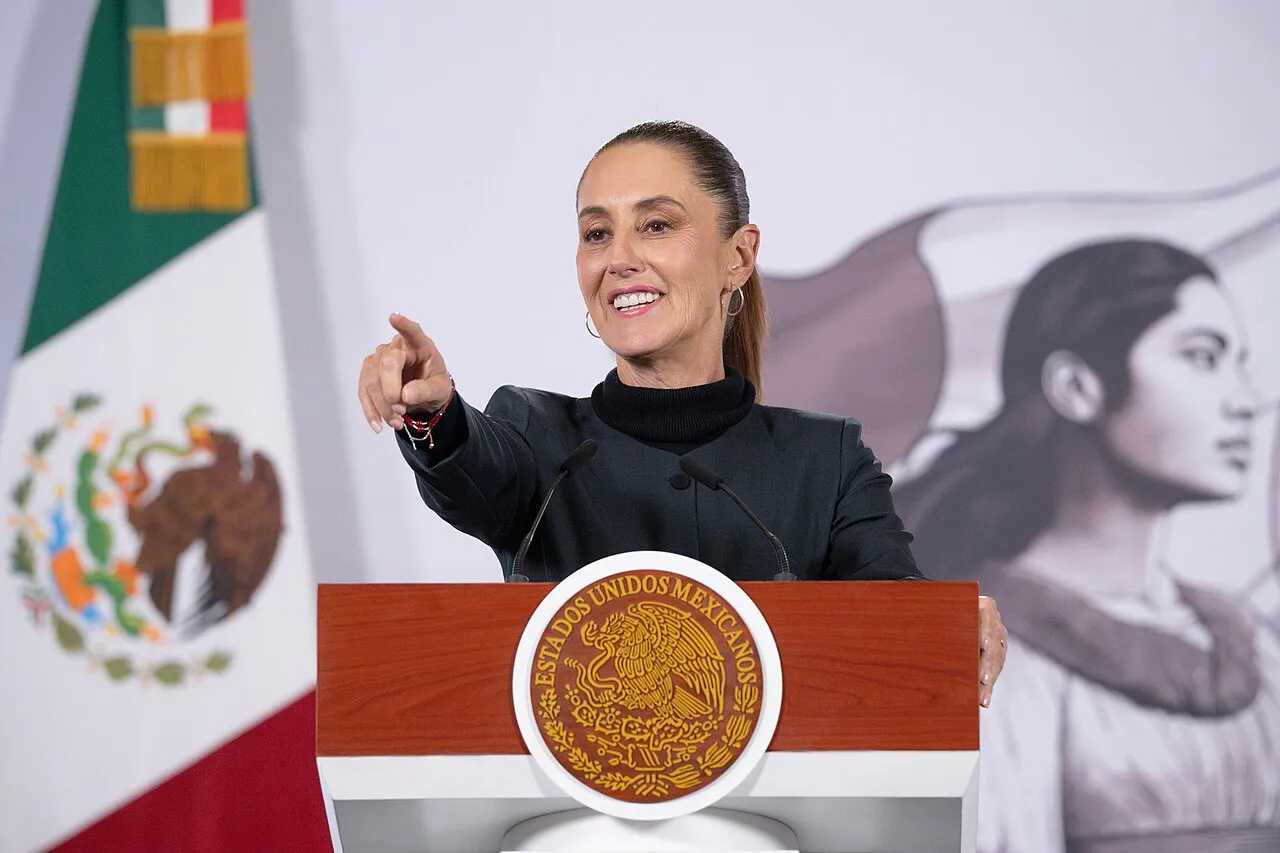
Mexican President Claudia Sheinbaum announced on 13 October a pipeline of public and mixed investment worth 8.4 trillion pesos (MXN) in infrastructure over the next four years. She did so at the 50th anniversary celebration of the Consejo Coordinador Empresarial (CCE, Mexico's main business association), before private-sector leaders.
"It's not for nothing, but it has never been seen before in a six-year term," the president said of the figure. Sheinbaum made clear that the amount excludes the private investment her government hopes to attract through incentives and faster permitting: "And that's without counting all the private investment you have."
Where the money would go
The amounts reported by project, in Mexican pesos:
| Destination | Amount |
|---|---|
| Viviendas para el Bienestar (housing programme) | 3 trillion |
| Pemex strategic plan | 2 trillion |
| Power generation | 794.109 billion |
| Passenger rail, Tren Maya freight line and Tren Interoceánico | 886 billion |
| Road network | 700 billion |
| Strategic water projects | 180 billion |
| Gas pipeline network | 140.905 billion |
Housing is the largest single line: 3 trillion pesos for 12 million housing actions over four years, with private developers taking part. The pipeline also includes ports, petrochemicals, fertilisers and a supercomputer. The Pemex and power-generation allocations would be carried out under public and mixed schemes, and the government has not said what share comes from public funds and what share from private capital.
The context: tariffs and a slowdown
The announcement lands with the Mexican economy growing at low rates. The IMF, in the report it released on 13 October, projects Mexico growing 1.5% in 2026 — an upward revision of three tenths of a point, sustained by exports — and 1.8% in 2027. The government is presenting the infrastructure and housing pipeline as a way to offset the slowdown tied to US tariffs.
Tax regularisation in the Ley de Ingresos
Sheinbaum also announced that the Ley de Ingresos (Mexico's annual revenue law) will include, for next year, a tax regularisation programme: taxpayers will be able to settle arrears with no fines and no surcharges, regardless of the amount. "Next year it can be paid with no fine, no surcharge. At any amount," she said. The president also committed to reducing the public deficit "responsibly."
At the same event she praised the work of Economy Secretary Marcelo Ebrard in his dialogue with the private sector, and the role of the US ambassador to Mexico, Ronald Johnson, in bilateral negotiations.
With information from Expansión and La Razón de México.