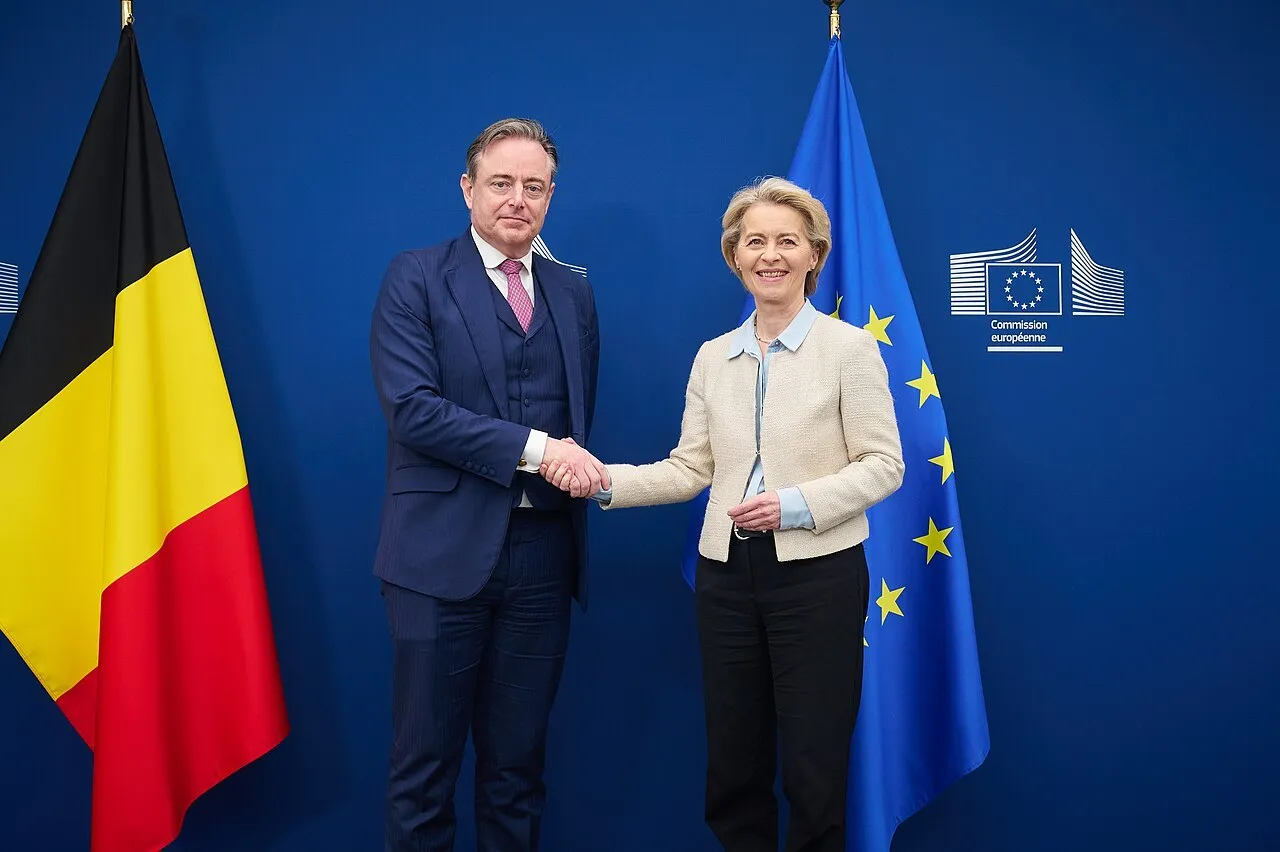
Belgian Prime Minister Bart De Wever was received in audience by King Philippe on Monday morning and handed in his government's resignation, after an overnight session of the inner cabinet ended without agreement on the 2027 federal budget. The audience was set for 9:30 am in Brussels, according to public broadcaster VRT.
The king did not answer at once. In a statement, the royal palace said Philippe "reserves the right to make a decision", regretted that "no agreement has been reached on a credible budget" and said the country "cannot afford a prolonged political crisis". Consultations with the leaders of the majority parties begin on Tuesday.
It is the same route taken last year, when the Belgian budget also stalled: the king held off rather than accepting the resignation, and the government carried on negotiating.
Ten billion euros, and a fight over where they come from
De Wever's coalition, nicknamed "Arizona" in the Belgian press, has five parties: the N-VA, the Flemish nationalists he himself led for close to two decades; Vooruit, the Flemish socialists; CD&V, the Flemish Christian democrats; the MR, the French-speaking liberals; and Les Engagés, the French-speaking centrists.
The adjustment at stake is about €10 billion in fiscal consolidation by 2029, the amount the government reckons it needs to stay within the European Union's fiscal rules. The fault line is not the size of the number but where it comes from: Vooruit, CD&V and Les Engagés want more tax on larger fortunes — on the "broader shoulders", in the phrase that circulates in the Belgian debate — while the N-VA and the MR refuse.
"The level of taxation on the table remains far too high," said Deputy Prime Minister David Clarinval, of the MR, who also argued that "refusing to implement concrete reforms to reduce public spending condemns the country to an ever-increasing deficit." On the other side, CD&V said "our country has no time to lose" and called for talks to resume at once, warning that a government crisis "would risk creating new ones". Foreign Minister Maxime Prévot, of Les Engagés, summed up the deadlock by saying that listing every point of disagreement would take "an eternity".
It is the second year in a row that the Belgian budget has gone to the wire. In 2025 the government was chasing the same order of magnitude and settled on €9.2 billion on 24 November — weeks past the deadline.
The highest deficit in the eurozone
The arithmetic behind the fight is among the worst in the single-currency bloc. Belgium's deficit came in at 5.2% of GDP last year, the highest in the eurozone according to the Brussels Times, against the 3% ceiling in the European rules. Public debt is above €735 billion and tops 110% of GDP this year; within the bloc, only France (116%), Italy (137%) and Greece (146%) are higher. The European reference value is 60%.
The deadlock already carries a price: the yield demanded on Belgian bonds rose during the talks, which makes rolling over precisely the debt the adjustment is meant to contain more expensive. It is the effect the government describes as a snowball — having to borrow in order to pay interest.
What happens now
If Philippe accepts the resignation, the government falls and stays on in a caretaker role. In principle a new majority could be assembled in the same parliament, without an early election, according to VRT; part of the Belgian press, such as Euronews, is working on the assumption that elections would be called.
With no budget approved, Belgium moves to the regime of provisional twelfths, under which each month of 2027 repeats the spending and revenue of the corresponding month of 2026. De Wever has said he does not want that outcome, because it freezes spending in the old design and, in practice, rules out the very adjustment that brought the talks down.
With information from VRT, the Brussels Times, Euronews and Il Sole 24 Ore, which cites the Belga news agency.