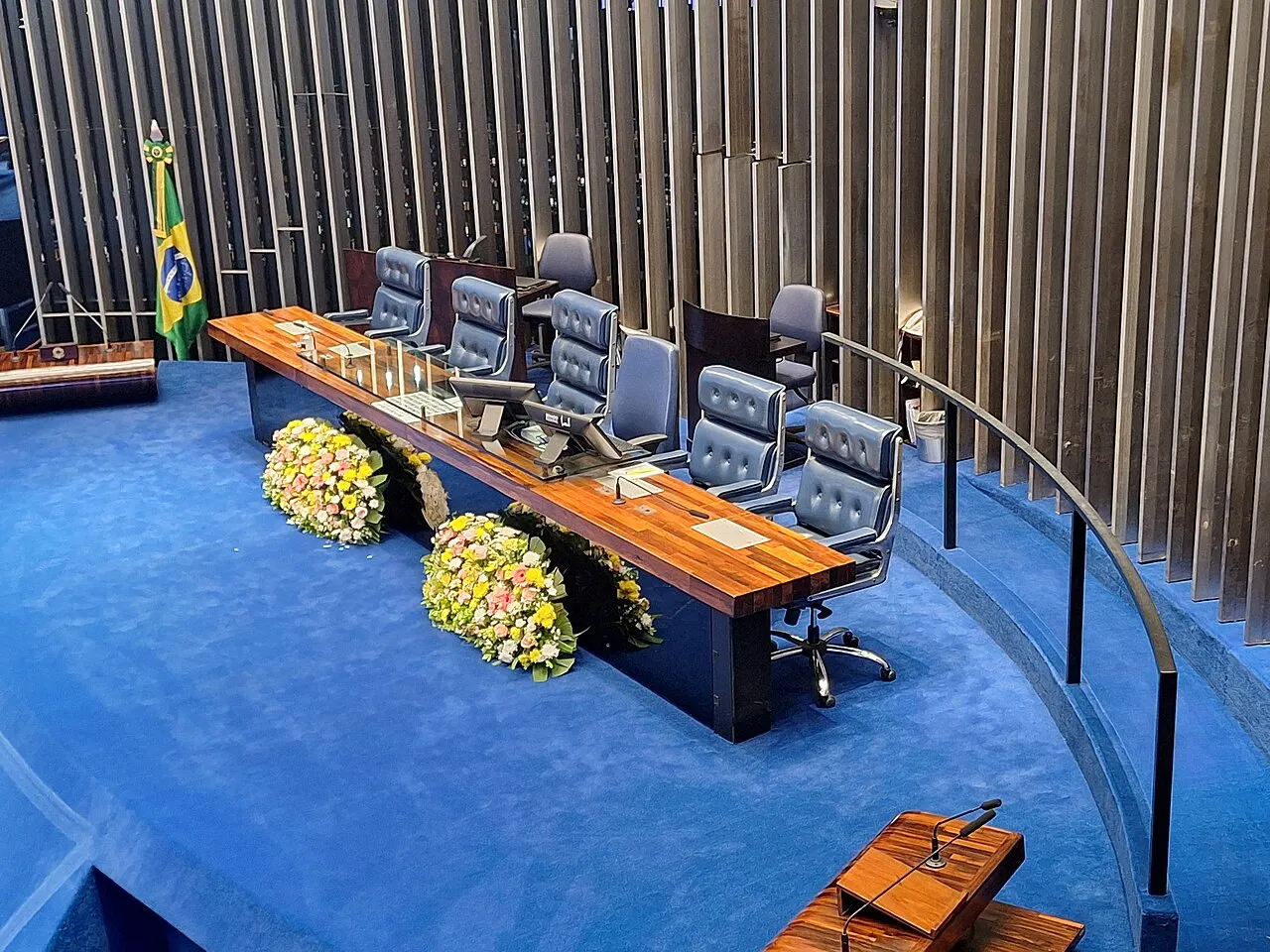
Brazil's Senate approved on Tuesday night a constitutional amendment on public security, sent by the executive in 2025, and left the lowering of the age of criminal responsibility out of the text. The proposal took 73 votes in the first round and 75 in the second — 49 were needed in each — and now goes to promulgation, without having to return to the Câmara dos Deputados (Chamber of Deputies).
Removing the age of criminal responsibility from the text was the night's narrowest vote: it passed 38 to 36.
What the amendment changes
PEC 18/2025 writes into the Constitution the Sistema Único de Segurança Pública (Susp, the country's unified public-security system), which today exists only in ordinary law, and widens the federal government's role in coordinating the sector. It also redistributes responsibilities among the federal government, the states and the municipalities, and creates a Sistema de Políticas Penais (penal policy system).
Among the approved provisions:
- Municipal police. Municipalities are authorised to create their own forces, subject to training, financial-capacity and oversight criteria.
- Federal highway police. The Polícia Rodoviária Federal's remit now reaches federal railways and waterways, not only highways.
- Gangs and militias. The text calls for punishment proportional to each member's rank within criminal gangs, militias and paramilitary organisations, with sentences served in maximum-security prisons, restrictions on parole and benefits, asset forfeiture, and liability for companies tied to those groups.
- Whistleblowers and victims. Protection is widened for those who report crimes and for their families, and victims' rights are guaranteed, with specific attention to women.
- Money. The amendment shields the Fundo Nacional de Segurança Pública (FNSP, the national public-security fund), the Fundo Penitenciário Nacional (Funpen, the national prison fund) and the Funapol from being frozen or diverted, and earmarks for security 10% of the surplus of the Fundo Social, the sovereign fund fed by pre-salt oil revenue.
An amendment by Senator Carlos Portinho (PL-RJ) was accepted, allowing the armed forces to be reimbursed from FNSP money when they take part in law-and-order operations.
Two items fell away. Earmarking 10% to 30% of betting revenue for public security had already been cut in the constitution and justice committee. And amendments on forensic police were rejected, because the subject is already moving through a separate proposal, PEC 76/2019.
The age of criminal responsibility, postponed again
Lowering the age was not in the government's original proposal. It arrived through two amendments: one from opposition leader Rogerio Marinho (PL-RN), dropping the age to 16 as a general rule and to 14 for heinous crimes, torture, drug trafficking, terrorism and membership of a criminal organisation; and one from Workers' Party leader Camilo Santana (PT-CE), limited to heinous crimes.
The rapporteur, Senator Rogério Carvalho (PT-SE), treated both as extraneous matter and proposed that they proceed as parallel constitutional amendments. Rejecting other changes, he argued, avoided sending the proposal back to the Chamber of Deputies, which would "delay meeting the Brazilian people's pressing needs".
The opposition pushed back. Marinho said the split left the floor "curtailed", and Efraim Filho (PL-PB) called it "inadmissible" to take from senators the right to vote on the amendments. Marcelo Castro (MDB-PI), who had argued for exactly this route at the leaders' meeting earlier in the day, said he saw "a consensus to lower the age of criminal responsibility, at least to 16".
The parallel amendments will not pass through the constitution and justice committee: the Senate's secretariat is waiting for a request for a special calendar, and Senate President Davi Alcolumbre (União-AP) promised to move the votes along quickly. In the Chamber of Deputies, a special committee set up in August is also examining the question.
The 38-to-36 margin on the split shows the real size of the dispute: the main amendment passed comfortably because the age question had been taken out of it. Standing alone, the two proposals face the same 49-vote threshold without the shelter of a text that the government and much of the opposition both wanted passed.
With information from Agência Senado and the newspaper O Tempo.