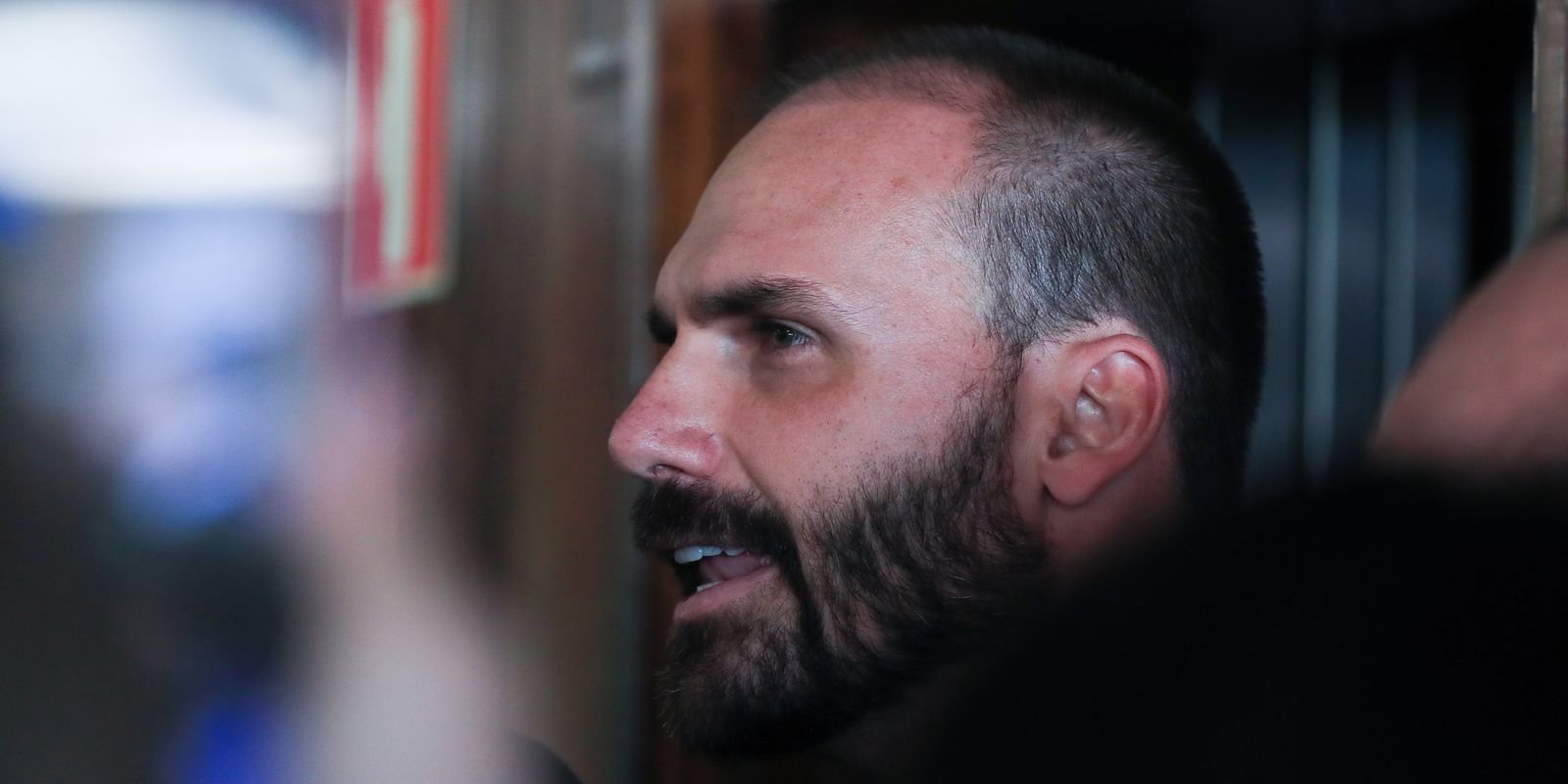
The First Panel of the Supremo Tribunal Federal (STF, Brazil's supreme court) has upheld the conviction of former congressman Eduardo Bolsonaro, who was sentenced to four years and two months in prison for coercion in judicial proceedings. The virtual session opened last week and closed on Friday, with all four voting justices siding against him.
At issue were embargos de declaração, a Brazilian appeal filed against the ruling that convicted him in June of this year in Criminal Case 2782.
An appeal that cannot reopen the merits
Embargos de declaração are not a vehicle for relitigating a conviction. They exist to flag an omission, a contradiction, an obscure passage or a clerical error in what the court decided. That is where the appeal failed: Justice Alexandre de Moraes, the case's rapporteur, concluded that the ruling contained none of those defects and that the panel had described the defendant's conduct precisely, matching it to the elements of the offence.
Justices Flávio Dino, Cármen Lúcia and Cristiano Zanin followed him. There was no dissent.
According to the Brazilian legal outlet ConJur, the sentence was set to begin in a semi-open regime. The offence is defined in Article 344 of Brazil's penal code, which punishes the use of violence or serious threats to advance one's own or another's interest in a judicial proceeding.
The conduct the court treated as a crime
The court found that Eduardo Bolsonaro worked in the United States to pressure Brazilian authorities and to build mechanisms of international pressure capable of interfering with the cases then running against his father, former president Jair Bolsonaro — among them the coup-plot prosecution.
It identified three strands of that effort: the sweeping US tariffs on Brazilian exports, known in Brazil as the tarifaço; the revocation of officials' visas; and the use of sanctions under the Magnitsky Act.
His seat was already gone
The loss of his seat in the Câmara dos Deputados (Chamber of Deputies) came before the conviction: the chamber voted to strip him of his mandate in December 2025. The criminal sentence therefore falls on someone who no longer holds elected office.
The election calendar around it
The ruling was finalised a little more than two weeks before the first round of October's elections, at a moment when the Bolsonaro name remains central to the presidential race. The session, however, dealt strictly with the criminal appeal, and the court made no findings about electoral consequences.
Neither the published decision nor the reporting consulted indicates whether any further appeal remains available or whether the conviction is now final.
With information from Agência Brasil and ConJur.