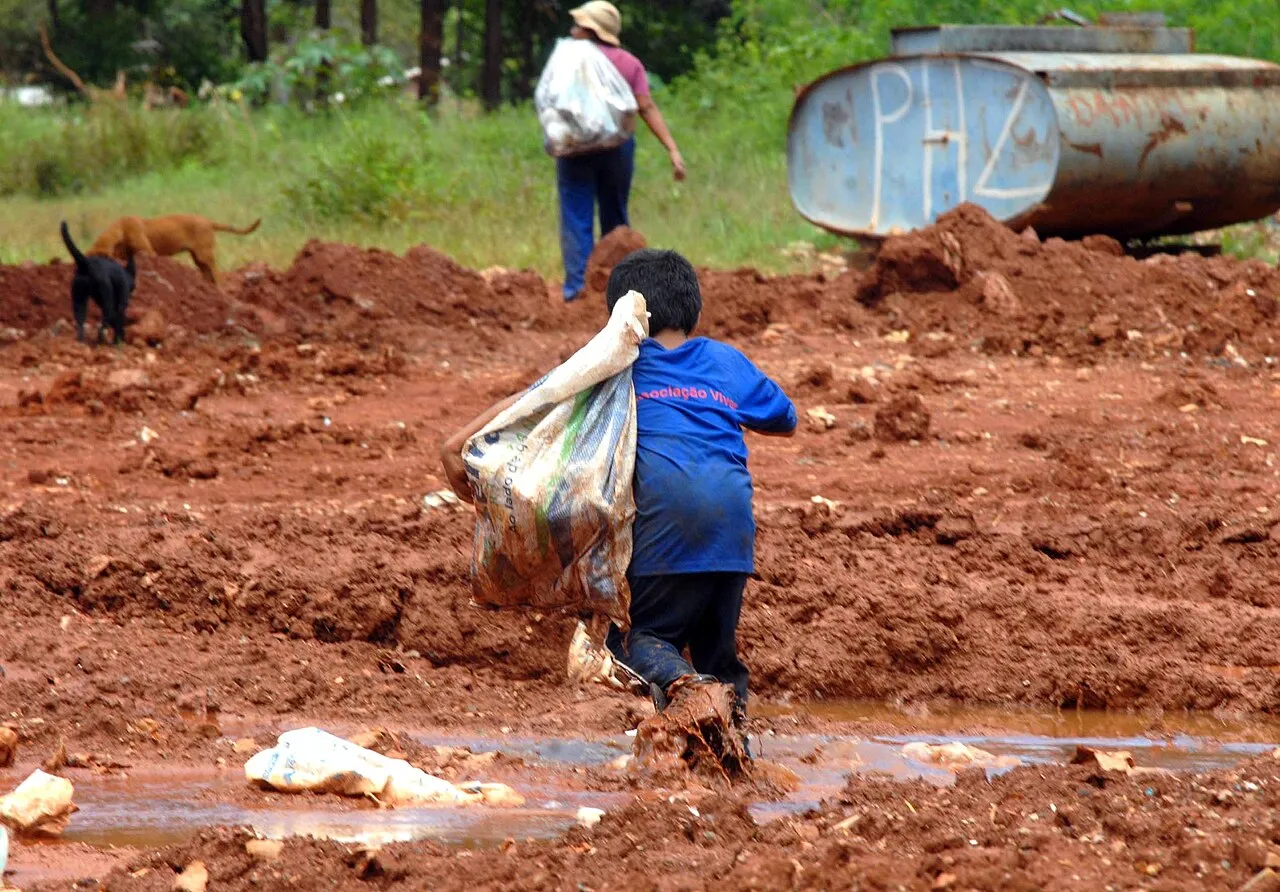
Brazil had 1.499 million children and adolescents aged 5 to 17 in child labour in 2025, equivalent to 4% of everyone in that age bracket. The figure is 9.2% lower than in 2024, when it stood at 1.65 million, and the lowest since the start of the Pesquisa Nacional por Amostra de Domicílios Contínua (Continuous National Household Sample Survey, known as the Pnad Contínua) module devoted to the subject. The data were released by the IBGE (Brazil's national statistics institute) on Friday.
Measured over a longer span, the decline is 28.6% against 2016, when the institute counted 2.1 million children and adolescents working — 5.2% of the age group. The path was not a straight line: a 15.7% fall between 2016 and 2019, a 7% rise in 2022, a further 14.7% drop through 2023, and a 2.1% increase in 2024, reversed last year.
Of the 2025 total, 1.141 million were engaged in economic activity and 358,000 worked only in production for their own consumption.
Age is the dividing line
Incidence climbs sharply as age rises. Among children aged 5 to 13, 280,000 were in child labour — 1.1% of the group. In the 14-to-15 bracket, where work is permitted only under an apprenticeship, the figure was 348,000, or 5.9%. Among adolescents aged 16 and 17, for whom work is allowed with restrictions, the number reaches 871,000, or 14.5%.
Average monthly earnings for those in child labour were R$ 936. The hours are not light either: 36.3% worked more than 25 hours a week and 21.4% put in 40 hours or more.
Worst forms at their lowest measured level
The survey's most sensitive cut covers what are called the worst forms of child labour, defined in the Lista TIP of Decree 6,481 of 2008 — activities considered hazardous or unhealthy and prohibited for anyone under 18. In 2025 there were 525,000 children and adolescents in that condition, the lowest figure in the series. In 2024 it was 560,000; in 2022, 763,000; and in 2016, 919,000.
Who they are
The distribution is uneven. The Southeast holds the largest absolute number, 481,000, but has the country's lowest rate at 3.3%. The North records the highest rate, 6.3%. The Northeast, with 408,000, saw the sharpest decline over the longer period.
Boys account for 65.4% of the total, although they make up 51.2% of the population aged 5 to 17. Between 2024 and 2025, child labour fell 10% among boys and 7.5% among girls. By colour or race, the rate was 3.2% among white children and adolescents and 4.4% among Black and mixed-race (pretos e pardos) children and adolescents.
Commerce held the largest share of those in economic activity, 29%, followed by other activities (23.1%), agriculture and livestock (16.7%), general industry (12.5%), accommodation and food services (12.2%) and domestic services (6.5%). Among 16- and 17-year-olds, informality stood at 67%, also a series low — it was 69.4% in 2024 and 76.3% in 2022.
The cost at school
School attendance is where the cost shows most clearly. Among 16- and 17-year-olds in child labour, 79.6% were attending school, against 89.6% of all adolescents that age. In the 14-to-15 bracket the gap is narrower but present: 95% against 98.1%.
Bolsa Família
In households covered by the Bolsa Família cash-transfer programme, 573,000 children and adolescents were in child labour, 4.4% of the group — above the national average of 4%, but down 20.1% in a single year, faster than the country as a whole. For the IBGE, the result reflects the population the programme targets.
"We see a sharper reduction in child labour among the programme's beneficiaries," said Gustavo Fontes, an analyst at the IBGE, commenting on the figures.
Average income per person in beneficiary households was R$ 660, against R$ 1,990 in households that do not receive the benefit.
The survey also measured, separately, unpaid domestic work and caregiving — which do not fall under the definition of child labour. On that count, 15.9 million children and adolescents, or 42.1% of the 37.8 million in the 5-to-17 bracket, performed such tasks: 47.9% of girls and 36.6% of boys.
With information from the IBGE and Agência Brasil.