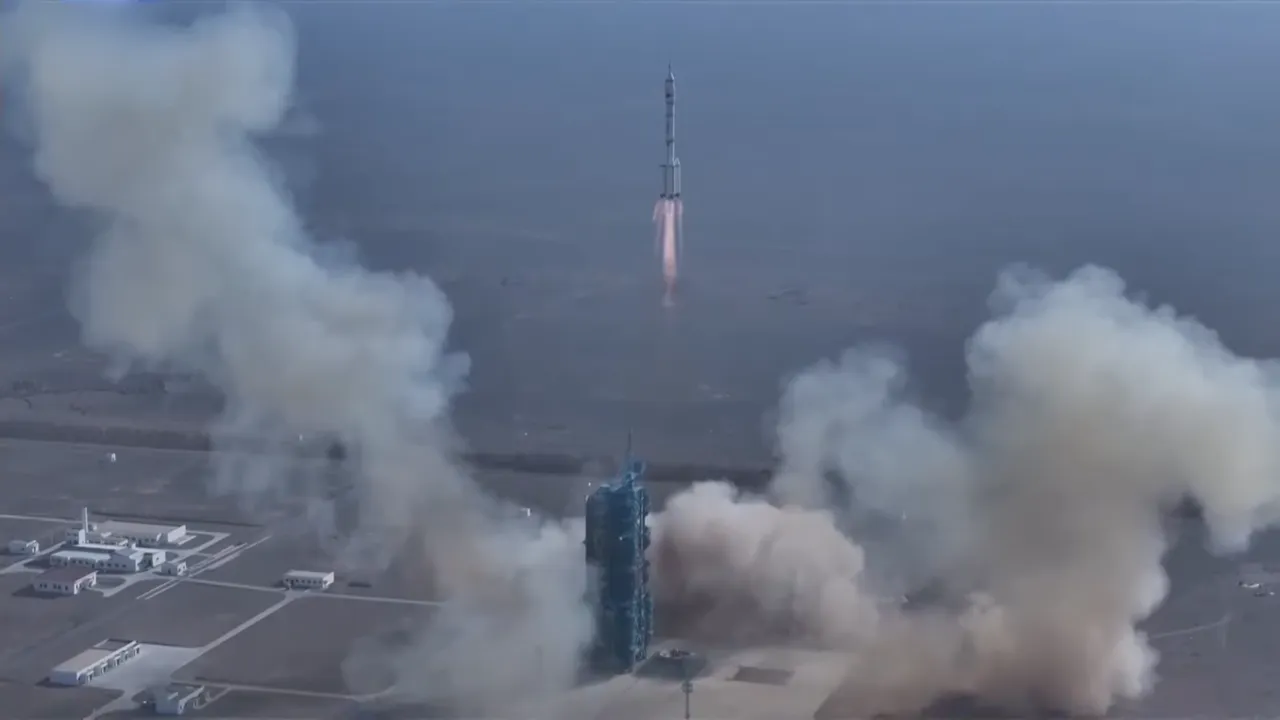
China's Shenzhou-24 spacecraft lifted off on Wednesday morning from the Jiuquan Satellite Launch Centre in Gansu province, in the country's northwest, carrying the first Pakistani astronaut in history. Muhammad Zeeshan Ali, 40, flew as payload specialist and also became the first foreign national to board China's Tiangong space station.
The Long March 2F rocket rose at 8:18 a.m. Beijing time — 5:18 a.m. in Islamabad. About ten minutes later the spacecraft separated from the launcher, and docking with Tiangong was completed 3 hours and 38 minutes after liftoff, according to the China Manned Space Agency (CMSA), cited by the Pakistani newspaper Dawn.
Who is on board
The crew is commanded by Tang Hongbo, 51, with Wu Yi as mission pilot on his first spaceflight. Ali is the third member.
"Pakistani astronaut Mohammad Zeeshan Ali is the first foreign national to visit Tiangong", CMSA spokesperson Zhang Jingbo said at a news conference on the eve of the launch. The crew, he added, "is in good condition and the space station is functioning normally".
Ali stays about a week in orbit and returns to Earth aboard the Shenzhou-23 spacecraft with Lai Ka-ying — Hong Kong's first astronaut — and Zhang Zhiyuan, both 40. Shenzhou-23 commander Zhu Yangzhu remains on board for roughly a year, in what will be the first twelve-month stay in orbit by a Chinese astronaut. During the handover, Tiangong can host up to six people.
Seven months of training and 90 experiments
Ali and Khurram Daud were selected in April to begin training in China under a cooperation agreement signed in February 2025 between Suparco, Pakistan's space agency, and the CMSA. A programme planned for one year was compressed into seven months. In a video released by the Chinese embassy, Ali said the "real challenge" was mastering Chinese.
The crew is to carry out about 90 experiments and tests, according to the CMSA. Suparco said Ali will grow microalgae — a candidate source of food and oxygen on long flights — and test the effects of spaceflight on quinoa seeds.
"This mission is not a finish line; it is a launch pad", Ali said at a news briefing in Jiayuguan the day before.
The political message
It is the first time China has opened its station to an astronaut from another country, in a programme from which US law has excluded Beijing since 2011. In a letter to Pakistani President Asif Ali Zardari released by Pakistan's presidency, Xi Jinping described the Chinese station as "an ark of peace, friendship and cooperation".
Pakistan's Planning Minister, Ahsan Iqbal, celebrated the flight on social media and said Ali and Daud had been "chosen from among Pakistan's finest pilots and scientists".
China aims to land astronauts on the Moon before 2030. NASA is working towards 2028 for a crewed return to the lunar surface.
With information from Dawn and the China Manned Space Agency (CMSA).