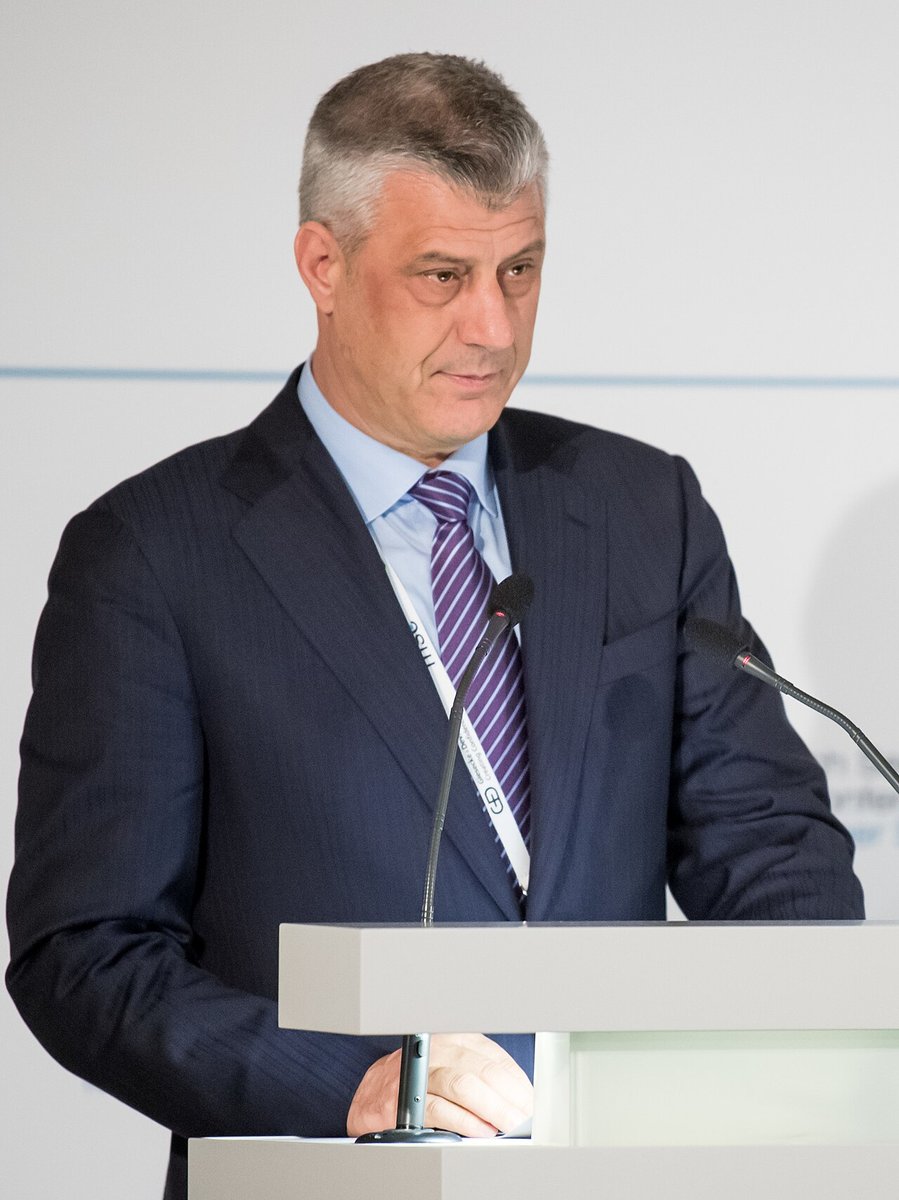
Former Kosovo president Hashim Thaçi was sentenced on Wednesday (Sept. 16) to 25 years in prison for war crimes committed during the conflict with Serbia in the late 1990s. The sentence was handed down in The Hague by the Kosovo Specialist Chambers, an EU-backed court that is part of Kosovo's judicial system but sits outside the country.
Thaçi, 58, was the top political commander of the Kosovo Liberation Army (KLA) during the war. He listened to the ruling in silence and denies all charges. He stepped down as president in November 2020, when the indictment was confirmed, and has been held in detention awaiting trial since.
Four convicted, different sentences
The trial involved four former guerrilla leaders. All were found guilty of the same four counts of war crimes:
- illegal or arbitrary detention of at least 385 people;
- torture of 303 people;
- cruel treatment of 49 people;
- murder of 96 people.
The sentences:
| Convicted | Post-war role | Sentence |
|---|---|---|
| Hashim Thaçi | former president and prime minister | 25 years |
| Jakup Krasniqi | former speaker of parliament | 25 years |
| Kadri Veseli | former speaker of parliament | 18 years |
| Rexhep Selimi | former KLA commander and MP | 13 years |
Time already served will be deducted. Prosecutors had sought 45 years for all four.
According to the judgment summary released by the court, the crimes took place between April 1998 and June 20, 1999, at KLA-run detention sites in 14 municipalities in Kosovo and in northern Albania. The victims were people seen as political opponents or as collaborators with Serbian security forces. The three-judge panel, presided over by American judge Charles Smith, found that the four accused shared a criminal purpose of targeting, detaining and eliminating those opponents.
Acquitted of crimes against humanity
All four were acquitted of the six counts of crimes against humanity, including persecution and enforced disappearance. The judges said the prosecution had failed to prove beyond reasonable doubt that the attacks were directed against a civilian population — a requirement for that category of crime.
The distinction matters: the ruling recognises serious individual crimes but does not characterise the guerrilla's conduct as a systematic attack on civilians. This is a first-instance judgment and can be appealed.
Opposite reactions in Pristina and Belgrade
In Kosovo, where former KLA commanders are regarded by much of the population as heroes of independence, thousands gathered in Pristina's central square the weekend before the verdict, carrying Albanian flags and portraits of the defendants. Prime Minister Albin Kurti said that "the first-instance verdict must be amended," according to European Western Balkans.
In Serbia, Deputy Prime Minister Ivica Dačić said the ruling confirms that "the so-called KLA was a criminal and terrorist organization," Kosovo Online reported.
The Kosovo war left about 13,000 people dead, most of them ethnic Albanians, and ended in 1999 after a 78-day NATO bombing campaign against what was then Yugoslavia. Kosovo declared independence in 2008, which Serbia still does not recognise. Thaçi also faces a separate case for alleged witness intimidation.
Reporting drew on the Kosovo Specialist Chambers (judgment summary), the Associated Press, Al Jazeera, European Western Balkans and Kosovo Online.