Iran's Islamic Revolutionary Guard Corps said it launched six drones at a US air-defence radar at Riffa Air Base in Bahrain in the early hours of Sunday. The claim was carried by Fars, the news agency affiliated with the corps. It is the second time in three days that the Guard has said it hit an American radar in the kingdom — and the resumption of an offensive that had been dormant for about two months.
There is no independent confirmation that the radar was hit, and no casualties have been reported.
What was heard in Manama
Bahrain's Interior Ministry issued two alerts about three hours apart. The first came at around 4.30am local time (1.30am GMT) and spoke of a "potential threat", urging residents to remain calm and to "proceed to the nearest safe location", without saying where the risk came from.
Agence France-Presse reported explosions at around 4am and a second series at around 6.30am, accompanied by sirens.
Bahrain's armed forces then said their air-defence systems had thwarted several Iranian "aerial attacks" before they reached their targets, accusing Tehran of a "systematic hostile approach" towards the kingdom. The foreign ministry rejected any attempt to turn the country into an "arena for settling scores" and held Iran fully responsible for the attacks and their consequences. Manama called for full implementation of United Nations Security Council Resolution 2817, which condemned Iranian attacks on the kingdom and other countries in the region and demanded that they stop.
Jordan, Egypt, Saudi Arabia and Qatar condemned the attack.
Friday's precedent
On 13 November, the Revolutionary Guard said it had destroyed a US early-warning radar in Bahrain in retaliation for an air strike on a telecommunications tower in southern Iran. US Central Command (CENTCOM) denied it, saying it had shot down two Iranian drones with no injuries or damage. In a statement carried by the Tasnim agency, the corps called the operation a "serious warning".
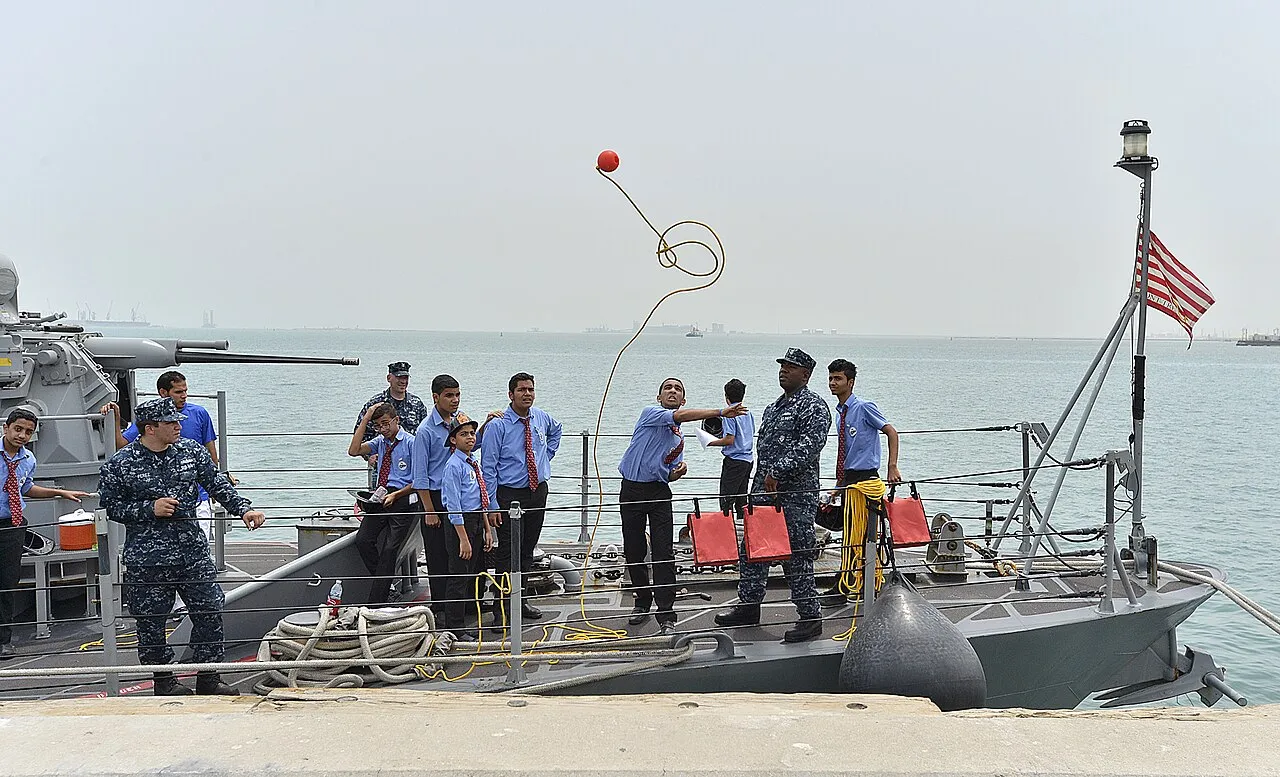
Bahrain is home to the US Navy's Fifth Fleet. A Pentagon inspector general report released in September found that Iranian attacks had damaged or destroyed buildings at American installations in eight countries, Bahrain among them, in the first four months of the war — which began on 28 February with US and Israeli strikes on Iran.
Hormuz and the board around it
The Revolutionary Guard also said the Strait of Hormuz remains closed and that American escorts for shipping had failed. On Saturday, the corps' navy said two oil tankers had struck sea mines while trying to cross the strait on an "unauthorised" route with their trackers switched off; two others are said to have turned back after warnings.
The same Sunday, the Saudi-led coalition said it had intercepted two ballistic missiles aimed at Riyadh and three drones over the Eastern Province, and later four drones over Mecca and Medina — seven in all that day. Houthi spokesman Yahya Saree called the account "a lie and a fabrication".
The New York Times, citing a US military official, reported that the aircraft carrier USS Theodore Roosevelt is due to join two others in the Middle East, bringing to three the number of carrier strike groups in the region. Neither the Pentagon nor CENTCOM has confirmed the timing.
The seven conditions
Talks remain stalled. Iran's parliamentary speaker and chief negotiator, Mohammad Bagher Ghalibaf, told Al Jazeera that Tehran wants to move beyond a state of "no war, no peace" and said it had conveyed seven conditions through a Qatari mediator, awaiting an official American response. They include an end to the naval blockade, the lifting of sanctions, the release of frozen Iranian funds, an end to hostilities on all fronts and a formal declaration that the war is over.
The Trump administration has tightened sanctions and kept the blockade on Iranian ports. According to Reuters, the president told advisers he might refrain from further strikes if Iran and the Houthis avoid new provocations — but that the naval blockade stays. Iran's foreign minister arrived in Oman for talks.
"Both sides may prefer to avoid a full-scale war, but the danger lies in miscalculation," political scientist Saeid Golkar, of the University of Tennessee at Chattanooga, told Al Jazeera.
With information from Al Jazeera, Radio Free Europe/Radio Liberty and the Anadolu agency.