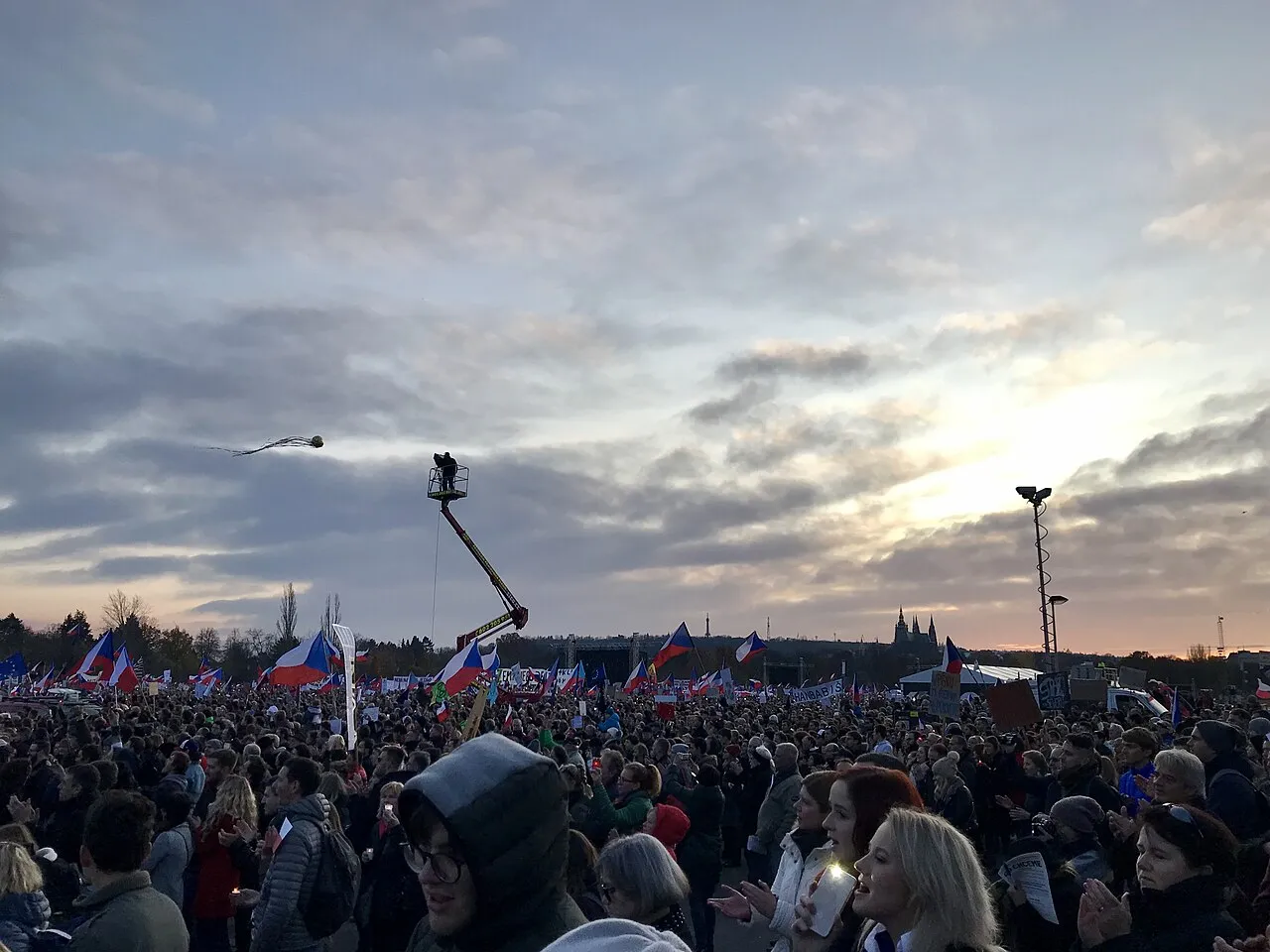
About 350,000 people gathered on the Letná plain in Prague on Sunday to demand that Andrej Babiš's government withdraw a bill changing how Czech Television and Czech Radio are funded. The figure is the organisers' estimate — no independent count was released — and, if confirmed, places the rally among the largest ever held in the country.
The site was not chosen at random. Letná is the ground where the crowds of the Velvet Revolution gathered in November 1989, bringing down more than forty years of communist rule. Sunday's protest came two days before the anniversary of those demonstrations.
What the bill changes
Czech public television and radio are currently funded by a licence fee paid by individuals, families and companies, together worth 205 koruna a month — about €8.39. The government's bill abolishes that charge and moves the cost to the state budget.
By the critics' arithmetic, the two broadcasters would receive about 15% less than they do now, opening the door to layoffs and cancelled programmes.
The heart of the dispute, though, is not the amount. It is who decides. With the money coming from the budget, the rally's organisers argue, the three-party coalition gains an annual instrument of pressure over newsrooms — something a fee collected directly from the public does not provide.
The 4.36am vote
The text passed the first of the three readings required in the Chamber of Deputies on 24 October, in a vote concluded at 4.36am after the opposition's speaking time was curtailed. Two readings remain.
Protests have been held in towns and cities across the country since then, and staff at Czech Television and Czech Radio went on strike on 3 November. The issue was also debated in the European Parliament last week.
What the government says
Babiš, a billionaire who returned as prime minister last year, says the plan will go ahead and denies that it threatens press freedom. In an op-ed answering what he called the opposition's "seven lies", he wrote that "under no circumstances will we interfere in editorial work" and dismissed the criticism as "hysterical outbursts". The prime minister says protesters are stirring up the public with unfounded claims.
His coalition brings together ANO, the right-wing Motorists for Themselves and the anti-migrant, pro-Russian Freedom and Direct Democracy. ANO still polls at about 30%.
The mirror argument
"We do witness here something extraordinary today," said Mikuláš Minář, lead organiser of the Million Moments for Democracy movement, which called the rally. In a statement, the group said that "Babiš and his government obviously think they will get away with anything."
The comparison protesters keep making is with the neighbours: Hungary, Poland, Serbia and Slovakia, where populist governments eroded the independence of public broadcasters. The European Broadcasting Union, the European Federation of Journalists, Reporters Without Borders and the International Press Institute have all criticised the Czech bill, likening it to steps taken by Slovak prime minister Robert Fico and former Hungarian premier Viktor Orbán.
European Justice Commissioner Michael McGrath said public service funding should rest on "transparent and objective criteria".
Minář closed the rally by saying Sunday was "just a beginning".
With information from the Irish Examiner (with the Associated Press and Agence France-Presse), the Lusa news agency and Democracy Now.