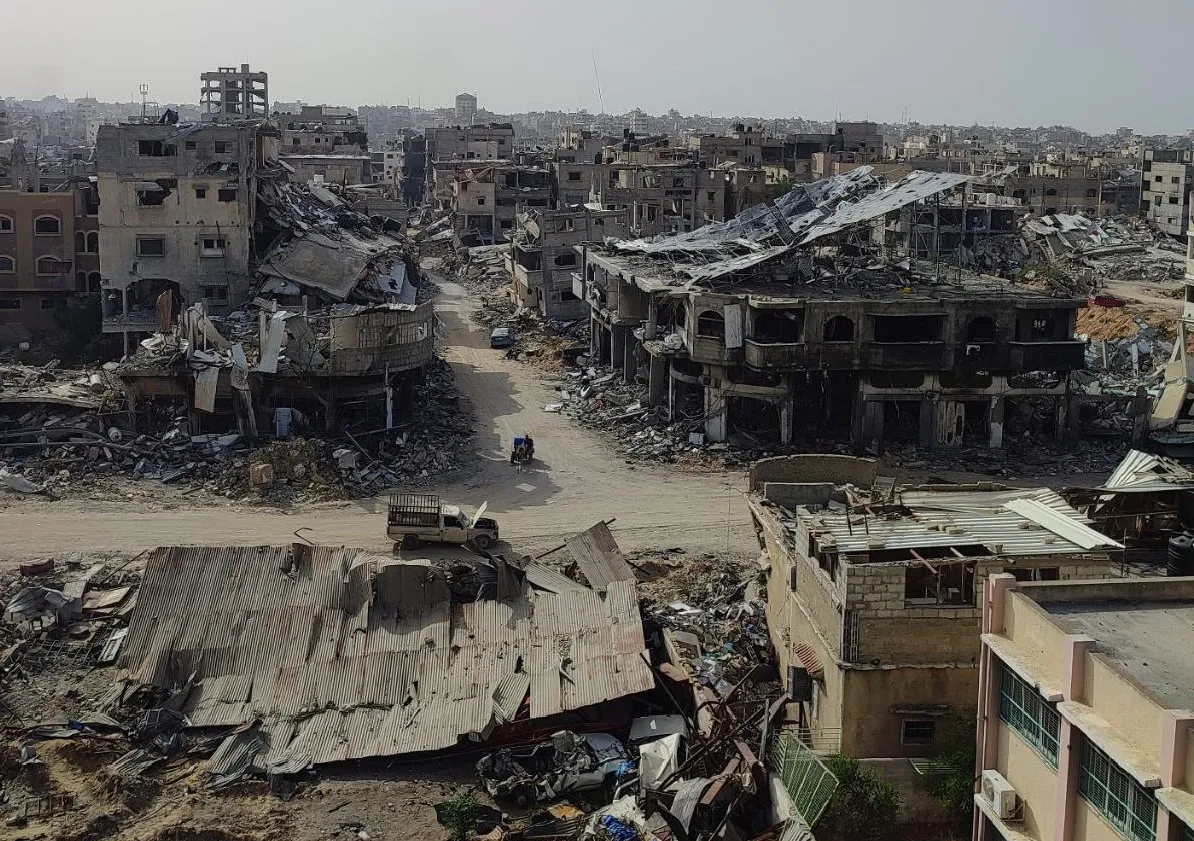
An Israeli air strike hit the Nasser medical complex in Khan Younis, in the southern Gaza Strip, in the early hours of Thursday, killing at least six people. At least 20 others were wounded, according to Palestinian health authorities and the local Civil Defence. The hospital's management said the death toll could rise.
Among the dead is surgeon Rizk Abu Shaira. The head of the hospital, Ahmed al-Farra, said he was killed while at work. Al Jazeera correspondent Hind Khoudary reported that most of the casualties were inpatients, including people due to undergo surgery the following day.
A missile that pierced several floors
The complex's director, Raed al-Dahshan, said the missile entered vertically and tore through several floors of the building. The surgery department and the intensive care unit were significantly damaged. Gaza's Civil Defence also identified the surgery department as the point of impact.
Nasser is the only hospital still operating in Khan Younis and serves an estimated population of at least 500,000 people in the south of the Strip. According to Al Jazeera, it was the seventh time in roughly two years that the complex has come under Israeli attack.
The military's account and the Palestinian response
The Israel Defense Forces said a "senior Hamas terrorist" and other fighters were using the hospital as a command centre, and named the target: Muhammad Abu Ismail, described by the military as overseeing one of the group's brigades and holding hostages. Israel added that it had used precision munitions and aerial surveillance to limit harm to civilians, and released audio of a warning sent to the health ministry. The evidence presented publicly amounted to graphics of the building.
Gaza's health ministry called the strike a serious violation of the international rules protecting medical facilities, and warned that attacks on hospitals worsen conditions for the sick and wounded. Hamas called the action a war crime and said the claim that its members were present served as a cover. Palestinian Islamic Jihad accused the United States government of giving Israel political and military cover.
A ceasefire that has not stopped the strikes
The episode adds to an almost daily sequence of attacks since the ceasefire agreed in October 2025. Gaza's health authorities count more than 1,600 dead since then, within a total that now exceeds 74,600 since the war began.
Talks on the next stage of the ceasefire are stuck on a question of sequence: Hamas conditions handing over weapons on an end to the strikes and an Israeli withdrawal, while Israel says it will only halt operations once the group disarms. Neither side will move first, and it is in that gap that the strikes continue.
Over the same period, the United Nations issued an emergency appeal for waterproof tents: heavy rains flooded at least 70,000 tents in the Strip. The organisation's humanitarian chief, Tom Fletcher, said restrictions on aid entering were "not an acceptable excuse" for the delays.
With information from Al Jazeera and ABC News (Australia).