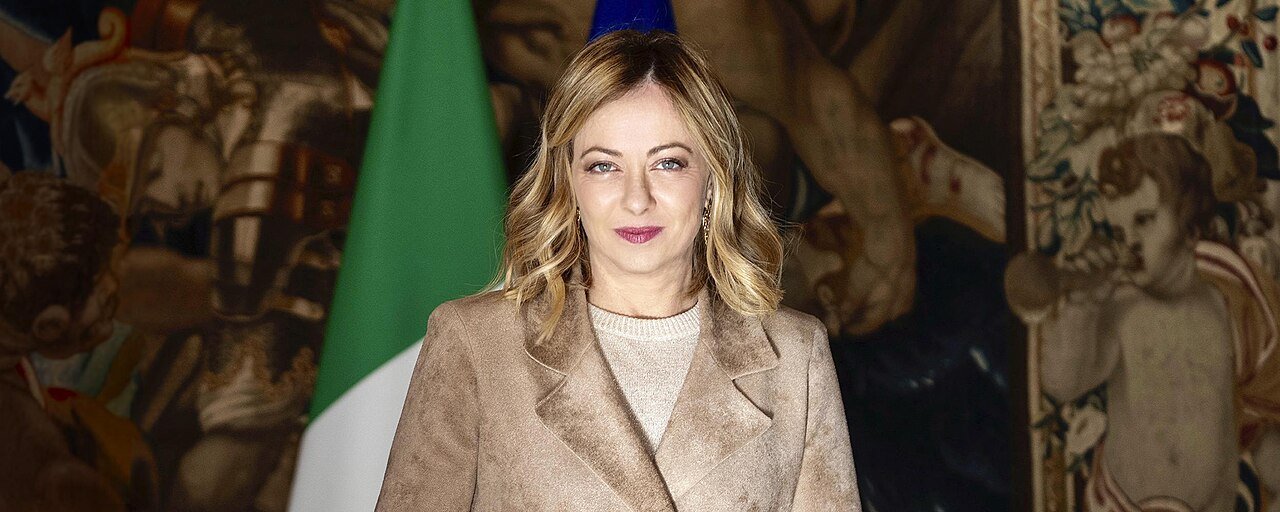
Italian Prime Minister Giorgia Meloni announced on Saturday that her government will take to the Council of Ministers a measure writing into law the maximum number of foreign pupils per class, banning the burqa and niqab in schools and requiring the parents of foreign pupils with serious integration difficulties to learn Italian. The announcement was made in Rome at Fenix, the youth festival of Fratelli d'Italia (Brothers of Italy), the prime minister's party.
What was announced
Meloni set out the package in a single sentence from the stage: about to go before the Council of Ministers, she said, is a measure that will set in law the maximum number of foreign pupils allowed per class, another making it compulsory for the parents of those pupils to learn Italian in serious cases of integration difficulty, and a ban on the burqa and the niqab at school.
The justification she offered was that it is "unacceptable that in an Italian classroom the children who end up feeling pushed into a corner are Italian children, because they have become the minority". Elsewhere in the speech, delivered to a standing ovation: "For us, anyone who comes to Italy and wants to build their future here must learn our language, understand our culture and respect our rules. It is the only serious way to welcome them."
The 30% ceiling already exists — but not as law
This is the change the announcement would make. Italy already operates a 30% ceiling on foreign pupils per class, but it comes from a 2010 ministerial circular signed by the then education minister, Mariastella Gelmini. A circular is not a law: the rule does not bind, and in practice schools apply it unevenly.
What the government proposes is to turn that limit into a legal norm. According to Euronews, that would make Italy the first European country to adopt a quantitative restriction of this kind in law — and the requirement that parents learn the language has no parallel among its neighbours either.
Foreign pupils make up around 12% of those enrolled in Italian schools, according to Al Jazeera.
What Italian law already says about covered faces
The announced ban also lands on ground that is already regulated. A 1975 law prohibits helmets or garments that prevent a person from being identified without justified reason. A 2008 ruling, however, allowed face-covering garments for religious or cultural reasons provided the face is shown during identification procedures. The government's measure removes that margin in the school setting.
The political calculation
The announcement did not come out of nowhere. Education Minister Giuseppe Valditara had already proposed similar measures in August. And in July a resolution along the same lines, tabled by Futuro Nazionale — the party of far-right MEP Roberto Vannacci — was approved with centre-right votes. Meloni's contest here is with parties to her right.
The criticism
Constitutional law professor Salvatore Curreri warned that the measures could run up against Article 34 of the Italian Constitution, which guarantees access to school — a legal cap on foreign pupils per class raises the practical question of where the surplus pupil studies.
MP Angelo Bonelli, of Europa Verde (Green Europe), accused the prime minister of "chasing the neo-fascist right" instead of addressing concrete problems in Italian education, such as low teacher salaries.
The text of the measure has not been released, and no date has been announced for the Council of Ministers meeting.
With information from Euronews and Al Jazeera.