The COP31 presidency published a revised version of the conference's central decision text in Antalya, Turkey, on Thursday — and the two things at the heart of the dispute had disappeared from it: any explicit mention of fossil fuels, and the proposal to raise adaptation finance for developing countries.
The new document runs to nine pages. The first draft, released on Monday, ran to 18. Neither presidency presented the text as final: negotiations continue, and the summit — which has gathered some 200 countries since 9 November — is scheduled to close on Friday.
What came out
Gone is the passage calling for an acceleration of the commitment made at COP28 in Dubai to transition away from coal, oil and gas. Gone too is the more ambitious proposal for an accelerated phase-out of fossil fuels, along with the acknowledgement of a voluntary transition roadmap being developed under Brazil's leadership.
According to Reuters, Monday's two references to fossil fuels, including language on limiting their use, were removed. Irish broadcaster RTÉ, which is covering the conference in Antalya, reports that the revised document "contains no explicit reference to fossil fuels."
On money, the proposal to raise annual adaptation finance for developing countries to at least $120 billion by 2035 was dropped. The commitment made at COP30 in Belém to pursue efforts to triple that finance survives — but with no figure and no deadline. In place of the target, the text commissions further work to define the starting point for the calculation and a pathway for delivery, leaving the number to next year's negotiations.
What stayed
The goal of raising electricity to 35% of global energy by 2035 — up from around 23% now, according to Reuters — remains in the text, but the language encouraging countries to meet it has been softened, and a specific call to accelerate clean electrification was removed. The proposal, put forward by host Turkey, is backed by roughly 75 countries.
The document adds that nations acknowledge "that the global transition towards low greenhouse gas emissions and climate-resilient development is irreversible," and encourages scaling up the deployment of carbon-removal technologies.
There is also an uncomfortable milestone: by Reuters' reading, it is the first time a COP cover decision explicitly acknowledges that global warming is projected to exceed 1.5 °C, the Paris Agreement's most ambitious limit.
The reactions
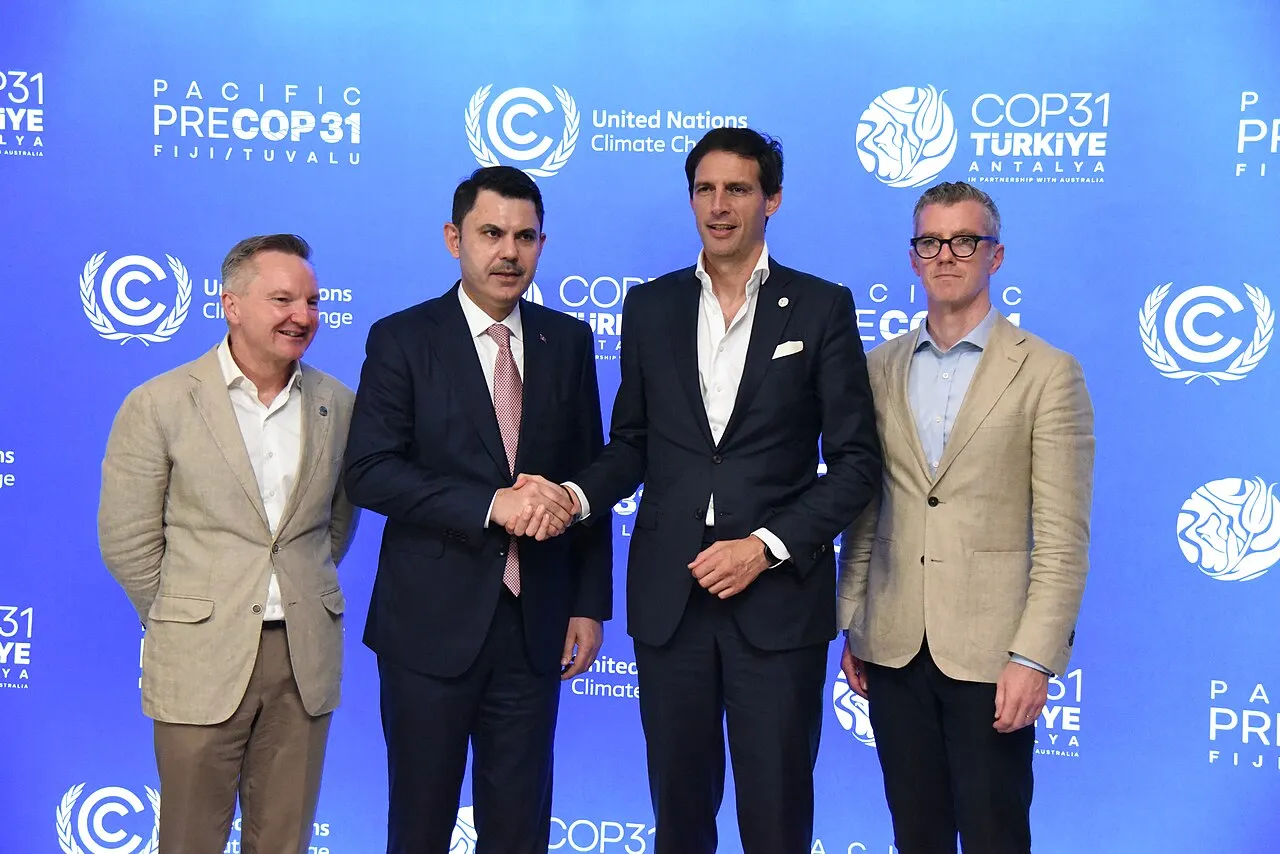
"I do not think we are taking a step back," said COP31 President Murat Kurum, Turkey's Minister of Environment, Urbanization and Climate Change, who called the document the Antalya Declaration.
Australia's Chris Bowen, Minister for Climate Change and Energy and the conference's negotiating president, defended the outcome in different terms: "What we're doing is finding the most ambitious outcome that consensus will allow." He said he would hold consultations through the night.
Outside the presidencies, the verdict was the opposite. "This new text has gone backwards from the one released earlier in the week," said Mohamed Adow, director of the think tank Power Shift Africa. "If this version of the text remains, it will be a ghost COP." For Jasper Inventor, head of Greenpeace's delegation at the conference, the carbon-removal language is "a profound backwards step," because it opens room for fossil-fuel expansion.
The European Union, which brings 27 countries together under a negotiated mandate, held back from commenting immediately after publication. European Climate Commissioner Wopke Hoekstra said the bloc would judge the text against three tests: whether it responds to the climate crisis and the risk of exceeding 1.5 °C, whether it implements agreements already made, and whether it reflects the member states' mandate. Ireland's Minister for the Environment, Darragh O'Brien, who is leading the bloc's work under Ireland's Presidency of the Council of the EU, was blunt: "We did not seek any opinions on it at this stage."
In recent years, climate summits have blown past the official deadline — by more than 24 hours, according to Reuters — because decisions require consensus among the nearly 200 countries present. Antalya's clock starts running on Friday.
With information from RTÉ and Reuters.