Australia and the Solomon Islands signed a bilateral treaty in Canberra on Wednesday that puts in writing what Beijing most wanted to avoid in the South Pacific: a commitment that there will be no foreign military or security base in the archipelago.
The document, officially called the Australia-Solomon Islands Treaty, was signed by Prime Ministers Anthony Albanese, of Australia, and Matthew Cooper Wale, of the Solomon Islands, according to the joint statement released by the Australian prime minister's office.
What is in the text
The joint statement says the treaty reflects the Solomon Islands' sovereign decision that there will be "no foreign military or security base in Solomon Islands" and that "Solomon Islands' sensitive infrastructure will remain free from militarisation, foreign interference and unauthorised access". According to Al Jazeera, that infrastructure covers ports, airports, energy, telecommunications and road and bridge works, and the agreement does not apply retroactively.
The text also records the choice of Australia as the archipelago's primary security partner, and refers future cooperation to the Pacific Islands Forum: "Pacific security is the collective responsibility of Pacific Islands Forum members," the joint statement says.
On the Australian side, the announced commitments are: support for the Solomon Islands' free education policy, investment in roads and renewable energy, modernisation of the Royal Solomon Islands Police Force, help with the border management system, a wider Solomon Islander role in the Pacific Australia Labour Mobility (PALM) scheme — including places in early childhood and aged care — and visas with longer stays, extended validity and in-country facilitation in Honiara. There is also a football partnership.
Al Jazeera, with information from AFP, puts the package at 740 million Australian dollars over ten years (about 490 million US dollars), aimed mainly at free education. The figure does not appear in the official Australian statement, which gives no amounts.
The shadow of the 2022 pact
The security agreement the Solomon Islands signed with China in 2022, whose full contents were never published, is the inescapable context of Wednesday's treaty. Asked by journalists about reports that he had ended that pact, Wale said only that talks with Beijing are "ongoing".
China's Ministry of Foreign Affairs did not confirm whether the agreement had been scrapped, but warned that the new treaty with Australia "should not target any third party", according to Al Jazeera.
Elected in May this year, Wale has repositioned the archipelago's diplomacy. Standing beside Albanese, he summed up the shift: "Solomon Islands has been for a number of years a source of uncertainty and doubt in the region. Those days are gone."
One piece of a larger design
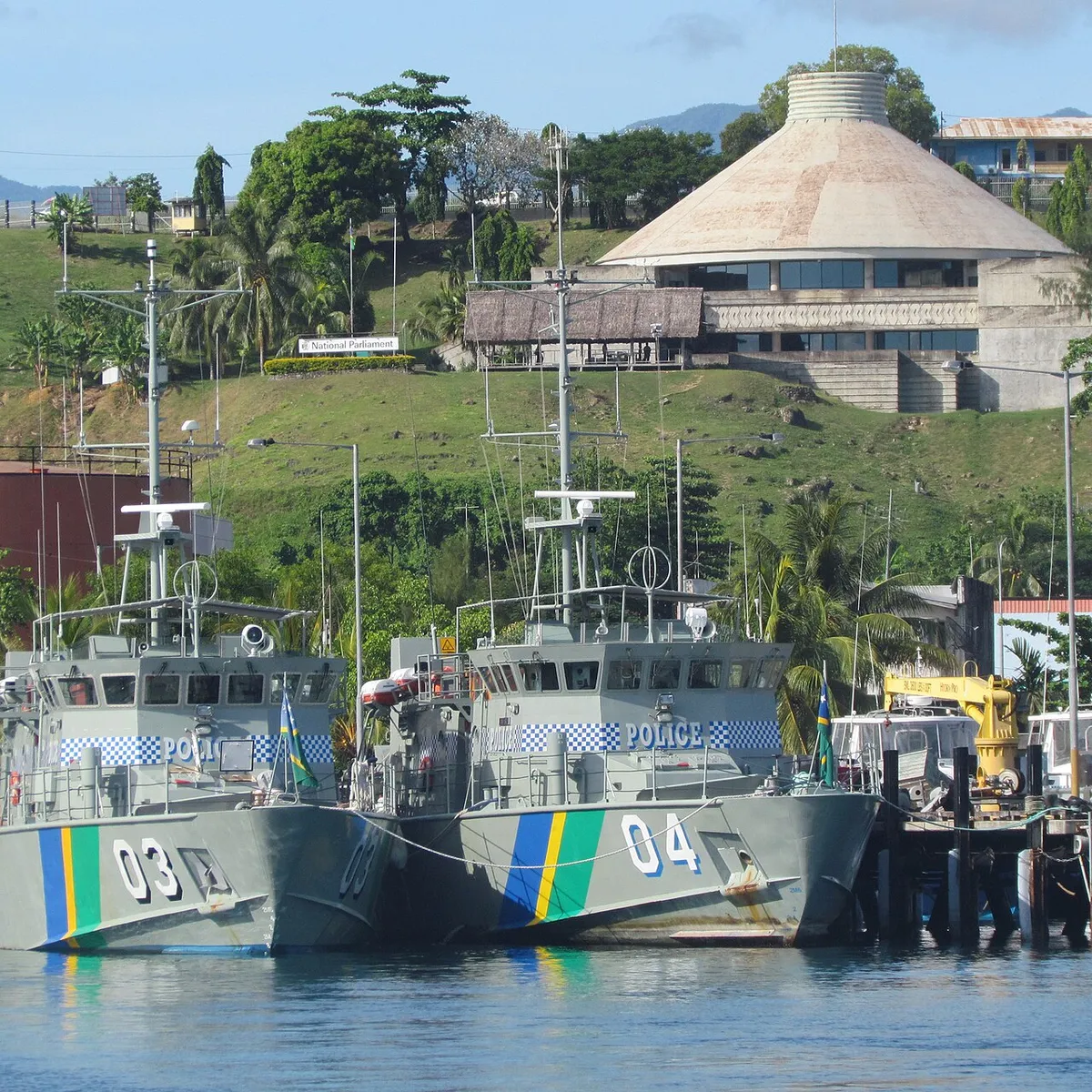
Australia was already the Solomon Islands' largest development partner and has had a bilateral security treaty with the country since 2017 — it was under that treaty that Canberra sent police officers to Honiara in November 2021, at the Solomon Islands government's request, during the unrest in the capital.
Wednesday's treaty fits a run of Australian agreements in the region: a mutual defence treaty with Papua New Guinea in October 2025, and a deal with Vanuatu in June this year that also blocks foreign military bases.
The full text of the treaty had not been published as of Wednesday evening; the terms known so far come from the two governments' joint statement.
With information from the joint statement released by the office of the Prime Minister of Australia (pm.gov.au), Al Jazeera and AFP.