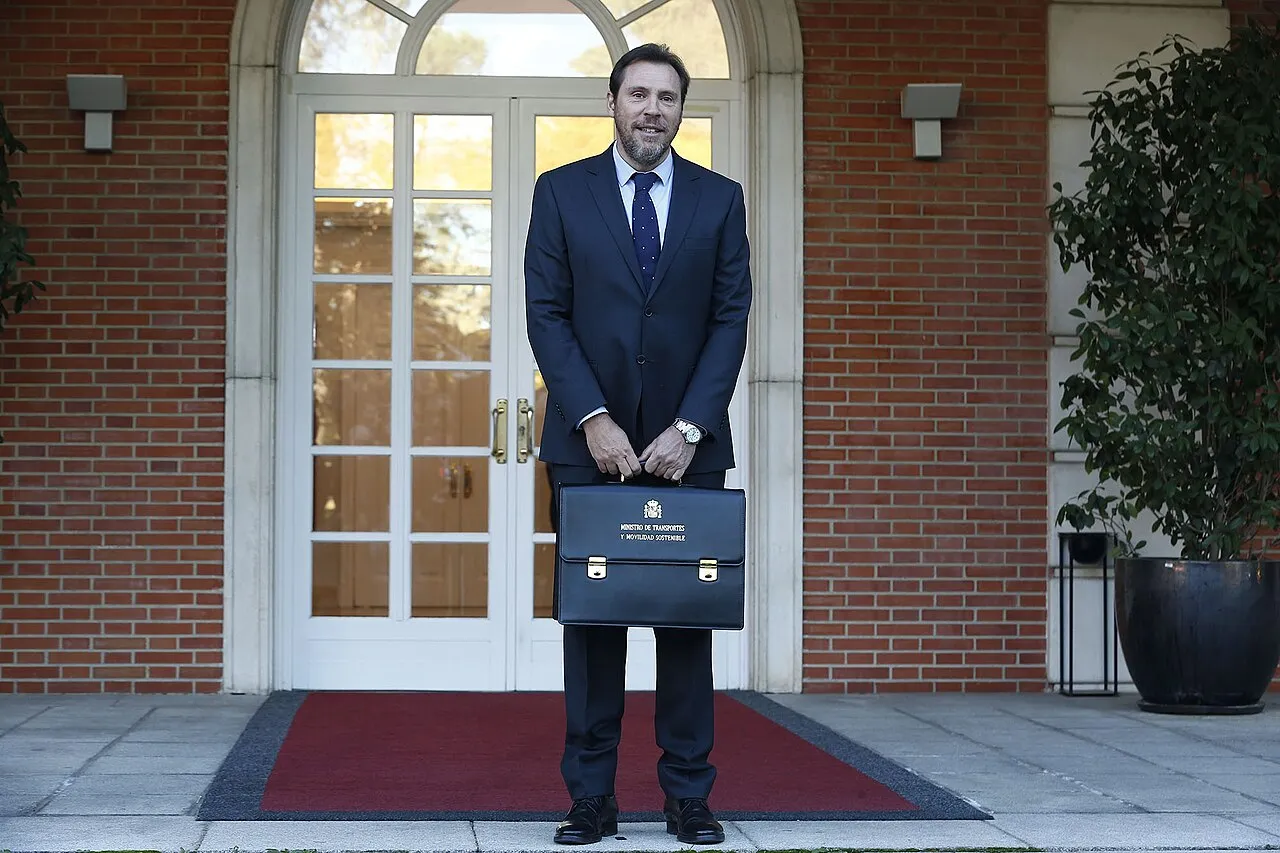
Spain lost the minister responsible for its rail network on Tuesday. Óscar Puente announced his resignation from the Ministerio de Transportes y Movilidad Sostenible (Ministry of Transport and Sustainable Mobility) in his final speaking turn before the Diputación Permanente, the standing committee of the Congreso de los Diputados (Congress of Deputies) — the very session convened so that he could account for the train collision at Urda, in the province of Toledo, which killed 69 people on 28 October.
"A transport minister in a country like Spain cannot stay in office with two accidents of this gravity in less than a year," Puente told the deputies. He described the decision as a matter of "political dignity, of consistency and of empathy with the victims".
Hours earlier, government sources were still saying a resignation was off the table and that the minister would remain the PSOE's lead candidate for Valladolid in the 29 November general election. On his way out, Puente dropped that candidacy as well.
Two crashes, 115 deaths
The number that ended Puente's career as a minister is the sum of two disasters on Spain's high-speed network in ten months:
- Adamuz, in the province of Córdoba, on 18 January 2026: 46 dead. After that crash, the government negotiated a package of measures with the main rail unions, among them Semaf, CCOO and UGT.
- Urda, in the province of Toledo, on 28 October 2026: 69 dead and dozens injured.
All 69 Urda victims have now been identified by the Instituto de Medicina Legal (Institute of Forensic Medicine) of Toledo and Ciudad Real: 54 Spaniards and 15 foreign nationals, 40 men and 29 women, all adults. Families and the consulates of the countries involved have been notified.
The technical causes of both collisions remain under investigation. The political responsibility Puente assumed by resigning implies no criminal liability and does not pre-empt the experts' conclusions.
What the minister said before he went
During the hearing, Puente defended Spain's railway system while acknowledging an urgent need to improve it and to revise its operating protocols. Three points from his remarks:
- Punctuality versus safety. He denied any instruction to put the timetable first: "it would never occur to me to tell anyone to sacrifice safety for the sake of punctuality." According to the minister, Adif, the infrastructure manager, flatly denies issuing any such instructions. After Adamuz, he added, punctuality on the network fell from 75% to 50%.
- The European comparison. Citing a European Union report, Puente said Spain ranks fifth on the continent for failures of automatic braking safety systems — behind the Czech Republic, Poland, Switzerland and Italy.
- Madrid–Seville. The line where the Urda crash happened is "neither abandoned nor forgotten", he said, and is receiving €780 million in renewal works.
The measures approved the same day
On that same 3 November, the Council of Ministers approved a package Puente presented to Congress before resigning: a temporary cut in train frequencies on the Madrid–Seville line, a mandatory second validation step for certain decisions taken by control centres, more staff, new technological tools, aid for the victims, and a mechanism to cap ticket prices in emergencies.
For the Madrid–Barcelona line, which will also undergo renewal works, the government is leaning towards keeping the service running rather than suspending it — an option that was studied, with an interruption of around 12 months. The final decision comes when the works are tendered next year.
The requirement for a second validation of control-centre decisions is the most telling item in the package: it treats isolated human error as a single point of failure to be engineered out, rather than as a cause still to be established. That was the criticism IU, through Toni Valero, took to the floor — a system that is only safe when nobody makes a mistake is not a safe system.
The reaction in the chamber
Calls for his resignation were already on the table from almost every bench. The PP, through deputy Ester Muñoz, accused the minister of refusing responsibility: "You are good at explaining why people die, but not at preventing it." The PNV, through Mikel Legarda, was blunt. Vox, Podemos and Ada Colau's Frente Amplio also demanded he go; Sumar asked that it happen at a moment of the minister's own choosing. EH Bildu was the only force not to call for his resignation, warning against assigning blame before the investigations conclude.
The PSOE defended Puente to the end — Patxi López said the minister had been "where he had to be" on the day of the crash. Junts, through Míriam Nogueras, pushed the bill further back: years of underinvestment and structural maintenance problems, under both PP and PSOE governments.
Outside Congress, Adif's works committee voted for a strike on 17 November, not yet formally called. PP leader Alberto Núñez Feijóo called the stoppage "a serious mistake" and urged the unions to drop it, while also saying the Urda tragedy "cannot be dealt with through routine explanations".
The debate reaches Brussels
The European Commissioner for Transport, Apostolos Tzitzikostas, argued for installing ERTMS — the European Rail Traffic Management System — on every line in the bloc. The European Union is also considering strengthening the powers of the European Union Agency for Railways.
No successor has been named at the ministry.
With information from Euronews, Diario de Pontevedra, Orain and El Cronista.