Thwaites Glacier, in West Antarctica, is likely to add about 30 millimetres to sea levels by 2100 — roughly double previous estimates, and that holds even if there is no additional global warming. That is the conclusion of a study published in Nature Communications and released on 15 October.
The work was led by the University of California, Irvine, with the participation of NASA's Jet Propulsion Laboratory (JPL). The lead author is Mattia Poinelli, now a project scientist at UCLA and at the time an Earth system science researcher at Irvine; glaciologist Eric Rignot, from the same university, is a co-author.
What changed in the model
The difference does not lie in newly observed warming, but in how the melting is described.
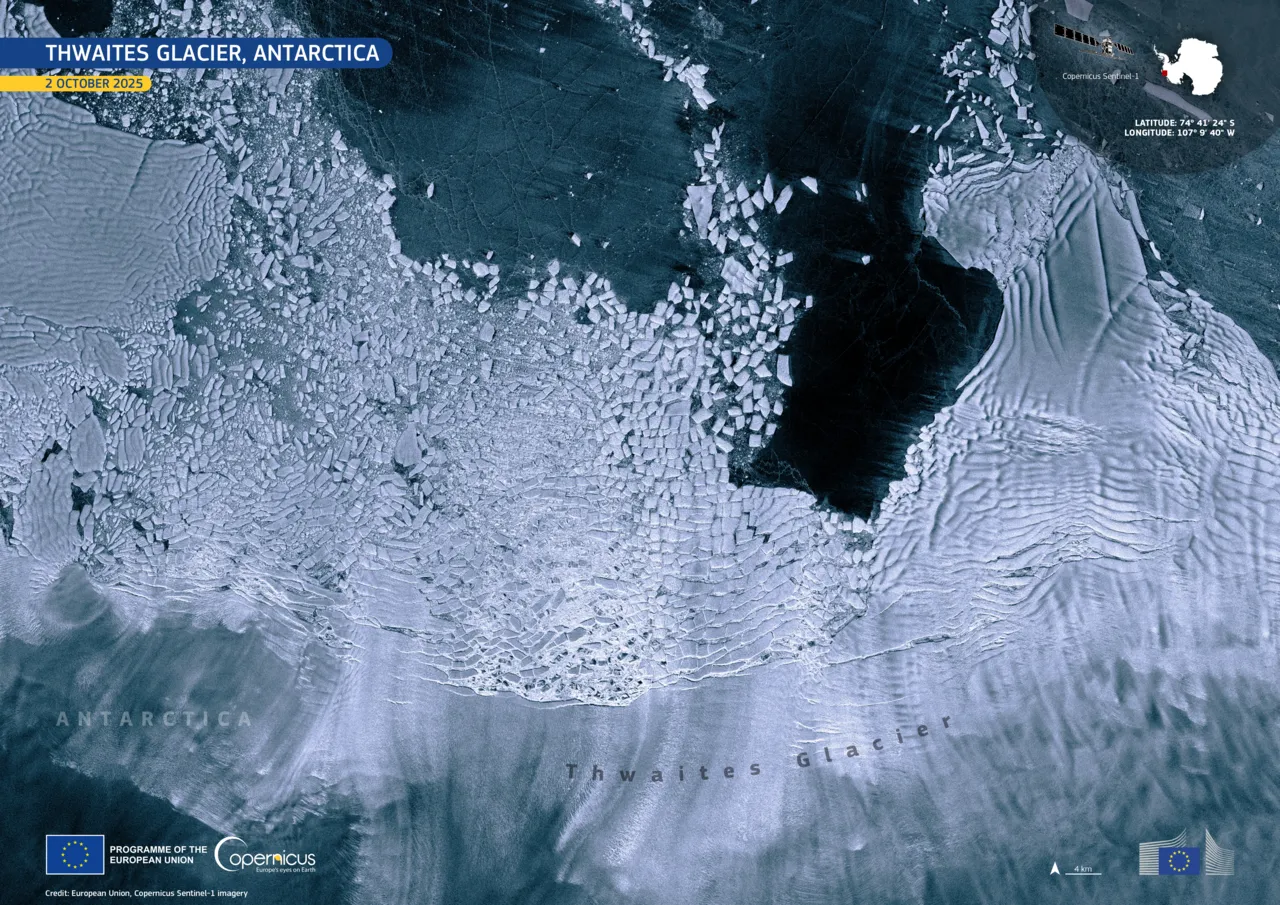
Conventional models treat the grounding line — the point where ice stops resting on bedrock and begins to float — as a narrow and relatively stable boundary. Satellite data show that in practice there is a grounding zone several kilometres wide, where seawater flows in and out with the tides.
That back-and-forth lifts and lowers the ice in a process called tidal pumping, which lets warmer ocean water reach several kilometres beneath the glacier and melt it from below. The team recalibrated the model with more than 20 years of synthetic aperture radar observations from the ICEYE satellites and simulated a grounding zone of 4 to 6 kilometres. Reconstructing the period from the 1990s to the present, the revised model points to changes four times larger than those captured by traditional models.
The ridge holding the ice back
The main trunk of Thwaites is currently held in place by an underwater bedrock rise, the Mouginot Ridge. Melting in the grounding zone is speeding the release of ice from that anchor, and the simulations indicate a 60% probability that the glacier unpins from the barrier by the end of the century. After that, the retreat would continue towards the next ridge, the South Ridge.
Some figures put the stakes in perspective:
- Thwaites covers about 192,000 sq km, an area equivalent to Senegal;
- it accounts today for roughly 4% of global sea-level rise;
- it has lost more than 1,000 billion tonnes of ice since 2000 and keeps losing about 50 billion tonnes a year, according to figures cited by Al Jazeera;
- a total collapse would raise sea levels by around 65 centimetres — and, because the glacier helps hold back the West Antarctic ice sheet, some 14 times larger, the ultimate effect could reach several metres.
Every centimetre of sea-level rise exposes about 6 million people worldwide to coastal flooding.
What the scientists say
Rignot sums up the central point: because of the damage already done, "we can expect higher sea levels in the future" even with emissions cuts.
The reception among researchers who did not take part in the study mixes interest with caution. Ted Scambos, of the University of Colorado Boulder, said the findings could be "a real gamechanger for sea level forecasting from Thwaites". Robert Larter, of the British Antarctic Survey, noted that "there is a lot we still need to find out about grounding zone processes", which keeps the projections uncertain.
That is where the study meets its own limit: it recalculates the mechanism but does not settle the volume of ice that will be lost. The team plans to travel to the glacier in 2028 to install equipment capable of directly measuring the flushing of seawater beneath the ice.
In July, a group from the British Antarctic Survey published in Geophysical Research Letters the conclusion that Thwaites will keep losing ice for at least 150 years, even under extreme ocean cooling.
With information from the journal Nature Communications, Al Jazeera and Interesting Engineering.