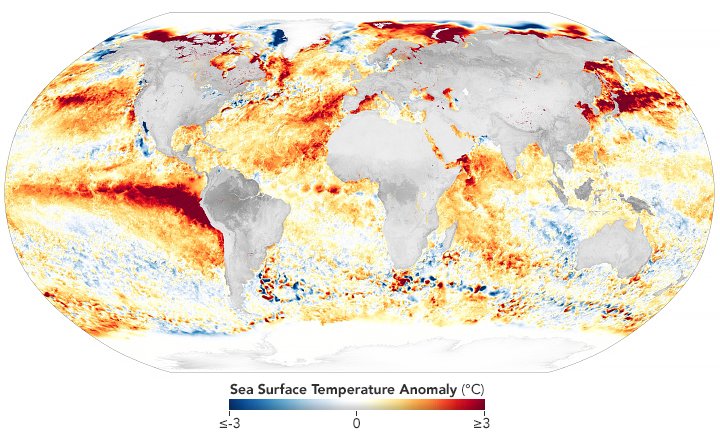
The El Niño now under way in the Pacific could cause as many as 451,000 heat deaths above average between June this year and the end of February 2027, according to a projection released on Wednesday, 23 September, by the Climate Impact Lab, an international research collaboration.
The figure is not a count of victims already recorded. It is the estimated gap between what is expected over those nine months and what would happen in an equivalent period of normal temperatures — what epidemiologists call excess deaths. Over the same window, the analysis projects 44% more days of extreme heat than in an ordinary year.
Where the projections concentrate
The distribution is uneven, and it tracks the capacity to withstand heat more closely than the intensity of the heat itself. The largest national projections are:
- Nigeria: 31,400 deaths
- Indonesia: 19,300
- Sudan: 17,600
Taken together, Niger, Chad, Nigeria and Sudan — the Sahel belt — account for 66,800 of the projected deaths. The Philippines, Vietnam, Thailand and Cambodia together account for 19,400.
These are regions where extreme heat meets very little adaptation infrastructure: scarce air conditioning, overstretched health systems and populations that work outdoors. It is that combination, rather than the thermometer alone, that the projection is trying to capture.
How the estimate was built
The researchers examined the relationship between temperature and mortality across 24,378 regions worldwide, accounting for each one's local climate and degree of vulnerability, then combined the result with temperature forecasts for the period. The comparison is drawn against the 1996–2025 average.
The methodology has yet to go through peer-reviewed publication — meaning the numbers are an estimate released ahead of formal scientific scrutiny, and should be read as such.
Michael Greenstone, an economist at the University of Chicago and one of the researchers associated with the group, argues that the value of the exercise lies less in the aggregate total than in the map: knowing where the risk concentrates lets governments target emergency measures before the peak.
A stronger El Niño on a hotter planet
Scientists are already describing the event as a "super El Niño". In early September, UN Secretary-General António Guterres summed it up in a sentence: "El Niño is being supersized before our eyes. The planet is in uncharted waters, and those waters are heating up."
Two numbers help explain why this cycle weighs more than its predecessors. Most El Niño events raise the global average temperature by roughly 0.2C — but that rise now sits on top of the 1.3C to 1.4C of warming above pre-industrial levels already caused by human activity. And a study published in August concluded that El Niños today are 36% stronger than before the industrial era, which the authors link to human-caused warming.
Akshay Deoras, of the University of Reading, attributes the intensity of this cycle to strong spring winds in the northern hemisphere that pushed warm water into the central Pacific. Adam Scaife, of the UK's Met Office, notes that the assessment of impacts is still under way, but that the expected effects are already visible.
What is already visible — and what is being prepared
India is recording below-normal monsoon rainfall, and southern Africa faces heightened drought risk. In both cases the effect is not only the heat: it is the harvest that does not arrive.
On the preparation side, the United Kingdom has pledged up to £15 million (about €17 million) for vulnerable countries, earmarked for livestock vaccination, reinforcing homes and supporting farmers — the kind of anticipatory spending that costs less than the emergency response after the disaster.
Davide Faranda, research director at France's National Centre for Scientific Research (CNRS) and a lead author on IPCC reports, sums up where the room for manoeuvre lies: "The key is to manage water and prepare for the changes in where and when rainfall occurs." Climate mitigation, he adds, does not make El Niño go away — it is a natural Pacific phenomenon — but it does reduce how far climate change worsens its consequences.
With information from the Climate Impact Lab, Al Jazeera and Euronews.