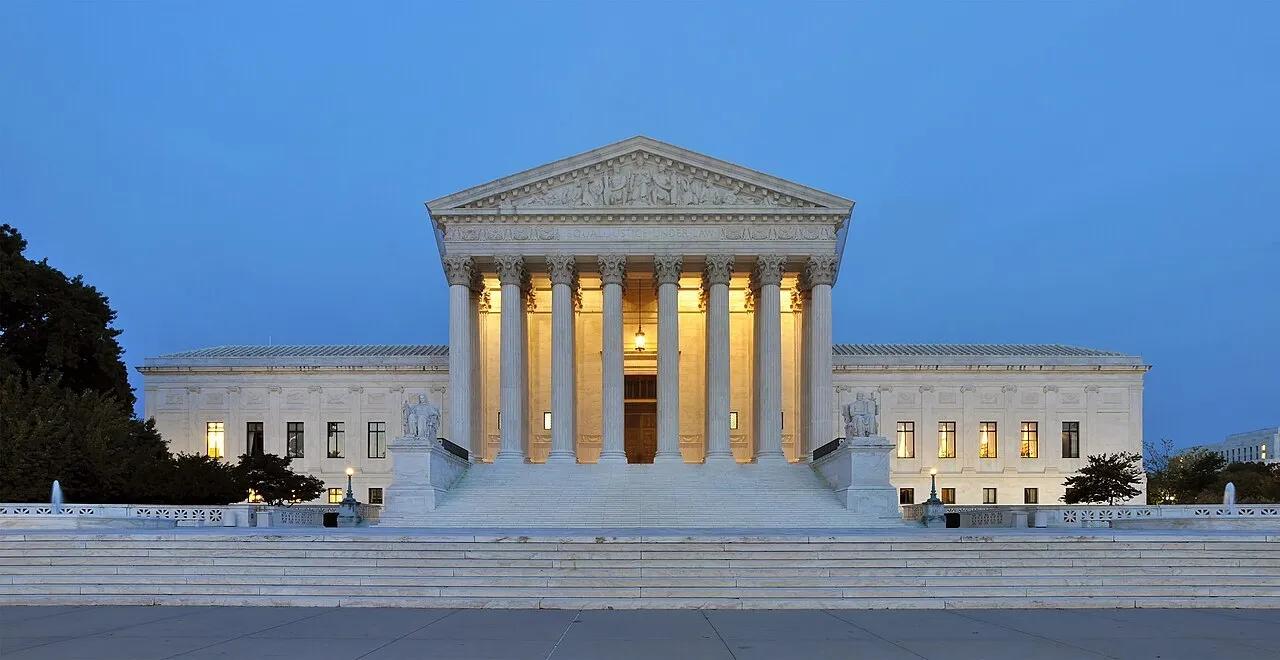
The Supreme Court on Wednesday left in place a Federal Communications Commission notice that lets political party committees buy broadcast advertising at the discounted rate reserved for candidates — with less than three weeks to go before the November 3 congressional elections.
The unsigned five-page order granted an emergency application from the FCC, docketed as 26A476, and paused an October 7 ruling by the U.S. Court of Appeals for the Fourth Circuit. A separate application filed by the National Republican Senatorial Committee and the National Republican Congressional Committee, 26A477, was dismissed as moot. Justices Sonia Sotomayor and Ketanji Brown Jackson said they would have denied the requests. Neither wrote to explain why.
What the discount actually is
Federal communications law requires broadcasters to charge legally qualified candidates for federal office no more than the "lowest unit charge" — the best rate the station gives any of its customers — during the 45 days before a primary and the 60 days before a general election. The obligation binds broadcast stations. It does not reach streaming services or social platforms, where a growing share of campaign spending now goes.
In March 2026, the FCC's Media Bureau issued a public notice saying that the same discounted rate should also be available to political parties and to joint fundraising committees. That notice is the document at the center of the case.
The practical effect is money. A party committee paying the candidate rate rather than the commercial rate buys more air time with the same budget in the final weeks of a campaign — the window in which broadcast inventory is scarcest and most expensive.
Who went to court
Four Democrats challenged the notice: Senate candidates Jon Ossoff of Georgia, Sherrod Brown of Ohio and Roy Cooper of North Carolina, together with Representative Kristen McDonald Rivet of Michigan. They petitioned the full commission to review the Media Bureau's notice in late April. In early June, with that petition still pending, they sued in federal court.
A divided Fourth Circuit panel sided with them. Writing for the majority, Judge Robert King called the statute "unambiguous": the discount covers a candidate's own use of air time, not what he described as "mere authorization of someone else's use."
Two trips to the Supreme Court in six weeks
The Republican committees asked the Supreme Court to pause the Fourth Circuit's decision in late August, arguing that the appeals court had no business reviewing the notice at all because it was not final agency action. On September 4 the Court temporarily paused the ruling in a four-page opinion, finding the committees likely to prevail on that reviewability argument. Jackson dissented.
The Fourth Circuit panel then went the other way on October 7, again divided, ordering the FCC to decide the pending petition by noon on October 9. Solicitor General D. John Sauer asked the Supreme Court to intervene the following day; Chief Justice John Roberts issued an administrative stay and set a response deadline for Saturday, October 10. The full order followed on October 14.
The reasoning, and what happens next
The Court's answer was procedural rather than substantive. The FCC must act on every application it receives, the order said, but it is not obliged to act within any particular timeframe and may set its own schedule. An order requiring a final decision five months after the petition was filed and within 48 hours of the court's command, the justices wrote, violated the separation of powers. They also found irreparable harm in forcing the commission to "triage its ongoing deliberation process."
Nothing in the order resolves whether the Media Bureau read the statute correctly. The stay holds while the appeal runs its course, the FCC faces no deadline, and it does not have to rule before election day. For the remaining weeks of the campaign, the discounted rate stays available to party and joint fundraising committees.
Reporting from SCOTUSblog, NTD and The Washington Times.