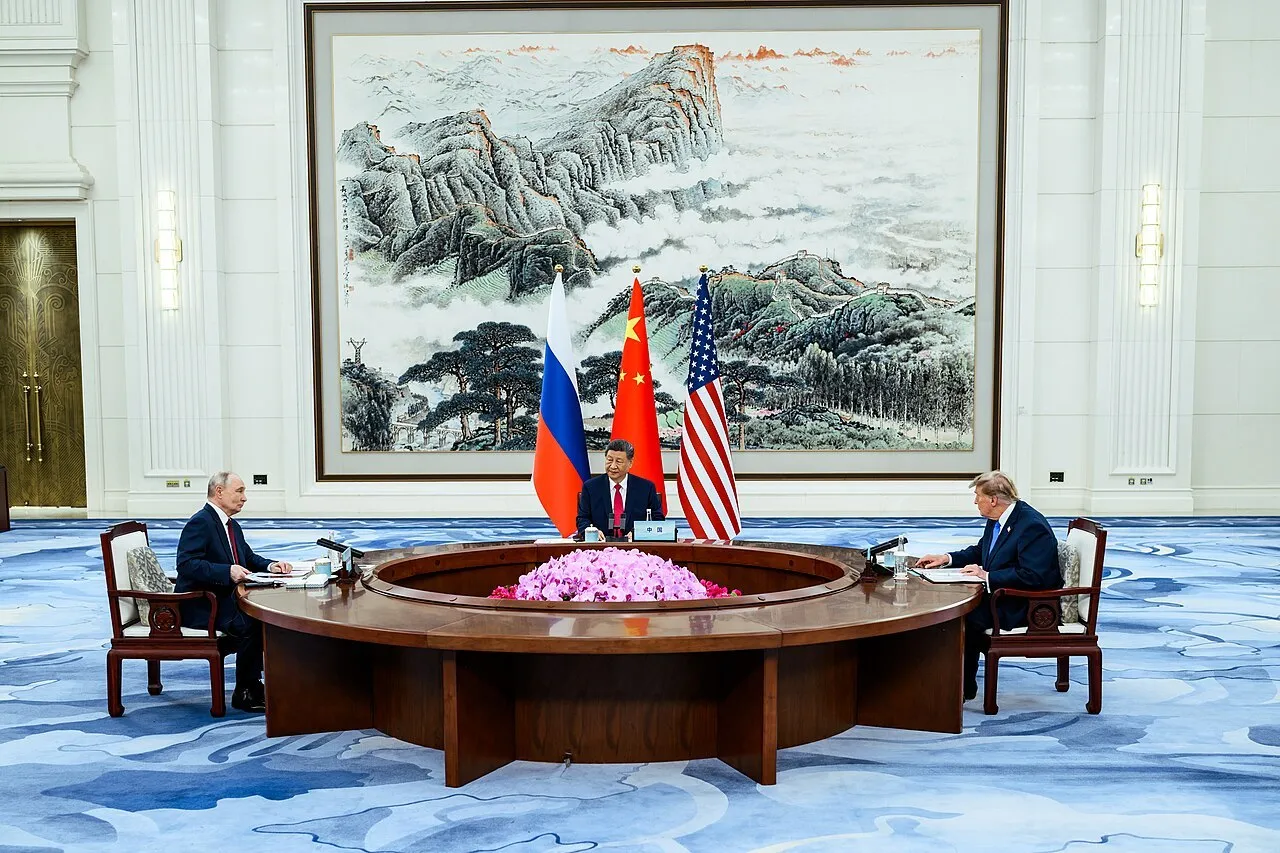
Donald Trump, Xi Jinping and Vladimir Putin sat down together for the first time on Thursday, November 19, 2026, at Kylin Villa in Shenzhen, China, on the sidelines of the Asia-Pacific Economic Cooperation summit. The meeting ran for more than an hour, according to Al Jazeera, and produced a four-point text that the White House published the same day as the "U.S.-Russia-China Heads of State Declaration toward Peace."
The Chinese government put out the same document through Xinhua a few hours later under a different name — the "China-Russia-U.S. Heads of State Declaration toward Peace" — with the three countries and the three leaders listed in a different order. Neither version carries a signature block.
"We are really making history," Trump said as the meeting opened, according to RFE/RL. Afterwards he said it "went great." Chinese Foreign Ministry spokesperson Mao Ning relayed Xi's assessment: "We three countries share the same view on safeguarding world peace."
The four points
The declaration is short and, in the White House text, ordered like this:
1. The United Nations. The three countries, all permanent members of the Security Council, commit to reforming the UN so that it responds more effectively to global challenges and fulfils its mission of maintaining international peace and security. The text does not say what reform means, or name the Security Council's composition as a subject.
2. Fuel. The three plan to increase the production and supply of refined petroleum products "for the benefit of all nations," and reaffirm the importance of stable energy flows. That paragraph lands in a market that has not been normal since February 2026, when the United States struck Iran and Iran closed the Strait of Hormuz.
3. International justice. The leaders say state consent and respect for the immunities of state officials are of paramount importance, and agree that the International Criminal Court and similar bodies must not abuse their jurisdiction. Putin has been the subject of an ICC arrest warrant since 2023. None of the three countries is a member of the court.
4. Nuclear weapons. The declaration reaffirms that a nuclear war cannot be won and must never be fought, and commits the three to a dialogue on reducing nuclear risks and preventing proliferation. It is a pledge to talk, not to cut: there is no number in the text, no timetable and no arms-control negotiation. Trump has pressed for three-way nuclear reduction talks and Beijing has resisted joining them, and that gap is not closed here.
Ukraine is in the room but not in the text
The word Ukraine does not appear in the declaration. A Kremlin spokesperson said the war was not the central topic of the trilateral, though it was central to Putin's separate meeting with Trump earlier in the day — the two leaders' first in-person talks since Alaska in August 2025.
Putin said afterwards that he had used the three-way session to go back to the beginning: "During the trilateral meeting, I recalled where it all began — where the Ukrainian crisis originally started." He also said Russia had proposed that European leaders travel to Moscow, and that the format of further talks would be decided after that.
Trump, for his part, said Xi agreed that the Strait of Hormuz must stay open and that Iran must not acquire nuclear weapons. That is Trump's account of the conversation; neither leader confirmed it publicly, and Iran is not mentioned in the declaration.
Europe pushes back from Berlin
The summit coincided with a meeting of the Coalition of the Willing in Berlin on the same day, attended by delegations from close to 40 countries. The American delegation was led by Steve Witkoff and Jared Kushner, who said Trump would carry European backing for Ukraine to Russia and was "not looking to impose anything unilaterally."
German Chancellor Friedrich Merz was blunter, calling Shenzhen a photo op and saying a "Yalta format cannot bring peace." Nine Democratic senators, led by Jeanne Shaheen, said in a joint statement that "American security cannot be traded away for photo opportunities or personal aggrandizement."
The three leaders are due to meet again sooner than the diplomatic calendar would normally allow: Trump is hosting the G20 in Miami next month and has invited Putin, and Xi is expected to attend.
Reporting from the White House, the State Council of the People's Republic of China, Al Jazeera and RFE/RL.