Two tankers were attacked in the Strait of Hormuz and nearby waters over the course of Monday, according to British naval monitors. Iran's Revolutionary Guard says six vessels have caught fire in the area since Sunday — a claim no independent authority has confirmed, and one that comes without the name of a single ship.
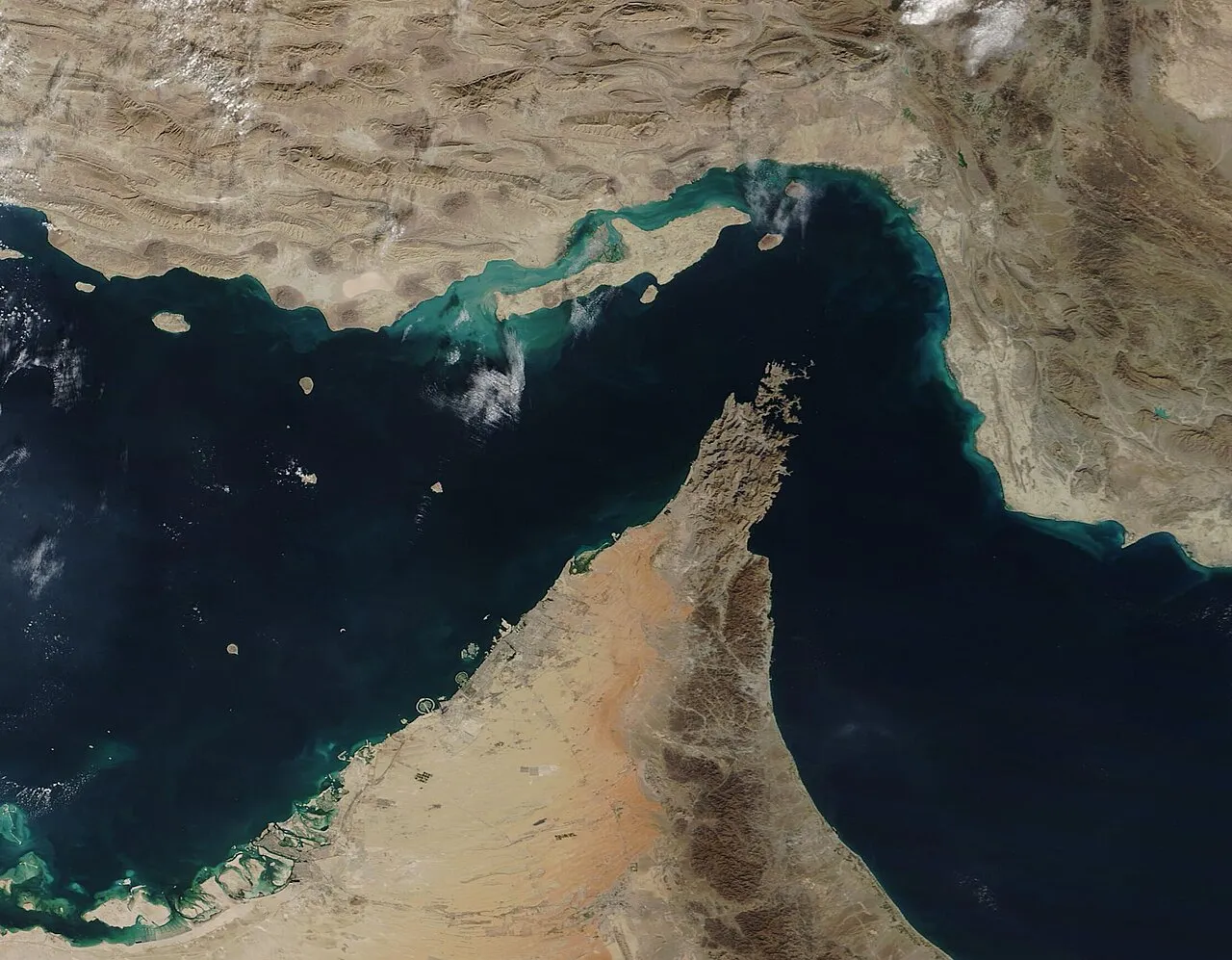
The strait is the chokepoint through which roughly a third of the world's seaborne oil passes. It is 34 kilometres wide at its narrowest point, and the shipping lanes are narrower still.
What the British monitors logged
UKMTO (United Kingdom Maritime Trade Operations), the Royal Navy office that tracks shipping incidents in the Gulf, issued two warnings on the same day.
In the first, at around 05:58 UTC, a tanker leaving the strait was struck by an unidentified projectile. The impact started an engine-room fire. There were no casualties, and the whole crew was accounted for.
In the second warning, some thirteen hours later, another tanker was attacked about seven nautical miles — 13 kilometres — north of Khasab, in Oman's Musandam exclave. The vessel was left disabled, also with an engine-room fire, and the crew was reported safe. In neither case did UKMTO attribute the attack to anyone: authorities are investigating, and the extent of the damage was still being assessed.
A day earlier, on Sunday, Indian maritime authorities had already reported an attack on a ship heading for the strait through the Persian Gulf. That crew was unhurt as well.
Iran's account: mines and an "unauthorised route"
Tehran offered a different explanation for the fires. The Navy of the Islamic Revolutionary Guard Corps said two tankers struck naval mines while crossing the southern part of the strait on a route Iran considers unauthorised, and described the episode as a response to an "illegal" American blockade. The force warned that the southern route is mined. Iran's regular navy, meanwhile, said another tanker caught fire and was left immobilised after hitting a mine in restricted waters east of the strait.
That amounts to three specific claims by Iranian authorities — against a total of six vessels said to be ablaze since Sunday, a figure the Revolutionary Guard released without detail. It is not clear whether the ship cited by the regular navy is among the six, nor whether any of the cases match the two UKMTO warnings. Oil prices rose on Monday.
Three American carriers in the region
The attacks on shipping are the maritime chapter of a military escalation that intensified over the weekend. On Sunday, Iran launched drones at a United States helicopter compound at Al Riffa Air Base in Bahrain — US Central Command denied damage to its own assets. That same night, the United States struck Iranian missile launchers at Bandar Lengeh and Sirik, in the south of the country.
The arrival of the aircraft carrier USS Theodore Roosevelt brought to three the number of American carriers in the Central Command area, alongside the USS George Washington and the USS George H. W. Bush. It is the first time since the Iraq war that the United States has kept three strike groups of that size in the Middle East, totalling about 19 warships in the region, according to a tally by Euronews.
For Danny Citrinowicz, a former head of research at Israeli military intelligence, the situation in the strait is "inherently unstable", and Iran is likely to keep raising the cost of the blockade with further attacks on shipping.
The chokepoint: 227 ships at a standstill
The practical effect shows up at the anchorages. JMIC, the maritime information centre that monitors the region, logged five attacks in the waters off the Musandam Peninsula since 1 November and reckons traffic remains well below prewar levels. About 227 commercial vessels were stationary at anchorages east of the strait — Fujairah, Khor Fakkan, Sohar and Musandam.
Between 12 and 14 November, JMIC counted 83 transits made with American support. Commercial traffic without that support ran at single-digit to low-double-digit vessels per day. The two figures cover different groups of ships and are not directly comparable, the centre cautions.
The year's running total gives the scale of the problem: the International Maritime Organization (IMO) recorded 136 security incidents involving vessels in the Strait of Hormuz and the wider Middle East between 1 March and 11 November, 35 of them in October alone.
Iraq: sirens at Khor Mor
The pressure is not confined to the sea. On Monday, warning sirens sounded at the Khor Mor gas field in Iraq's Kurdistan region after a drone flew over the area, according to two security sources quoted by Reuters. There was no strike and no damage reported.
Production at the field had already been halted since the previous week, after a suspected drone attack caused a fire and interrupted 2.8 gigawatts of power generation, according to the operator Dana Gas, based in the United Arab Emirates. Iraqi Kurdish officials blame recurring attacks on the field on Iranian-backed armed groups, but no group was identified in Monday's episode.
With information from Al Jazeera, gCaptain, Euronews, UKMTO, JMIC and the International Maritime Organization.