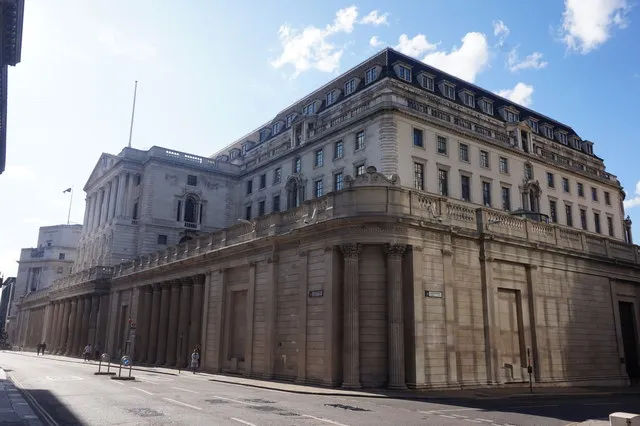
The Bank of England raised its benchmark interest rate from 3.75% to 4% on Thursday. It is the first increase decided by the Monetary Policy Committee (MPC) in more than three years: since 2023 the British central bank had only cut rates or left them alone, and Bank Rate had sat at 3.75% since the July and September meetings.
The decision came with an uncomfortable forecast attached. UK consumer price inflation was 3.5% in September, up from 3.1% in August, and the Bank itself calculates that it will climb again over the coming year to reach close to 5% by the middle of 2027.
One vote wanted double
The split was 8-1 — but none of the nine members voted to leave the rate where it was. The eight in the majority (Andrew Bailey, Sarah Breeden, Swati Dhingra, Megan Greene, Clare Lombardelli, Huw Pill, Dave Ramsden and Alan Taylor) backed the 0.25 percentage point rise. The dissent came from Catherine Mann, who argued for half a point, taking the rate to 4.25%, and said a 50 basis point increase would be "good policy".
That is unanimity on direction and disagreement on the size of the step — a different situation from a committee split between raising and waiting.
The bill arrived through energy
What pushed the committee was the price of energy, driven up by the conflict in the Middle East. Over the 15 working days to 27 October, Brent crude averaged $108 a barrel, 38% above the level assumed in the July Monetary Policy Report. Natural gas came in at 216 pence a therm, up 81% over the same stretch.
That is where the projections come from. In the Bank's central scenario, UK inflation runs at around 4.5% in the first quarter of 2027 and close to 5% in the second — the peak, averaging 4.8% over the quarter. In an adverse scenario, with the barrel near $130, the figure reaches 6.2% in the third quarter of 2027.
The committee, in other words, raised rates with inflation currently at 3.5% and the forecast pointing to almost double that: it moved ahead of the peak rather than after it.
What Bailey said
Governor Andrew Bailey sought to head off any reading of the decision as the start of a long tightening cycle. The increase "should not be seen as the first in an inevitable long sequence of hikes", he said. In the same breath, though, he left the door open: "unless the conflict in the Middle East is resolved, neither does it seem likely to be the last".
Among the other members, readings varied. Alan Taylor described his own vote as a "one-for-now" hike and said the next move "could be up, down, or sideways". Huw Pill and Megan Greene signalled that they expect further rises.
Growth, mortgages and markets
The Bank projects British GDP growth of 1.6% this year and 1.3% next year. The economy grew 0.5% in the second quarter of 2026, after 0.6% in the first.
For mortgage holders, the effect is immediate on deals tied to Bank Rate: on a £250,000 loan over 25 years, a quarter point adds about £37 a month, according to a Moneyfacts calculation cited by MoneyWeek. Borrowers on fixed rates feel nothing until their deal ends — and some lenders had already priced the rise in: two-year mortgage rates have risen by almost 50 basis points since the start of September.
In the markets, the reaction was muted precisely because the hike was expected. The FTSE 100 closed about 0.6% above the previous day, and two-year gilt yields rose by around 5 basis points.
The committee's next decision is set for 17 December.
With information from the Bank of England, the Cyprus Mail, MoneyWeek and AskTraders.