Americans had spent $9.7 billion online by 6:30 p.m. Eastern time on Black Friday, 12.8% more than at the same point last year, and Adobe Analytics responded by raising its forecast for the full day to between $13.0 billion and $13.4 billion. In September, the same firm had put the day at $12.9 billion.
That is the gap worth noticing. Adobe's pre-season forecast assumed Black Friday would grow 9.2% over 2025. The partial-day reading came in several points above that pace, which is why the estimate moved while the day was still going.
The day inside the week
Adobe counts Black Friday as the second-largest online day of the American holiday season, behind Cyber Monday. Its September forecast, published on September 28, set out the shape of the five days from Thanksgiving to Cyber Monday: $6.9 billion on Thanksgiving, $12.9 billion on Black Friday, and $15.1 billion on Cyber Monday, which falls on November 30 this year and is expected to become the first single day above $15 billion. Together the five days were projected at $47.5 billion, up 7.4% and worth 17.3% of the whole season.
For the weekend now underway, Adobe expects $6.1 billion on Saturday, up 6%, and $6.4 billion on Sunday, up 7.5%.
The full November-December season was forecast at $275.1 billion, a 6.7% rise. Adobe also expected a record 63% of the week's online spending to come through phones, against 61.6% a year ago, and projected that traffic arriving at retail sites from artificial-intelligence tools would run 130% above last year across the season, and 95% above it on Black Friday itself.
Two trackers, two numbers
Salesforce, which publishes its own holiday figures, measured $5.9 billion in U.S. online sales in the first half of Friday and put the full day on course for $18.7 billion, a 4% rise, with $83 billion worldwide.
The two sets of numbers are not comparable and should not be added or ranked against each other: Adobe and Salesforce track different groups of retailers and model the rest of the market in different ways. What they agree on is the direction — a record Friday, with growth in the low double digits by Adobe's count and the low single digits by Salesforce's.
In the stores
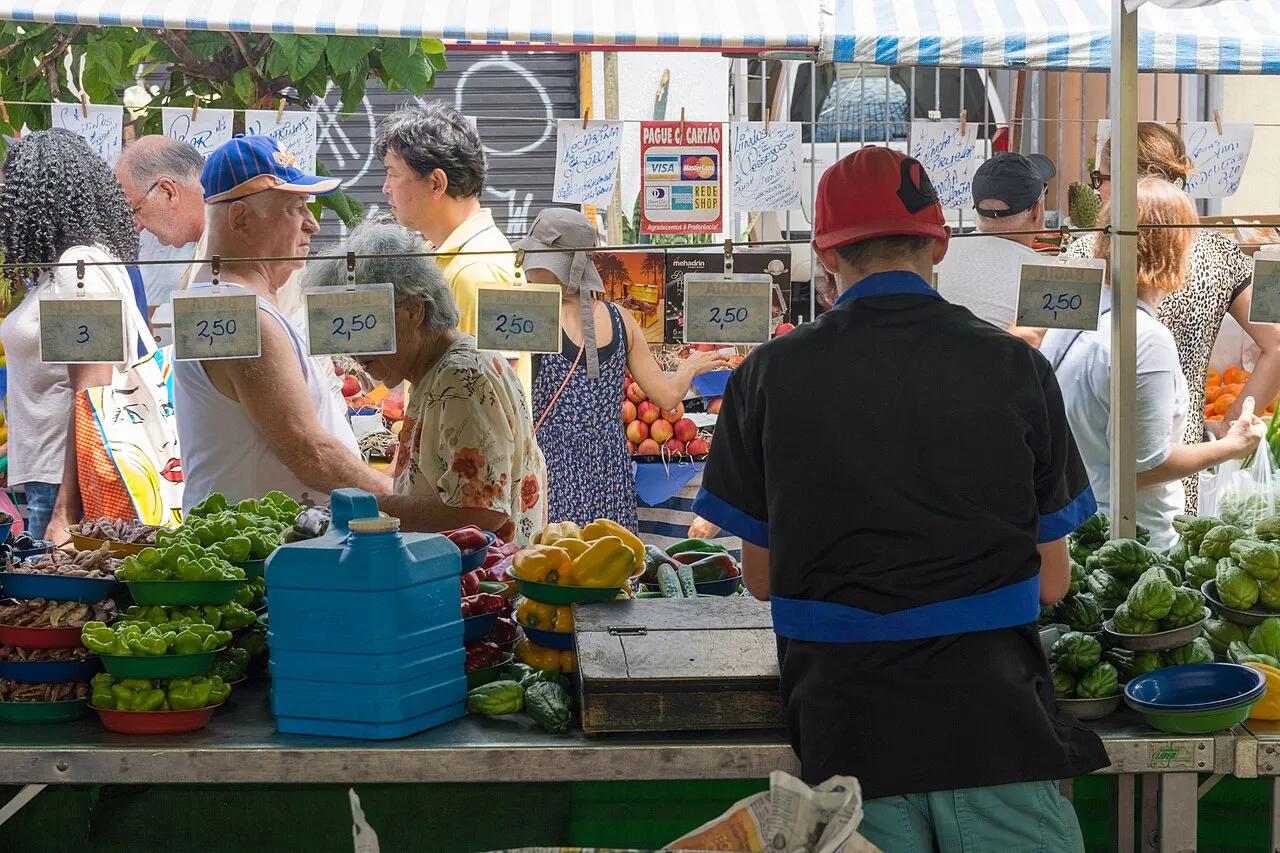
Walmart opened its in-store event at 6 a.m. local time across the country, and lines formed outside some locations as early as 3 a.m., Fox Business reported. The chain leaned on items sold only in stores to pull people through the doors.
"From an in-store standpoint, what we've tried to do is get some really key, great items that are in-store only to drive traffic," said Julie Barber, chief merchandising officer for Walmart U.S. She also described customers as "pretty intentional about how they're shopping" this year.
The price backdrop
The National Retail Federation expects U.S. holiday sales in November and December to rise 4.2% from last year, to $1.01 trillion, against 3.1% growth a year earlier — an increase that higher prices account for in part. Core inflation in the United States rose to 3.3% in October, the last full price reading before the Federal Reserve's December 9 decision.
That is the tension in Friday's figures: a record in dollars does not by itself prove a record in goods carried out of the store. Adobe measures spending, not volume, and some of the increase is the same basket at a higher price.
Reporting from Adobe Analytics, Salesforce, the National Retail Federation, Reuters and Fox Business.