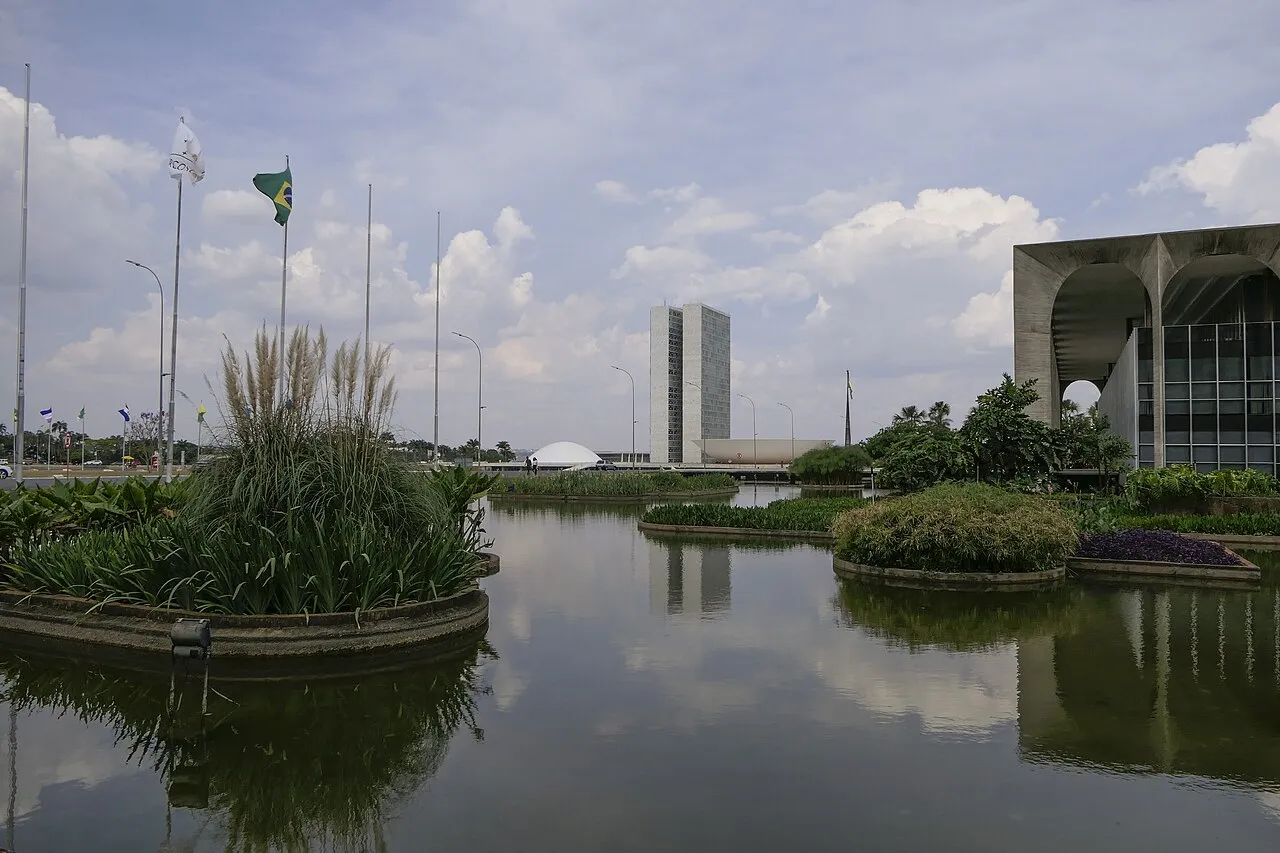
Brazil's Comissão Mista de Orçamento (the joint budget committee of the Câmara dos Deputados and the Senado) approved on Wednesday (25) the revenue report for the 2027 federal budget, the first stage in the passage of bill PLN 24/2026, which the government sent to Congress in August. The report, by deputy Neto Carletto (Avante-BA), raises the revenue estimate for next year by R$ 37.1 billion.
Gross primary revenue rises from R$ 3.459 trillion to R$ 3.496 trillion. The figure that matters for paying the federal government's bills is smaller: after R$ 19.5 billion in transfers, mostly to states and municipalities, the net gain is R$ 17.6 billion.
Almost all of it is oil
The revision does not come from a stronger economy. It comes from the barrel.
Royalties and financial participations jump from R$ 176.3 billion to R$ 214.8 billion — an increase of R$ 38.5 billion, larger than the total addition to revenue. The calculation was redone with Brent crude at US$ 86 a barrel for 2027, against the US$ 71.03 assumed in the government's August proposal.
Take oil out and the revision runs the other way: the revenue estimate would fall by about R$ 1.3 billion. That dependence is worth noting, because the price assumption is the part of the forecast Congress controls least.
On the negative side, revenue administered by the Receita Federal (the federal tax authority), including social security contributions, was cut by R$ 12 billion.
What rose and what fell
A handful of specific items explain the rest of the adjustment. Court fees are forecast to rise from R$ 1.4 billion to R$ 4.7 billion. In the other direction, Provisional Measure 1,394/2026 banned fixed-odds betting, and the original proposal had counted on R$ 6.7 billion from those companies in 2027.
On tax breaks, Complementary Law 239 of 2026 provides for an additional cut of up to 20%, worth R$ 15.4 billion. Debt forgiveness for individual micro-entrepreneurs costs R$ 1.1 billion in forgone revenue, and Law 15,525 of 2026 raises estimated forgone revenue by a further R$ 254.4 million.
Weaker growth, a tighter target
The GDP growth projection for 2027 was cut from 2.5% to 1.8% — a downward revision that shrinks the tax base in the very year the government wants to move out of deficit.
At the same session, the minister of planning and budget, Bruno Moretti, presented the primary-result numbers. He said the government expects to close 2026 with a deficit of R$ 77 billion, about 0.56% of GDP, and projects a surplus of 0.1% of GDP for 2027. Moretti said this presidential term began with a deficit above 2.2% of GDP. Spending restraint in the 2026 budget was revised to R$ 12.6 billion.
Neto Carletto also noted that 2027 will be the first budget drawn up with the Contribuição sobre Bens e Serviços (CBS), the new goods-and-services contribution replacing the PIS and Cofins levies, and with the new selective tax — the first to be executed under the machinery of Brazil's tax reform, with no historical series to compare it against.
The calendar
The revenue report sets how much there is to spend. Spending comes next: the budget's general rapporteur, senator Eduardo Braga (MDB-AM), presents his preliminary report on Thursday (26). The expectation is to finish the vote by 17 December. Once approved in a joint session of the Câmara and the Senado, the text goes to the president for signature.
With information from Agência Senado, Agência Câmara de Notícias and CNN Brasil.