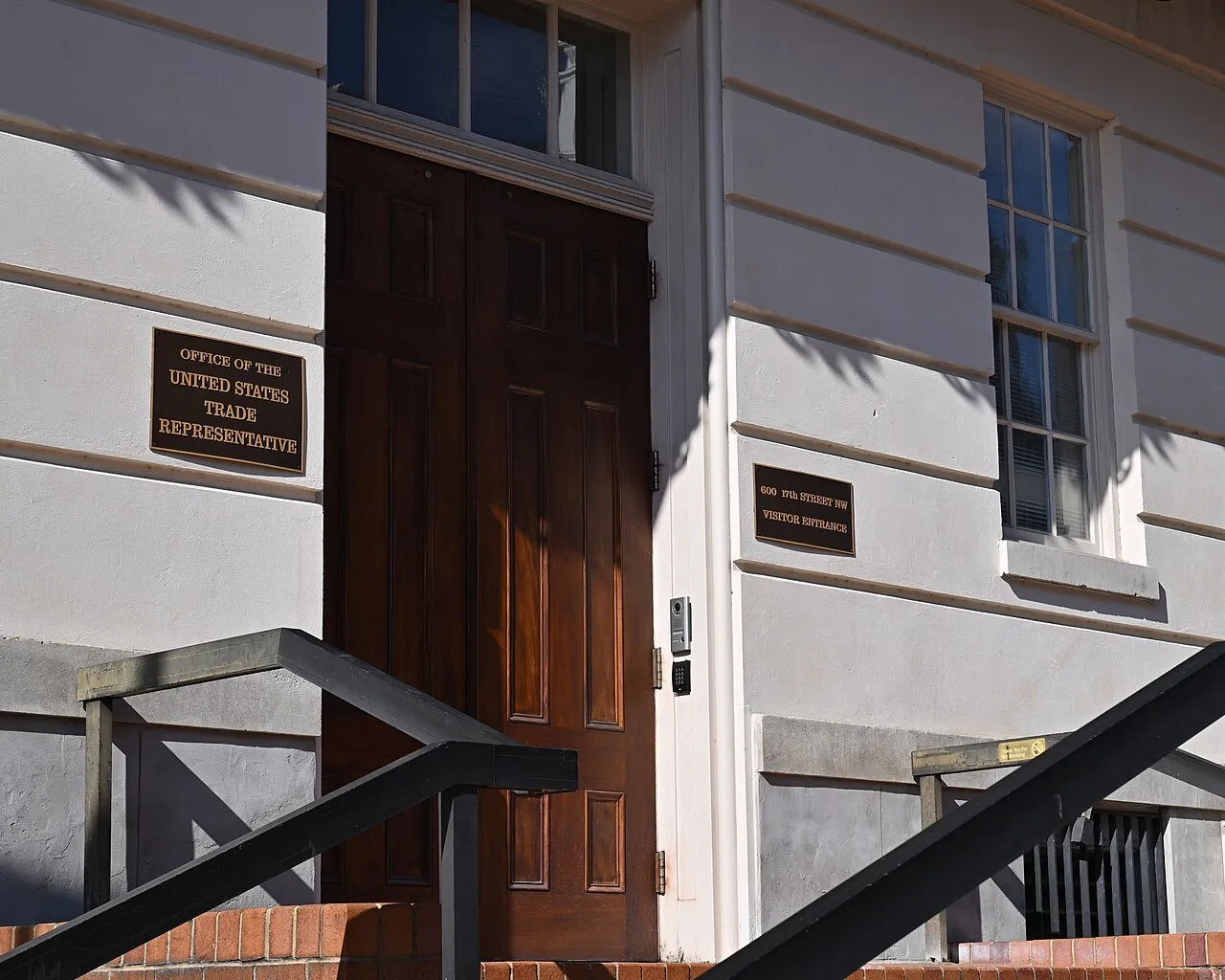
The Office of the United States Trade Representative ended an eight-month investigation on November 25, 2026, by proposing a new layer of tariffs on 14 economies, including a rate of up to 20% on China and a flat 15% on the European Union. None of the duties is in force. They would apply only after a comment period that closes on January 5, 2027 and hearings that begin on January 25.
Trade Representative Jamieson Greer determined that the practices of those 14 economies relating to structural excess capacity and production in manufacturing are unreasonable and burden or restrict United States commerce, and are therefore actionable under Section 301(b) of the Trade Act of 1974. USTR published an economy-by-economy report with each determination.
The proposed rates
The investigations were opened on March 11, 2026 and covered 16 economies. USTR says it heard nearly 140 witnesses and received 1,070 written comments. Fourteen economies drew a determination:
- Vietnam — up to 35%, or a rate reflecting 20% if it concludes an Agreement on Reciprocal Trade
- India — up to 25%, or 17% with a responsive trade agreement
- China — up to 20% on goods outside the annexes, and up to 10% on goods listed in Annex A
- Singapore — up to 20%, adjustable to 10% with an agreement
- Bangladesh, Cambodia, Indonesia, Malaysia, Thailand — up to 18% each
- European Union, Japan, Republic of Korea, Switzerland, Taiwan — 15% each
Mexico and Norway were investigated but, in USTR's words, the Trade Representative "has not made determinations" on either one "at this time." The agency gave no timetable for the two pending files.
"Net of" is doing most of the work
Every rate is framed as net of duties already being collected. For the European Union, Japan, Korea, Switzerland and Taiwan, the proposal is net of the most-favored-nation rate and of existing Section 301 duties; for China it is net of the duty imposed under the earlier forced-labor Section 301 investigation. USTR says the China proposal accounts for the 20% rate set in the Kuala Lumpur Joint Arrangement of October 30, 2025.
That accounting is why the headline numbers and the forecast effect diverge. The Yale Budget Lab, cited by Yahoo Finance, put the average United States effective tariff rate at about 11.3% earlier this month, against 13.86% immediately before the Supreme Court struck down the administration's emergency-powers tariffs in February 2026, and above 15% through much of 2025. The group's reading of this week's package is that the administration said it wanted to rebuild that tariff regime using Section 301 and, in the aggregate, has now done so.
Stephen Brown, chief North America economist at Capital Economics, wrote that the announcement "is not as alarming as it looks," while adding that the duties will still give prices a marginal push and keep core goods inflation firm into next year.
What is exempt
Outside China, the proposed exemptions cover products already carrying Section 232 duties: steel, aluminum and copper articles and their derivatives; passenger vehicles, light trucks, heavier vehicles and their parts; wood products; patented pharmaceuticals; and semiconductors. Informational materials, donations and accompanied baggage are also excluded. According to RTÉ, where a Section 232 duty and the new Section 301 duty would both apply, the higher of the two prevails rather than the two adding together.
China is the only economy with named exemption detail in the announcement. Goods on its Annex B are drawn from the United States imports list of the U.S.-China Board of Trade "30-For-30" lists of products recommended for reduced tariff treatment. RTÉ reported that roughly $30 billion of Chinese imports would fall outside the duties under that bilateral process. The 20% ceiling for China sits under a truce that expires on January 10.
Greer framed the action as the end of a long argument rather than the start of one, saying that since 2016 leaders "ranging from Donald Trump, to Joe Biden, to Xi Jinping, to Emmanuel Macron" had identified the problem, and that statements at the G7, G20 and the World Trade Organization had not produced change.
Reaction
Chinese foreign ministry spokesman Guo Jiakun rejected the overcapacity accusation on Wednesday and called for talks, saying that "tariff wars and trade wars are not in anyone's interest," according to Euronews. RTÉ, citing an unnamed senior United States official, reported Washington's position as seeking stability with Beijing. The European Commission had not responded publicly.
Euronews also reported a separate Section 301 action aimed at Brazil, proposing higher out-of-quota duties on sugar and a new 10% tariff on finished Brazilian aircraft. That proposal is not part of the 14-economy package and was not addressed in Wednesday's announcement.
Reporting from the Office of the United States Trade Representative, Euronews, RTÉ, Yahoo Finance and Husch Blackwell's trade analysis.