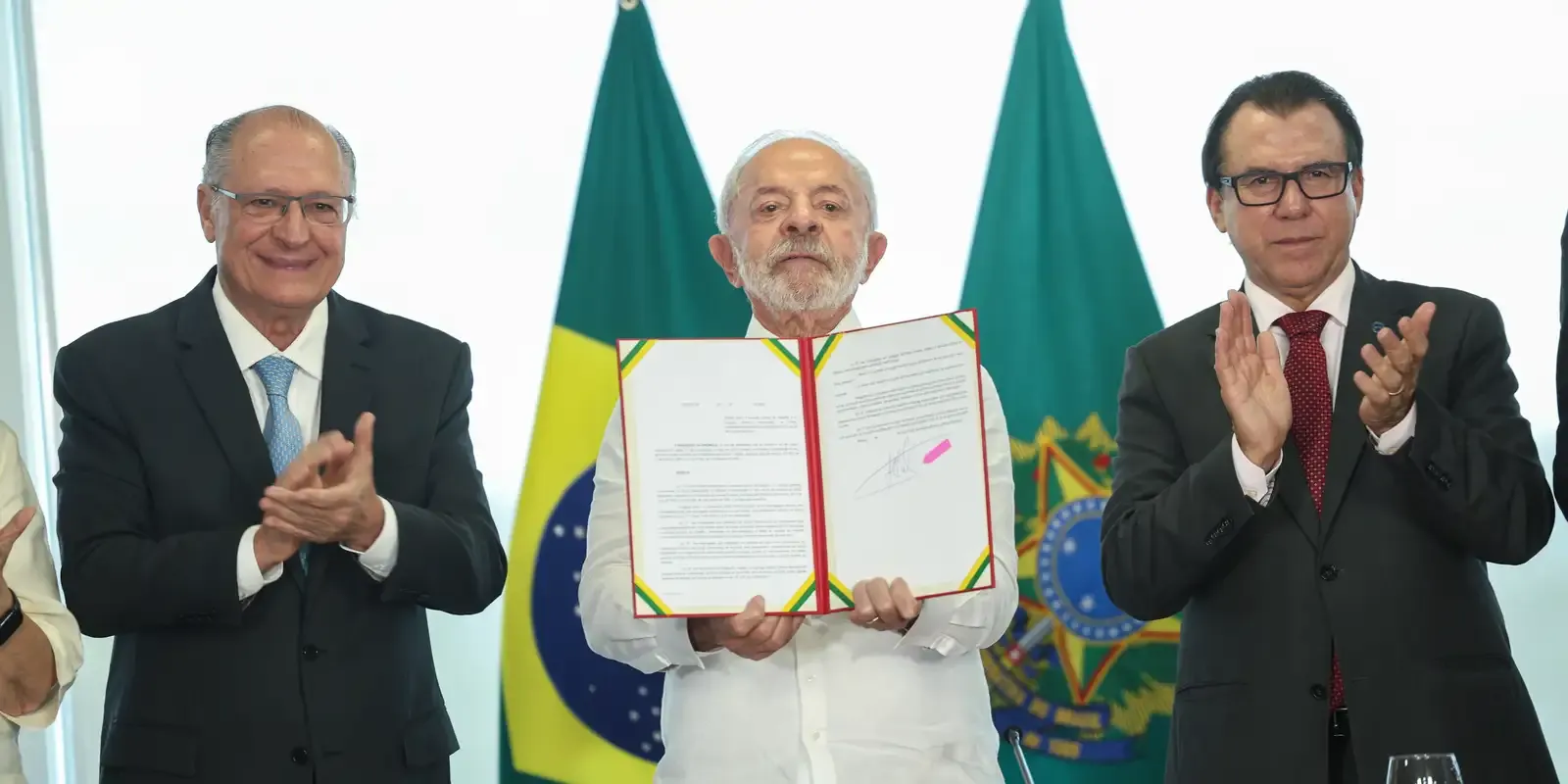
President Luiz Inácio Lula da Silva on Thursday signed, at the Palácio do Planalto, the decree regulating Brazil's new 5x2 work schedule — five working days and two days off — setting in motion the reduction of the country's weekly working hours. The text was published in a special edition of the Diário Oficial da União as Decreto 13.173, of 19 November 2026, according to Agência Senado.
The decree implements Constitutional Amendment 141, passed by the Congresso Nacional (National Congress) last month, which abolished the 6x1 schedule of six working days and one day off. Vice-President Geraldo Alckmin and the minister of Labour and Employment, Luiz Marinho, attended the ceremony.
42 hours in December, 40 hours in 2027
The weekly ceiling falls from 44 to 42 hours on 16 December 2026, and to 40 hours in December 2027. Paid weekly rest becomes two days, one of them preferably Sunday. The rule applies to existing and new contracts, with no pay cut.
It covers urban, rural and domestic workers and, where applicable, casual dockworkers. Employees of the direct and indirect public administration are excluded. Those already working 40 hours or less spread over six days, with one day off, also gain the guaranteed two rest days.
By the government's count, about 14 million workers are currently on the 6x1 schedule with a 44-hour week, and more than 20 million already working five days with 44 hours will see their load cut to 42.
The salary stays; the hour gets dearer
The decree does not touch fixed monthly pay, but it changes the divisor that converts that salary into an hourly figure: from 220 hours (for a 44-hour week) to 210 (42 hours) and then 200 (40 hours). A smaller divisor means a higher reference hour — and therefore costlier overtime and night-shift premiums.
Marinho gave the example of a worker on R$ 3,000 a month: the salary stays the same, but the reference hour rises from the current R$ 13.64 to R$ 14.29 on 16 December, reaching R$ 15 in December 2027.
Asked about the cost to employers, the minister said companies should "just not call overtime, replacing it with hiring".
That is where the practical effect of the design lies: because fixed pay is preserved while the hour gets dearer, the decree shifts the arithmetic at the margin — hiring now competes with paying overtime, without any article having to say so.
Continuous shifts, 12x36 and collective bargaining
Continuous rotating shift work stays at six hours a day unless a collective agreement says otherwise, with the monthly average of weekly hours capped at the new ceiling — 42 hours, then 40 — and the equivalent of two paid rest days a week. Continuously operating sectors such as transport, aviation, shipping and oil are to receive complementary rules.
The 12x36 schedule used in hospitals and private security has not been abolished: where the monthly average exceeds the weekly ceiling, hours must be offset or overtime paid, as set by collective bargaining.
Collective agreements and conventions in force remain valid; only clauses incompatible with the new rules lose effect from 16 December. The decree also places no restriction on businesses operating around the clock — the requirement is to reorganize rotas so that every worker gets the two weekly rest days. Marinho said the law allows flexibility where two days off in the same week are not possible: "That, however, is not the general rule, which is two weekly rest days."
What is still to come
Next week the ministry of Labour and Employment is due to publish a complementary ordinance and a question-and-answer guide, with its labour relations and inspection teams charged with guiding and enforcing compliance. The decree itself provides for a ministerial act on how paid weekly rest and special schedules are to be applied.
One front also remains open at the Supremo Tribunal Federal (Supreme Federal Court). According to Agência Brasil, Justice Flávio Dino last week granted an interim ruling allowing daily hours above eight during the one-year transition — up to 8 hours 24 minutes across five days, to reach the 42-hour week — without the extra 24 minutes creating a right to overtime pay.
At the ceremony, Lula said there would be no rollback of social rights. "As long as I am president, there will be no reduction in the rights the Brazilian people have won," he said. He also rejected criticism of his government's commitment to the public accounts, saying fiscal control had been a priority in all three of his terms.
The senators who attended the signing — Teresa Leitão (PT-PE), Randolfe Rodrigues (PT-AP), Paulo Paim (PT-RS) and Eliziane Gama (PSD-MA) — welcomed the decree. Fabiano Contarato (PT-ES) called the change a "historic achievement", comparable in weight to the 44-hour week written into the 1988 Constitution.
"We are building a responsible transition, with dialogue, legal certainty and respect for economic activity, but without giving up the essential: fewer hours of work, more hours of rest, more time with family and no pay cut," Marinho said.
With information from Agência Brasil and Agência Senado.