
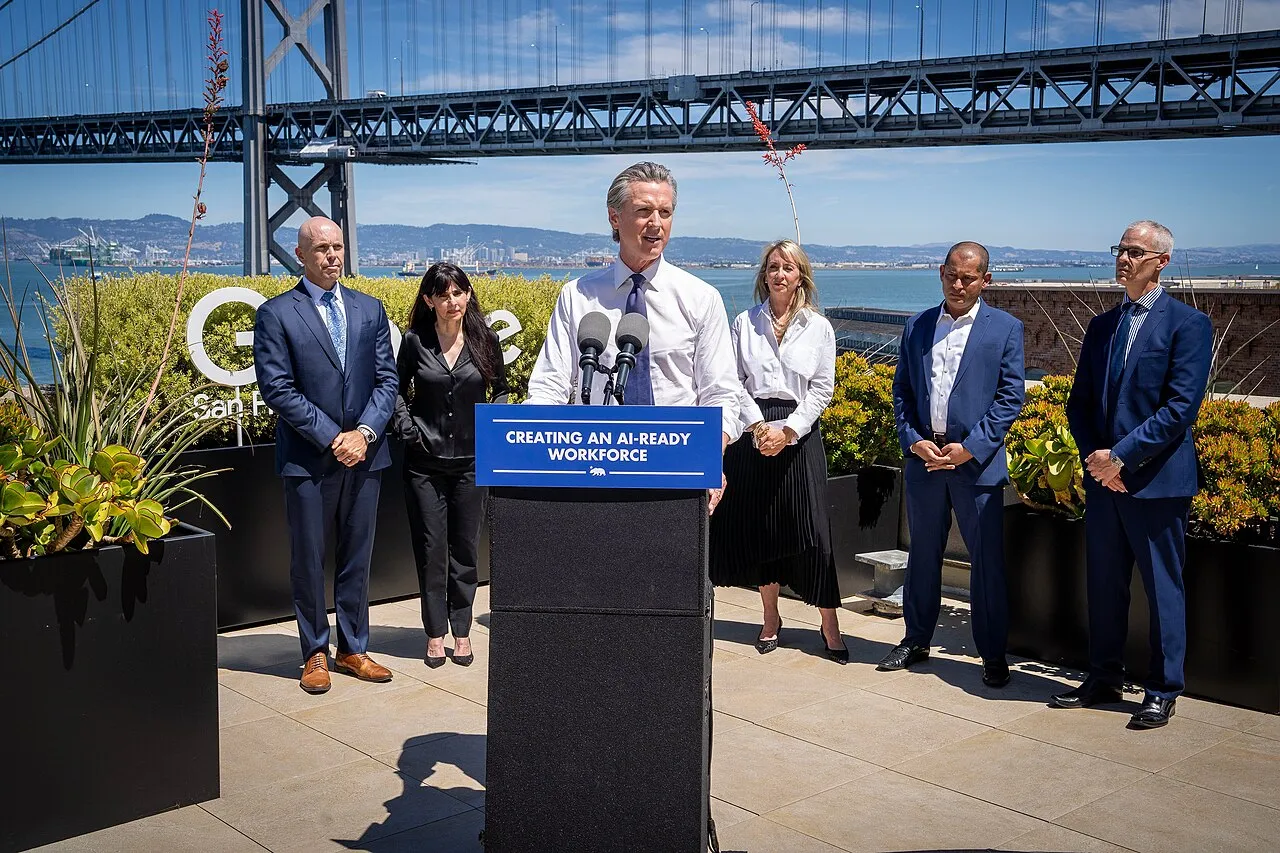
California will no longer allow an employer to discipline or dismiss a worker on the strength of an automated decision alone. Governor Gavin Newsom signed SB 947, known as the No Robo Bosses Act, on Tuesday, September 30, 2026 — the last day of his final bill-signing deadline as governor, with 1,160 bills on his desk.
The law requires a human being to review the decision, and requires the employer to tell the worker afterwards when an automated system was the main basis for it. The core obligations take effect on July 1, 2027, with a civil penalty of $500 per violation.
Newsom had vetoed an earlier version of the same idea. This time he signed it.
What else was signed
Four other bills on artificial intelligence and work went through on the same day:
- AB 1883 bars employers from using AI systems that try to infer a worker's emotional state, and from collecting neural data.
- AB 1979 keeps the final say on patient care with the health professional rather than with an AI recommendation.
- SB 951 requires employers to tell workers when a layoff is the result of AI or automation.
- AB 1331 bans AI-powered surveillance in bathrooms.
Taken with the social-media and child-safety package Newsom signed earlier in September, the state has now written a body of AI rules that has no federal counterpart — and, because California is where most of the companies are, one that tends to set the floor nationally.
The two vetoes
Two bills did not survive, and both concerned health care.
AB 2575 would have protected health workers from retaliation for refusing to follow a clinical decision-support system's recommendation. Newsom called it unenforceable, on the ground that the state Labor Commissioner has no medical expertise. SB 903, which would have limited the use of AI in mental health settings, he called overly broad.
The California Nurses Association, which pushed AB 2575, was blunt. "The governor knows A.I. should never replace a nurse's clinical judgment, but he vetoed the bill that would have protected us for using our judgment," said its president, Sandy Reding, RN. Assemblymember Liz Ortega, the bill's author, said Californians "want a nurse, not a robot, making the final call."
Lorena Gonzalez, president of the California Federation of Labor Unions, counted the result as a partial win — organised labour got seven of the nine bills it was pushing — while saying there was "still work to do, especially to regulate AI in healthcare."
The gap between the two outcomes is the shape of the year's fight in miniature. Where the question was an algorithm's authority over a worker, the state said no. Where it was an algorithm's authority over a patient, the state deferred.
Reporting from CalMatters, the legislative update published by the Office of the Governor of California on September 30, 2026, and National Nurses United.