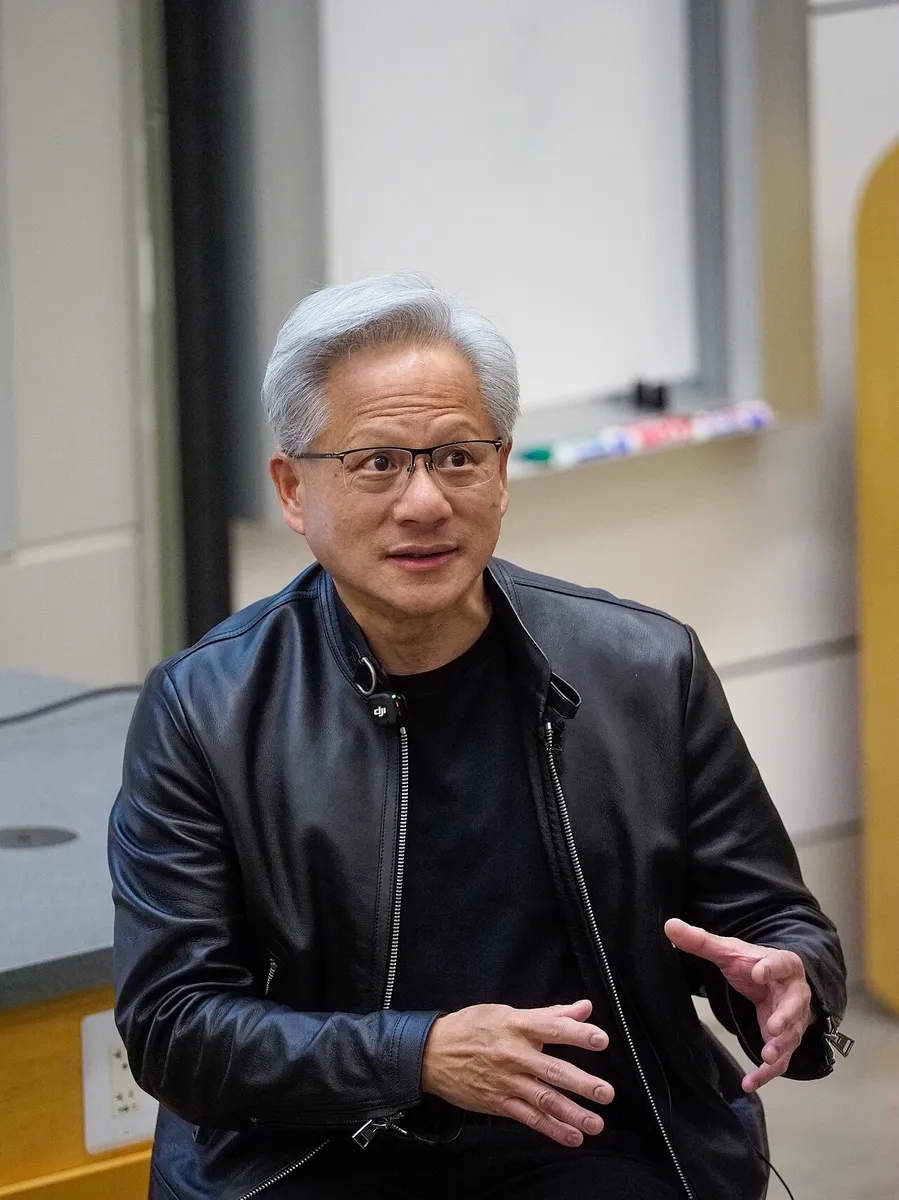
Nvidia said on Thursday, November 12, 2026, that Jensen Huang had resigned as president, chief executive officer and member of the board of directors, effective immediately. The announcement closed a 33-year run at the chipmaker he co-founded in 1993 and turned, over the past three years, into the most valuable company in the world.
The board named Colette Kress, executive vice president and chief financial officer, as interim chief executive. She keeps the finance job while she holds it. In the same announcement, the board appointed Harvey C. Jones as its chair — a position Nvidia had never had, because Huang held the top job and the board's leadership at once.
A statement without a reason
Nvidia's announcement did not say why Huang left. The board thanked him for what it called his "immeasurable contributions" to the company and to the industry, and said it had begun a search for a permanent chief executive that will consider internal and external candidates.
"The Board has full confidence in Colette and the leadership team," Jones said in the company's statement. Kress, for her part, said she intends to build on the foundation Huang laid over 33 years.
Jones is a technology executive and venture investor of more than three decades who ran Synopsys as chief executive and later as executive chairman. Kress joined Nvidia in September 2013 after roughly 25 years in finance at Texas Instruments, Microsoft and Cisco. Her tenure as chief financial officer covers almost the whole of the company's transformation: annual revenue went from $4.13 billion in fiscal 2014 to $215.9 billion in fiscal 2026.
What happened in the four days before
The resignation followed a week of reporting that the company never directly addressed on Thursday.
On Sunday, November 8, Huang acknowledged having been unfaithful to his wife and apologized to his family and to Nvidia employees. The board said at the time that it had confidence in his leadership, and it opened an independent investigation into reports that Chinese intelligence had targeted him. The reports centered on a former executive of Megaspeed, a Singapore-based company described as Nvidia's main partner in Southeast Asia; according to Al Jazeera, Megaspeed has been examined over whether it helped Chinese companies reach its $4.8 billion stock of Nvidia chips.
On Wednesday, November 11, Reuters reported that the board was meeting to weigh removing him, after The New York Times reported a relationship between Huang and a senior Nvidia executive who reported directly to him. The resignation came the following day.
The board has said it has no reason to believe national security was compromised, and no evidence has been established that Huang knowingly assisted Beijing or that company secrets were exposed. The FBI, Congress and a law firm hired by Nvidia itself have all been reported to be looking into the matter, and the company is also facing a shareholder class-action suit.
President Donald Trump said Huang had told him he had "absolutely no idea" about the relationship at the center of the reports.
Below $4 trillion
Nvidia shares fell about 10% in early trading on Thursday and closed at $166.19, down $7.54, or 4.34%. That is roughly 30% below where the stock traded a month ago, and it left the company's market value under $4 trillion for the first time since 2025.
The broader market moved far less: the S&P 500 closed at 7,592.40, down 0.35%; the Nasdaq Composite at 25,366.09, down 0.39%; and the Dow Jones Industrial Average at 52,297.09, down 0.36%. Rising bond yields weighed on the session alongside the Nvidia news.
The gap between the two numbers is the useful one. A 4% drop in a single company, even one that had been the market's anchor for three years, did not move the index by more than a third of a percentage point — which suggests investors read Thursday as a governance event rather than a verdict on demand for Nvidia's chips.
What comes next
Huang, 63, owns about 3.6% of Nvidia's stock and had spent much of the past two years pressing Washington to loosen restrictions on chip exports to China — the policy question that the intelligence reports now sit next to.
The first test of Kress's interim tenure arrives quickly: Nvidia is scheduled to report quarterly results next week, and she will present them as chief executive and chief financial officer at the same time.
Reporting from Nvidia's own announcement, Al Jazeera and Yahoo Finance, with figures cross-checked against the company's statement and Thursday's market close.