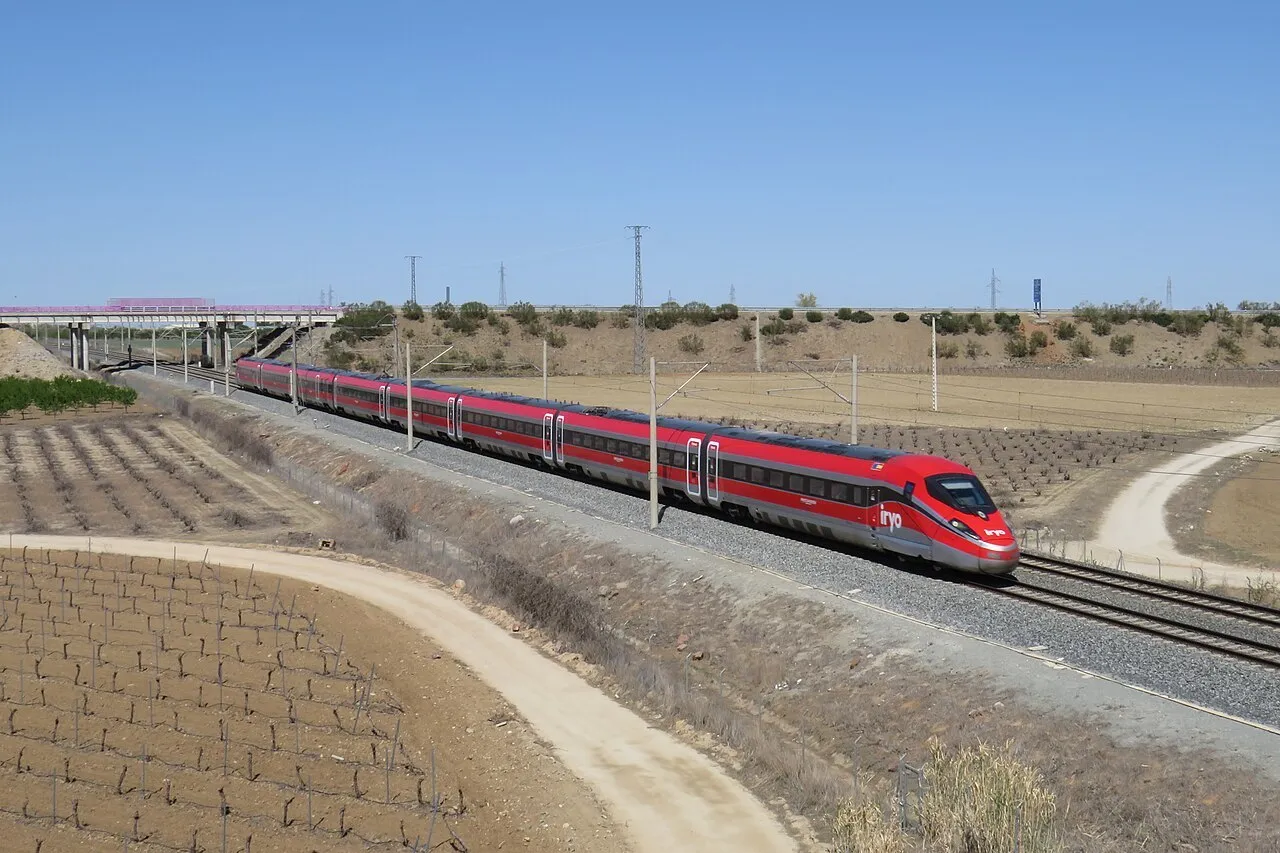
A Renfe AVE high-speed train struck the rear of a train operated by the private company Iryo that had stopped on the track on Wednesday morning, at kilometre 118 of the Madrid–Seville high-speed line, between the towns of Mora and Urda in Spain's province of Toledo. At least 64 people were killed, according to the regional government of Castilla-La Mancha, which warned the toll is likely to rise as the rescue operation continues.
The collision happened at 8:54 a.m., according to the 112 emergency service. Two carriages of the Iryo train derailed and fell down an embankment beside the track. Adif, the manager of Spain's rail infrastructure, described the episode as an "alcance" — the technical term for one train hitting the back of another — and halted high-speed traffic between Madrid and Andalusia indefinitely.
How many people were on the two trains
The Renfe AVE involved was service 2080, with 147 passengers. The Iryo train was service 6076, with 397 people aboard — more than 540 passengers between the two trains, plus crews.
Castilla-La Mancha raised its regional emergency plan, Platecam, to level 2 and requested the deployment of the Unidad Militar de Emergencias (Military Emergency Unit). Firefighters from Alcázar de San Juan and Orgaz, Civil Protection teams, three air ambulances and two mobile intensive care units were sent to the site. The regional government called for blood donors in Alcázar de San Juan, Ciudad Real and Toledo.
Urda's mayor, Manuel Galán, said the town hall was preparing a pavilion to receive the injured, at Civil Protection's request.
The signalling failure
According to reporting by the newspaper El Español, the section was operating under lateral signalling block (BSL) because of a failure in the LZB, the system that provides full track protection. Under that regime, permission to proceed depends on the driver reading the trackside signals rather than on continuous onboard control. Human error is the initial hypothesis of an investigation that has yet to reach a conclusion.
The newspaper El País, citing government sources, reported that the Renfe train had slowed and stopped minutes before the crash because of a traffic problem on the line.
The government's response
Spain's prime minister, Pedro Sánchez, said he was "shocked by the serious rail incident" and expressed "affection, solidarity and support" to the victims and their families. He cancelled his appearance at the closing of a health event to follow the emergency.
Transport Minister Óscar Puente went first to the Atocha control centre in Madrid and then to the crash site. The president of Castilla-La Mancha, Emiliano García-Page, suspended his agenda and travelled to the region. The Partido Popular, led by Alberto Núñez Feijóo, suspended its pre-campaign events for the 29 November elections nationwide.
The year's third disaster
It is the third rail disaster recorded in Spain in 2026. On 18 January, on the same Madrid–Seville line, a crash near Adamuz, in the province of Córdoba, killed 46 people and likewise involved an Iryo train and a Renfe train. Wednesday's accident comes a little more than nine months later.
Renfe opened free ticket changes and cancellations on the affected routes.
With information from El Español, CNN, Libertad Digital, Telecinco, Europa Press and El País.