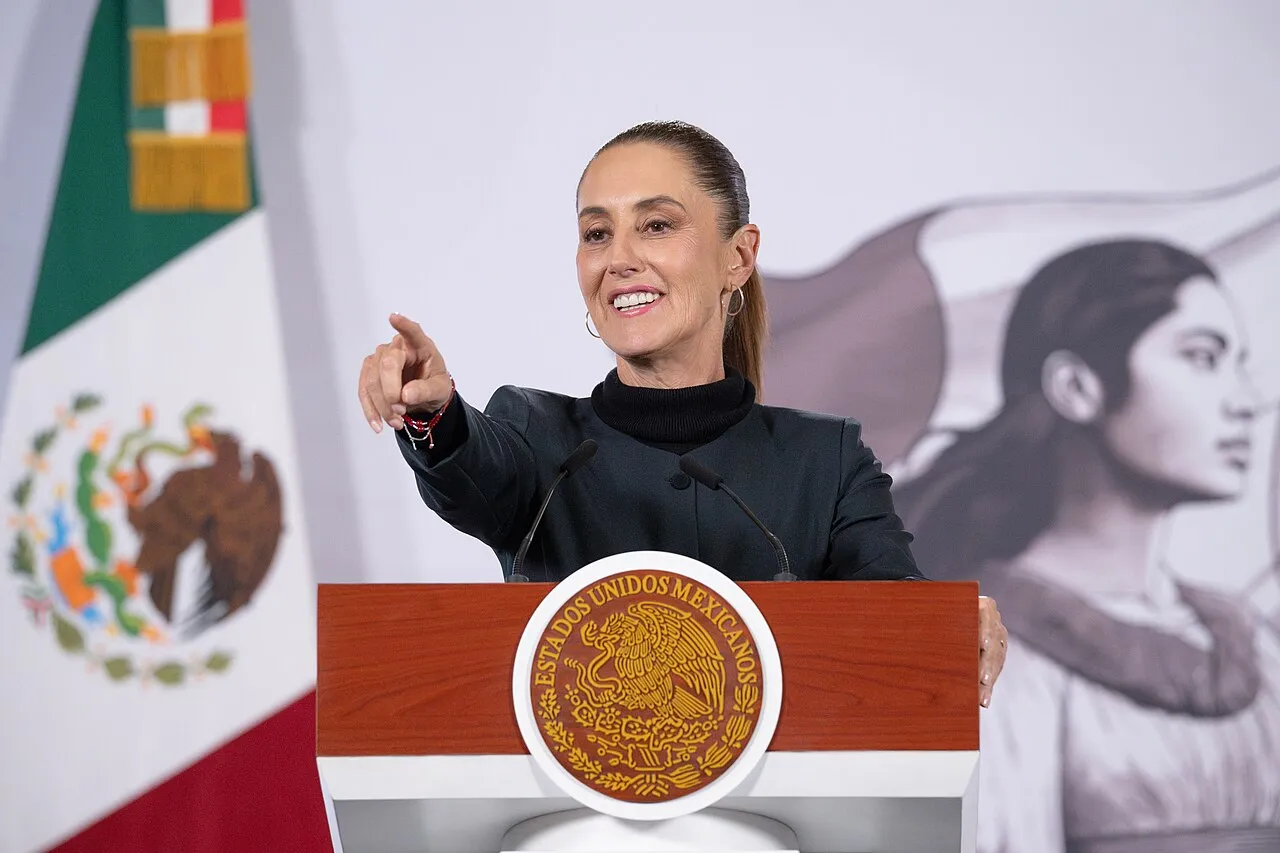
Mexico's president, Claudia Sheinbaum, met China's president, Xi Jinping, on Tuesday, 17 November 2026, in Shenzhen, on the eve of the leaders' summit of the Asia-Pacific Economic Cooperation forum (Apec), which sits on Wednesday and Thursday. The meeting was held at the Villa Kylin complex, inside an ecological reserve.
It was their second encounter: the first came on the sidelines of the G20 summit in Rio de Janeiro in November 2024. Hours before seeing Xi, Sheinbaum presented the Plan México — her government's industrial strategy — to more than 1,000 businesspeople at the Apec business forum.
A "new era", and an invitation for 2028
Sheinbaum summed the meeting up on her X account: "We spoke of a new era of cooperation for development in Mexico-China relations." According to the Chinese readout of the encounter, she also said the visit represented "a new era in the relationship between Mexico and China" and argued for "a relationship based on deep ties and shared principles."
She invited Xi to travel to Mexico in 2028, when the country will host the forum. "Mexico will host Apec in 2028," she told him, adding: "It will be a pleasure to receive you."
Xi, for his part, called for a "stable and healthy relationship" and said China "has always viewed China-Mexico relations from a strategic, long-term perspective." He described the two countries as "good friends and partners on the other side of the Pacific Ocean" and called for joint efforts given the "complex and changing international situation." He also proposed more tourism and more collaboration between provinces and cities on both sides.
What Mexico put on the table
The agenda the Mexican delegation brought was one of technical rather than commercial cooperation: science, technology, agriculture, clean energy, water resources, health, culture and tourism.
Mexico expressed interest in Chinese "smart hospitals", which combine artificial intelligence, robotics and large-scale data analysis, in the Chinese model of waste incineration for power generation, and in expanding renewables, solar panels among them. Sheinbaum also asked that more Mexican products be allowed into the Chinese market.
No signed agreements were reported. The president said the cabinet members present would follow up on what was discussed. Travelling with her were Economy Secretary Marcelo Ebrard; the head of Foreign Affairs, Roberto Velasco; Environment and Natural Resources Secretary Alicia Bárcena; Energy Secretary Luz Elena González; the head of Science, Humanities, Technology and Innovation, Rosaura Ruiz; Health Secretary David Kershenobich; and Tourism chief Josefina Rodríguez.
The backdrop: tariffs
The meeting comes little more than a year after Mexico raised tariffs on imports from countries with which it has no trade agreement — China among them — on the argument that this would boost domestic production. The measure drew a sharp reaction from Beijing. Before travelling, Sheinbaum had said trade would not be the central topic of the meeting.
The figures explain why Mexico's ask was market access rather than investment. Bilateral trade tops US$100 billion a year, but it is heavily lopsided: for every dollar Mexico exports to China, it imports 13 dollars' worth of Chinese goods. At the same time, more than 80% of Mexican exports go to the United States, and the country's negotiators are working on the review of the USMCA, its treaty with the United States and Canada.
With information from Infobae, Bloomberg Línea and the official account of the Mexican presidency.