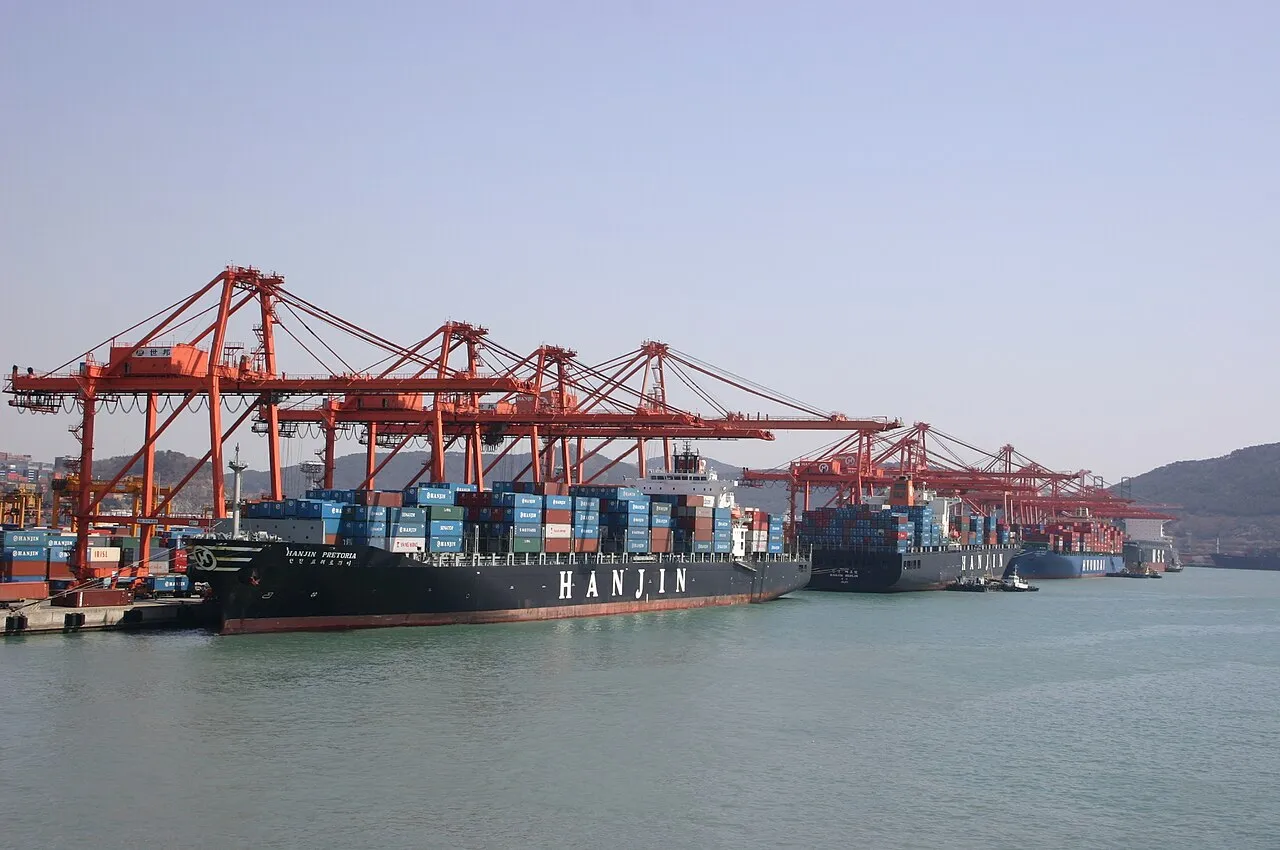
South Korea's cumulative exports for 2026 passed $1 trillion at 2:09 p.m. Seoul time on Thursday, according to the Ministry of Trade, Industry and Energy, which tracked the figure on the electronic customs clearance system of the Korea Customs Service.
The country becomes the fourth in the world to cross that line in a single year. Germany and the United States got there in 2006 and China in 2007 — and in the 19 years since, no other had joined them, not even Japan, whose all-time record is $822.6 billion, set in 2011.
In 2025, South Korean exports came to about $709.3 billion. The jump into trillion-dollar territory in a single year is roughly 40%.
What drove it: memory chips for artificial intelligence
There is essentially one engine. From January to October, semiconductor exports brought in $396.8 billion, against $135.4 billion in the same period of 2025 — a rise of about 193%. Chips accounted for 42.7% of everything the country sold abroad in the period and for 74.5% of the entire increase in exports.
Part of that is price rather than volume: the benchmark contract for 16GB DDR5 memory went from $8.70 in October 2025 to $50 in October 2026, on the back of the race to build artificial-intelligence data centres. South Korea holds 83% of the global market for HBM memory, used in AI accelerators, and 65.6% of the DRAM market.
Outside chips, exports grew 20.2% in the year to October. Computers brought in $45.1 billion, three times the previous record, and petrochemicals hit a record $57.4 billion, helped by costlier oil. Non-ferrous metals, electrical equipment, biotech, cosmetics and farm and fishery products also set records.
The trade surplus from January to October stood at $294.9 billion — more than three times the previous annual record of $95.2 billion, set in 2017.
What the government expects for the full year
The ministry expects the year to close with $1.17 trillion in exports, $780 billion in imports and a surplus of around $390 billion, roughly five times the 2025 figure. The Bank of Korea projects exports above $1 trillion in 2027 as well.
"While discovering new growth engines, we will concentrate all the government's capabilities so that the warmth of exports leads to revitalisation of regional economies and the creation of youth jobs," said Trade, Industry and Energy Minister Kim Jung-kwan.
Dependence on a single sector is the weak spot in the arithmetic. Kwon Nam-hoon, head of the Korea Institute for Industrial Economics and Trade, said that "due to base effects and other factors, the pace of increase will slow somewhat next year, but we can keep the $1 trillion trend going".
One caveat in reading the number: joining the trillion-dollar club is not the same as being the world's fourth-largest exporter. On World Trade Organization figures for January to August cited by the South Korean press, the country ranked fifth ($694 billion), behind China, the United States, Germany and the Netherlands — the latter at $989.2 billion last year, largely on re-exports, and also closing in on the trillion mark.
For a sense of the trajectory: South Korea exported its first $100 million in 1964, when wigs and other low-value goods made up much of what it sold.
With information from the Seoul Economic Daily and DigitalToday, citing South Korea's Ministry of Trade, Industry and Energy.