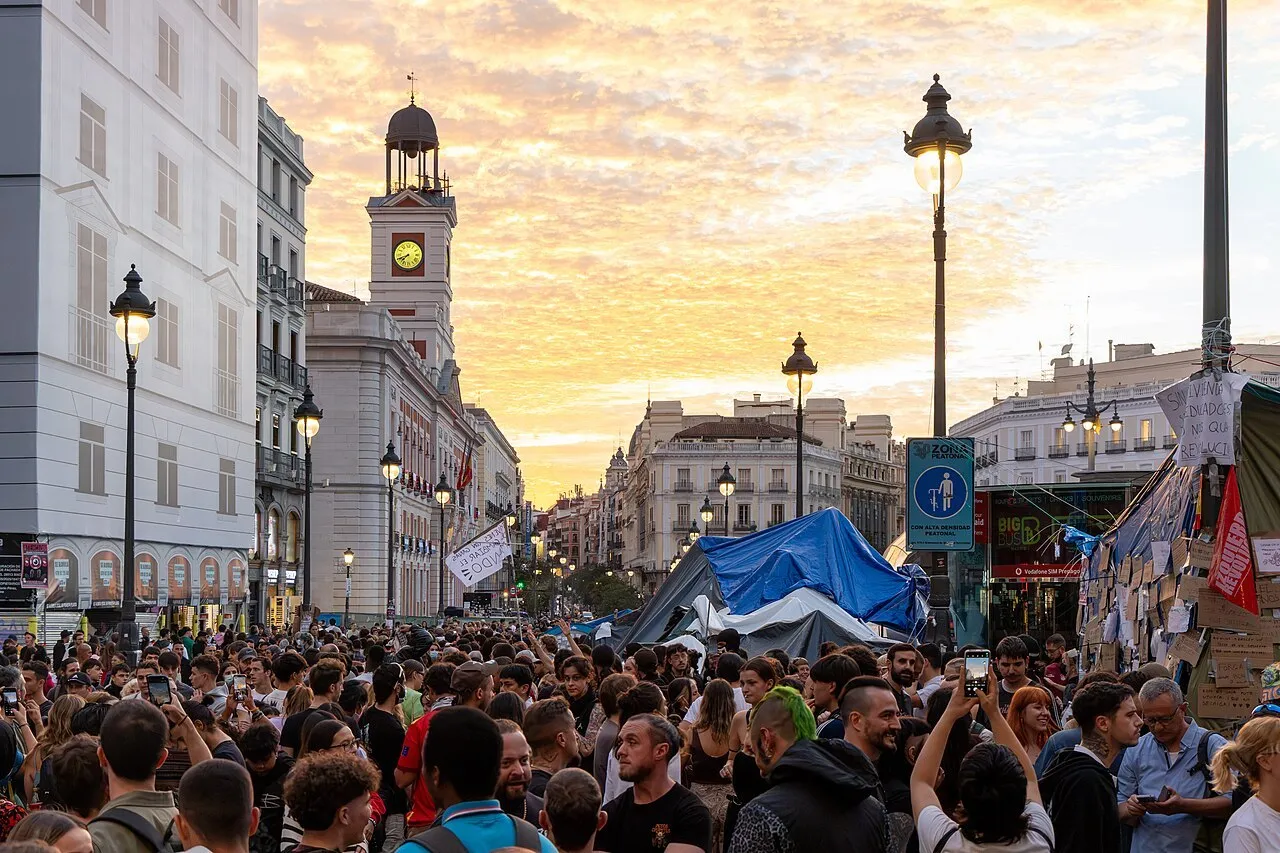
Spain went through a 24-hour general strike on Wednesday, 11 November, called around three words: wages, housing and prices. The walkout was registered with the Ministerio de Trabajo (Ministry of Labour) on 19 October by the confederations CCOO and UGT — the country's two largest — by the anarcho-syndicalist CGT and CNT and by smaller organisations, among them the tenants' unions, which pushed the mobilisation after months of protest over the housing crisis. It is the first nationwide general strike backed by both big confederations since 2012.
The stoppage ran from midnight to midnight, with shifts that began before midnight and, in parts of industry, end only on Thursday.
Ports, car plants and rubbish
The participation figures released through the day come from the unions themselves, not from public bodies. According to CCOO and UGT, the strike reached 90% at the ports — above all Valencia and Algeciras — and in the car industry, with full stoppages at Volkswagen Navarra and SEAT in Barcelona. The unions also reported 85% in the meat industry, 82% in rubbish collection, 75% in energy, 38% in social and health care, where minimum services were guaranteed, and 35.04% in the postal sector. Canal Sur, Andalusia's public broadcaster, went off air from 8am.
The picture is not uniform. Seville city hall described participation in municipal companies as "negligible", and shops in central Madrid opened as usual.
234 flights cancelled and the metro at 79%
In transport, the minimum service levels set by the Ministerio de Transportes (Ministry of Transport) cushioned the effect. Aena, the state airport operator, reported 234 cancellations by 10am, 5.16% of the 4,529 scheduled flights; at Barajas, the country's largest airport, six of 1,097 operations were cancelled. For air routes, the guaranteed minimum ranged from 18% to 85%, depending on the type of connection.
Renfe, the state rail operator, ran 75% of Cercanías commuter trains at peak hours and 50% for the rest of the day, around 65% on medium-distance services and 73% on high-speed and long-distance lines, with AVE cancellations at Atocha. Madrid's metro ran 79% of its trains at peak and recorded a 21% drop in passengers. In Barcelona, TMB metro and buses stopped between 9.30am and 4.30pm, after the first band of minimum services.
That combination explains the ambiguous scene of the early hours: traffic into Madrid much like an ordinary working day, while brief blockades hit the M-30 ring road and the A-42, cleared at around 9.10am.
Pickets, police charges and a criminal complaint
There was friction. At Mercamadrid, the capital's main wholesale food market, police dispersed pickets, and the unions said pepper spray had been used; CCOO announced a criminal complaint. In Granada, two people were detained at a picket outside the Alhambra, and police say there were assaults. In Pamplona, rubbish containers were set on fire in the Mendillorri district. In Bilbao, pickets closed shops on Gran Vía. In Barcelona and Tarragona, access to logistics hubs, to the Mercabarna market and to the port was blocked.
The Ministerio del Interior (Interior Ministry) ordered action against "violent pickets", without setting out the criteria. Unai Sordo, general secretary of CCOO, called for a "massive" turnout, with a particular appeal to young people; Pepe Álvarez, of UGT, defended what he called "pickets of freedom". Storm Charles, with a yellow warning in Madrid, ran through the day.
What the unions are asking for
The platform brings together pay rises of 4% to 7%, an increase of at least 7% in the statutory minimum wage in 2027, rent controls, an expansion of public housing stock, stronger protection against evictions, a shorter working week and the unblocking of collective bargaining, stalled with employers. According to elDiario.es, rents in the country have risen by more than 40%.
The political arithmetic
The strike arrives in a decisive week. On 2 October, Congress rejected the government's housing decrees with votes from the PP, Vox and Junts; days later, Prime Minister Pedro Sánchez called an early general election for 29 November. The Diputación Permanente, the standing committee of Congress, is due to vote on Thursday on the main decree, which suspends evictions, bars investment funds from buying homes and widens subsidies; the text on automatic rent extensions is not expected to pass, because of the PNV's refusal. The election campaign starts at midnight between Thursday and Friday.
Employers kept up the criticism but backed away from a court fight: the CEOE business confederation, chaired by Antonio Garamendi, had announced an appeal against the strike call and dropped it on 22 October. CCOO and UGT reject the idea that the strike is party-political.
The figure to watch in the coming days is not the participation rate, always disputed, but what Congress does with the housing decree on the eve of the campaign — the same vote that pushed half a million people into the streets in September and brought a protest camp to the Puerta del Sol.
With information from elDiario.es, Libertad Digital and Démocrata.