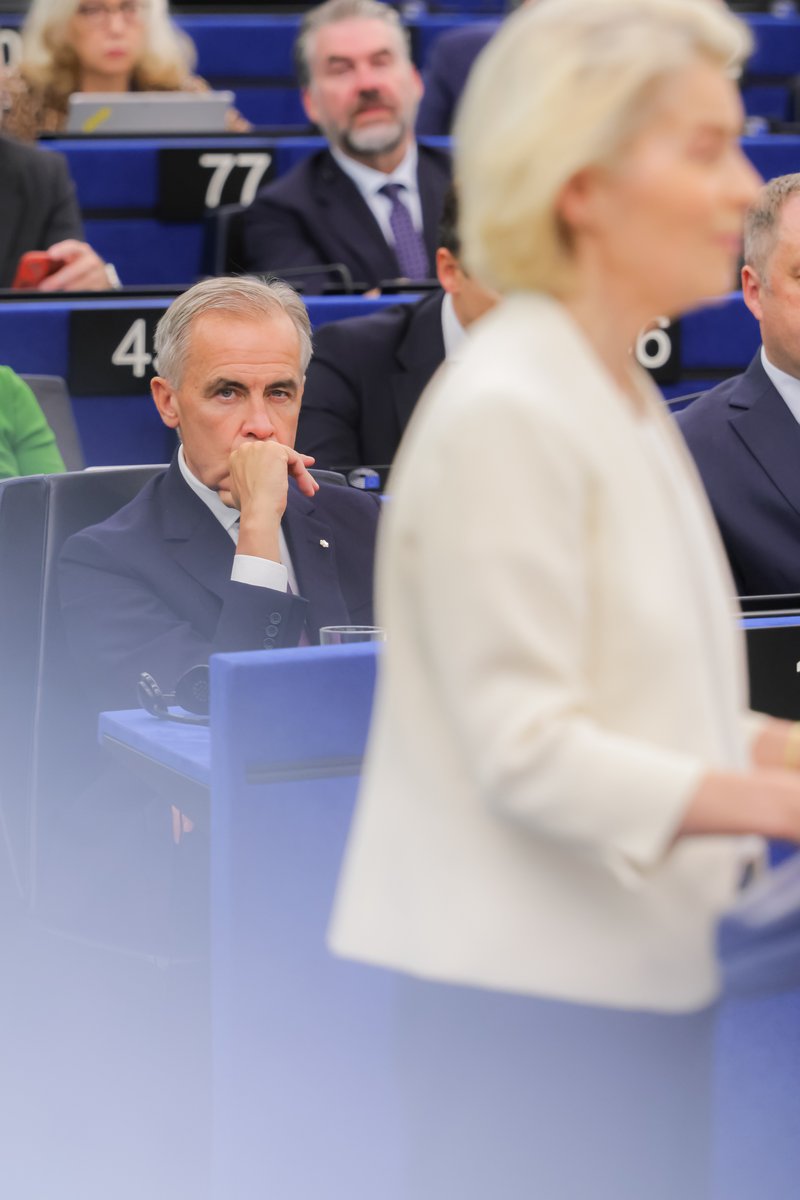
European Commission President Ursula von der Leyen proposed on Wednesday (16 September) that Canada become the first "associate member" of the European Union. She made the announcement at the European Parliament during her annual State of the Union address, with Canadian Prime Minister Mark Carney in the chamber as a guest.
"I would like to work with you on opening the door for Canada to be the first associate member of the EU," von der Leyen said, addressing Carney. "We share one ocean, one set of values, one way of seeing the world."
A status that does not yet exist
Associate membership is not provided for in the EU treaties. The idea was floated by German Chancellor Friedrich Merz with Ukraine in mind, and would give access to summits and parts of the EU budget without full voting rights, according to Al Jazeera. The details — including whether Ottawa would have any say in the institutions — have yet to be defined, Euronews reported.
Carney had already ruled out seeking full membership and pushed instead for a bespoke alliance with Europe. Canada is negotiating participation in Erasmus+, the Horizon Europe research programme and the mutual recognition of professional qualifications.
In the speech, von der Leyen said the CETA trade agreement, in force since 2017, has grown trade in goods between the two sides by 75% in less than a decade, and that it will give way to an "Alliance for the Future" covering defence, manufacturing, the Arctic, energy, critical minerals, artificial intelligence and cybersecurity. An EU–Canada summit is scheduled for October in Montreal. "This is a partnership not against anyone else, but for our common strength," she said.
Social media only from age 13
The announcement with the most immediate impact for Europeans was the EU Kids Act, which the Commission presents on Thursday (17 September). The proposal bans social media for children under 13; between 13 and 15, only "mini accounts" set up and supervised by parents, with limited features and one hour of use a day; and from 15 to 18, platforms must adopt safe design. The burden will be on companies to prove their services are safe.
Security: a European "Article 4"
Von der Leyen cited incidents over the past week in Denmark, Lithuania and Poland, and described the attempted drone attack in Leipzig as carried out by "Russian operatives on European soil". She proposed:
- an Emergency Security Protocol, modelled on NATO's Article 4: triggered by one country, it would convene all member states to coordinate a response;
- a European Security Council, with partners such as Canada, Norway, Ukraine and the United Kingdom;
- a new instrument to fund "strategic enablers" such as air defence, strategic transport and air-to-air refuelling.
For Ukraine, she pledged the strongest-ever support for the winter, reinforced air defences — last week the EU approved, for the first time, the purchase of US Patriot interceptors — and stricter enforcement of sanctions on Russia.
Economy, climate and China
The Commission President said the closure of the Strait of Hormuz had cost Europe an additional €90 billion in imported fossil fuels, and that the trade deficit with China has reached €1 billion a day. She announced a new European Corporation on Critical Raw Materials to buy and stockpile inputs for which the bloc depends on China for more than 80%.
On climate, she noted that Europe's summer burned 660,000 hectares and caused more than 35,000 additional deaths during heatwaves, and promised a European Heatwave Plan and a Climate Insurance Alliance. She also announced a connectivity corridor to the South Caucasus and Central Asia, aiming to mobilise up to €12 billion.
On the Middle East, she called the Israeli government's decision to advance the E1 settlement project in the West Bank "unacceptable" and regretted that member states had failed to build majorities for a common response.
Reporting based on the European Commission (official speech text), Euronews and Al Jazeera.