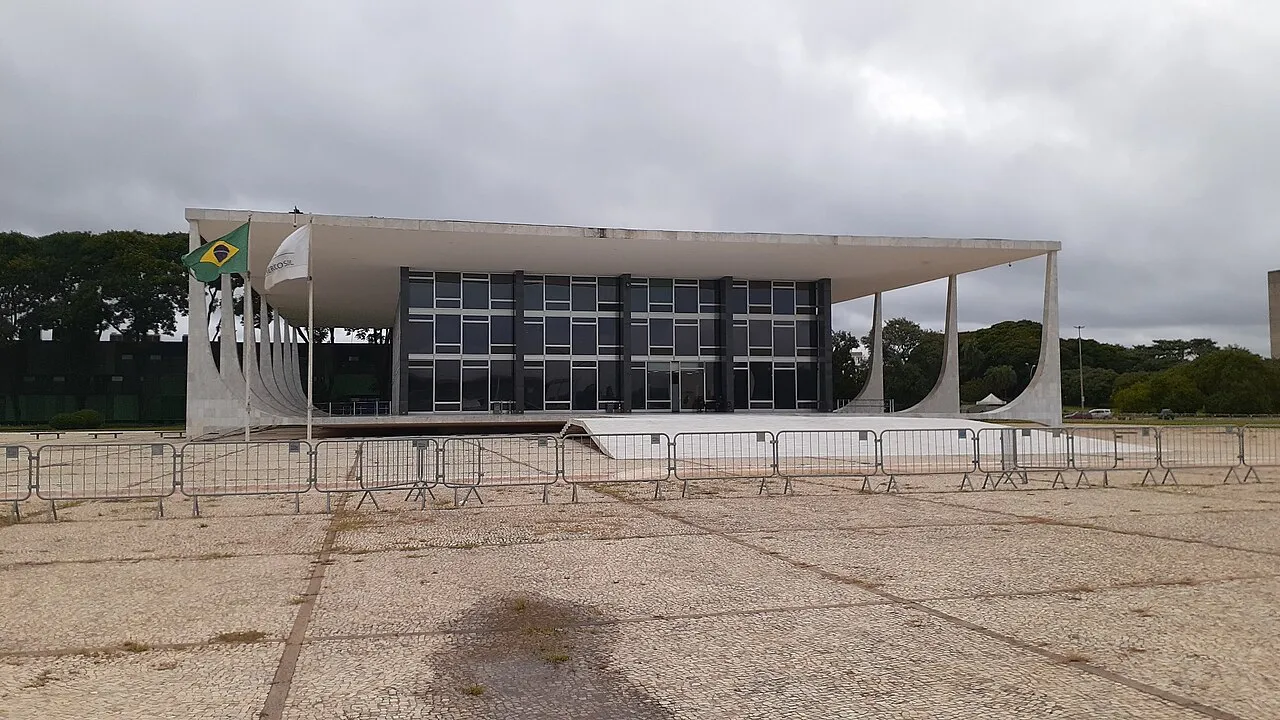
In 135 years, no Black woman has ever held one of the eleven seats on the Supremo Tribunal Federal (Supreme Federal Court), Brazil's highest court. That is the figure Brazil's Black movement put back on the table on Friday (20), the national Day of Zumbi and of Black Consciousness, as it revived its campaign for an unprecedented appointment — with a specific target: the seat opened by the early retirement of justice Luís Roberto Barroso in October 2025, which remains empty.
Some 40 organisations are behind the campaign "Mulheres no STF" ("Women on the Supreme Court"), among them the Coalizão Negra por Direitos (Black Coalition for Rights) and the Articulação de Mulheres Negras Brasileiras (AMNB, the Brazilian Black Women's Alliance). What they are asking the government for is broader than a single nomination: that the court's next four vacancies be filled by women, and that at least two of them be Black women.
"The Supreme Court has never had a Black woman justice, and that is no accident," said Stephane Ramos da Costa, leadership coordinator at Movimento Mulheres Negras Decidem, who also notes the absence of Indigenous people and of Black men from the court's history. For Janira Sodré, executive coordinator of the AMNB, the almost unbroken sequence of white men from the south-east has worked as an unwritten pact.
The numbers behind the campaign
Since the court was created in 1891, 172 people have sat on it. Three were women: Ellen Gracie, appointed in 2000, Cármen Lúcia, in 2006, and Rosa Weber, in 2011. None was Black.
On the other side of the ledger is the population. According to the census by the IBGE (Brazil's national statistics institute), women are 51% of Brazilians, and Black and mixed-race women make up 28.4% of the country — around 60 million people. The Ipea research institute estimates that Black and mixed-race Brazilians are 57% of the population.
The imbalance also shows up inside the judiciary, in figures presented by the court's own president. At a national meeting of Black judges held in Rio de Janeiro in early November, justice Edson Fachin, who also chairs the Conselho Nacional de Justiça (National Council of Justice), said Black people are about 15% of Brazilian judges and 28% of judiciary staff. In the appeal courts, the share of Black judges falls to 11%; among staff, only about a quarter of management posts are held by Black people. Fachin said the judiciary had not been a bystander to racial inequality, and that there are Black women judges qualified for the next Supreme Court seat. At the same meeting, the judges proposed a national equity policy for the judiciary, with step-by-step targets for raising the number of Black judges by 2036.
The arithmetic in the Senate
Barroso's seat has been vacant for more than a year, and not for lack of trying. President Luiz Inácio Lula da Silva nominated the solicitor general, Jorge Messias, whose confirmation hearing ended in rejection on the Senate floor on 29 April, by 42 votes to 34 — the first time a Supreme Court nominee had been turned down in more than a century. A Senate rule bars a new vote on the same nominee within the same legislative year, which would push any second attempt with Messias to 2027.
The government has been weighing alternatives since. Names circulating include Rodrigo Pacheco, a member of the Tribunal de Contas da União (Federal Audit Court) and a former Senate president, described as the smoothest path through the chamber, as well as women judges and politicians — among them Daniela Teixeira and Regina Helena Costa, of the Superior Tribunal de Justiça (Superior Court of Justice), and former minister Simone Tebet. No nomination has been filed.
Time is a factor. Any nominee needs a majority in the Senate's constitution and justice committee and 41 votes on the floor, and the chamber's make-up changes in February 2027, when the Bolsonarista camp is expected to hold 44 of the 81 seats, according to a count by researcher Beatriz Rey. The next mandatory retirements are set for 2028 (Luiz Fux), 2029 (Cármen Lúcia) and 2030 (Gilmar Mendes).
The Ministério da Igualdade Racial (Ministry of Racial Equality) says it backs the cause. At an anti-racism policy event in Rio, Cleidisson Santos Júnior, the ministry's secretary for the national racial equality system, said the choice is the president's prerogative, but that the ministry supports a nominee who represents Black women and is walking alongside the popular mobilisation. Lula has not commented on the appointment.
With information from Agência Brasil, Correio Braziliense, BBC News Brasil and the newspaper O Povo.