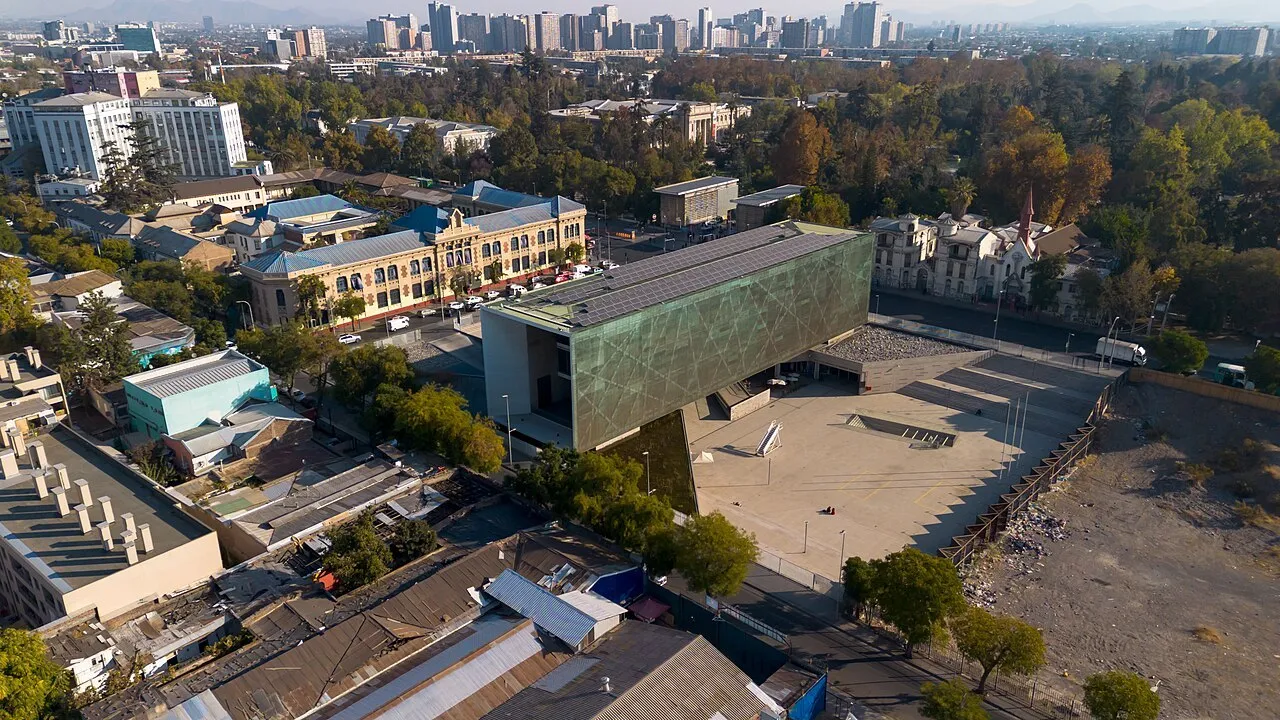
Santiago's Museo de la Memoria y los Derechos Humanos (Museum of Memory and Human Rights) has opened "Colonia Dignidad: a plena luz, todavía" — roughly, "Colonia Dignidad: in plain sight, still" — the first exhibition a Chilean institution has devoted entirely to the German enclave founded in 1961 in the Andean foothills of Parral. It was inaugurated on Thursday, October 29, 2026, and can be visited from October 30 until April 30, 2027, on the third floor of the museum's building at Matucana 501, in the Quinta Normal district.
The exhibition is part of the international project Memorias Interactivas de Colonia Dignidad (iECID) and was developed together with the Free University of Berlin, through its Institute of Latin American Studies and its Digital Interview Collections team, which manages the case's oral archive. It is supported by Germany's Federal Foreign Office.
Five themes and a digital station
The visit is organized around five thematic axes: the territory, the states, life inside the self-described "benefactor society," the enclave's role during the dictatorship, and resistance and the struggles for dignity. It combines testimonies, archival documents and personal objects belonging to people affected by the compound.
The novelty is an interactive digital station giving access to material from the Colonia Dignidad Oral History Archive (CDOH), built between 2019 and 2022 and publicly available online. When the temporary show closes, the station will not be dismantled: it will become part of the museum's permanent exhibition, so the archive is folded into the institution's standing account.
That detail defines the project's reach. This is not only a show with an end date, but the incorporation of a documentary collection into the apparatus through which Chile officially tells the history of human rights violations.
A compound that operated inside and outside the state
Colonia Dignidad was founded by the preacher Paul Schäfer, who had left Germany while facing accusations of sexual abuse. Inside the compound there was forced labor and the systematic sexual abuse of children. During Augusto Pinochet's dictatorship, the enclave operated in coordination with the DINA, the regime's secret police, as a site of detention, torture and the disappearance of people.
The museum's executive director, María Fernanda García, placed the show in that double register of state and private responsibility. "It is very important for the Museum to be part of the symbolic reparation regarding this very complex place," she said. On another occasion she referred to the case as "this wound that is still open."
The choice of an axis devoted to "the states" — in the plural — points to the same question: the enclave's functioning over decades involved tolerance, omission or collaboration by Chilean authorities and by the German state alike, a point Berlin's diplomats acknowledged in recent years and which explains why the project is funded by Germany's own foreign ministry.
With information from El Ciudadano, Radio Nuevo Mundo and El Siglo.